Mostrando entradas con la etiqueta Comentario de texto. Mostrar todas las entradas

domingo, 20 de octubre de 2019

John Donne: 'The Good-Morrow'


Ediciones en red de un comentario sobre el poema de John Donne 'The Good-Morrow' que hice en el año de Jesu Christo de 1982.


José Angel García Landa. "John Donne: 'The Good-Morrow'." Typescript, U of Zaragoza, 1982. Online edition (2005)
2012
_____. "John Donne: 'The Good-Morrow'." iPaper at Scribd (sos_english) 29 Aug. 2008.*
         2012
_____. "John Donne: 'The Good-Morrow'." Social Science Research Network 21 Dec. 2012.*
         2012
_____. "John Donne: 'The Good-Morrow'." ResearchGate 24 Jan. 2014.*
         2014
_____. "John Donne: 'The Good-Morrow'." Academia 5 Sept. 2014.*
         2014
_____. "John Donne: 'The Good-Morrow'." Semantic Scholar.*
         2019


—oOo—

viernes, 29 de marzo de 2019

Docencia e investigación en Filología (J. M. Blecua)

Un comentario del prólogo a la Biblia de Ferrara (1553) permite a José Manuel Blecua Perdices ejemplificar los elementos básicos que deben subyacer a un enfoque filológico de los textos, tanto en la investigación como en la enseñanza. Dos cuestiones se enfatizan: la importancia de la semiótica del lenguaje y de la escritura (la 'tecnología de la palabra') puesta de manifiesto en el texto, y la necesidad de que el estudioso conozca la propia tradición académica y sus transformaciones históricas. Este artículo resume y comenta la contribución de Blecua, enfatizando el papel del intérprete como mediador entre el texto original y una diversidad de discursos y disciplinas culturales que median su recepción.


Docencia e investigación en Filología 

(J. M. Blecua) 

https://ssrn.com/abstract=3345872


11 Pages Posted: 29 Mar 2019


Jose Angel Garcia Landa

Universidad de Zaragoza
Date Written: March 3, 2009


English Abstract:

Teaching and Research in Philology (J. M. Blecua)

A commentary of the prologue to the Ferrara Bible (1553) allows José Manuel Blecua Perdices to exemplify the basic elements which must underlie a philological approach to texts, both in the research and in teaching. Two issues are emphasized: the importance of the semiotics of language and writing (the 'technology of the word') evinced in the text, and the need for a familiarity with the student's own scholarly tradition and its historical transformations. This paper summarizes and comments Blecua's contribution, emphasizing the role of the interpreter as a mediator between the original text and a variety of cultural discourses and disciplines which mediate its reception.

Note: Downloadable document is in Spanish.


Garcia Landa, Jose Angel, Docencia e investigación en Filología (J. M. Blecua) (Teaching and Research in Philology (J. M. Blecua)) (March 3, 2009). Available at SSRN: https://ssrn.com/abstract=3345872
 
 
 También aquí:
 

_____. "Docencia e investigación en Filología." In García Landa, Vanity Fea 3 March 2009. (José Manuel Blecua Perdices, Biblia de Ferrara).

         http://garciala.blogia.com/2009/030301-docencia-e-investigacion-en-filologia.php

         2009

_____. "Docencia e investigación en Filología (J. M. Blecua)." Academia 4 March 2019.*

         https://www.academia.edu/38484366/

         2019

_____. "Docencia e investigación en Filología (J. M. Blecua)." ResearchGate 5 March 2019.*

         https://www.researchgate.net/publication/331523756

         2019

_____. "Docencia e investigación en Filología (José Manuel Blecua)." In García Landa, Vanity Fea 29 March 2019.*

         https://vanityfea.blogspot.com/2019/03/docencia-e-investigacion-en-filologia-j.html

         2019

_____. "Docencia e investigación en Filología (José Manuel Blecua)." Net Sight de José Angel García Landa 4 Jan. 2023.*

         https://personal.unizar.es/garciala/publicaciones/blecuafilologia.pdf

         2024


—oOo—

sábado, 5 de mayo de 2018

Retropost (5 de mayo de 2008): How to Comment a Critical Text


Some guidelines on how to comment a critical text:

• Read the text carefully. Make sure you understand the meaning of all the words and the contextual sense of the sentences. Use the dictionary.

• If you are given the name of the author, use your knowledge of the author's work as background information for your commentary. Point out the relationship between the text and the author's main ideas, but do not drift away from the text at hand. You are required to write a commentary of a specific text, not an essay on the author in question.

• Is the text an original text or a translation? Does the language of the text give you any clue as to its possible origin or date?

• If you do not know the author of the text, do not write as if you did. Be more tentative, find ideas, concepts, etc. which can be related to theories or to the work of authors you do know.

• Try to point out the main idea of the text.

• How is this idea developed through the text? Is there an exposition? a conclusion? Examples? Try to analyse the rhetorical structure of the text. Does this structure tell you anything about the author's style, method or approach?

• Be especially attentive to the author's assumptions about a shared context, and the presuppositions used in the text. Do they enable us to determine the expected ideology, ideas, attitudes, etc. of an implied reader or addressee? Can we share those presuppositions, or should they be questioned in any way? Does the text's argumentative concerns enable us to reconstruct a critical conversation or an ongoing debate, a critical or literary problematics beyond the limits of this specific text?

• Which are the main critical concepts, whether explicit or implicit, which are used in the passage in question? Locate these concepts in the history of ideas. You can also comment on the relationship between these concepts and the intellectual and cultural milieu of the period you think they belong to: to the work or contemporary or near-contemporary authors.

• Do not read the text as a statement which is simply and literally true (or false). Try to see these ideas as the product of a given mind, a given culture and intellectual milieu. Point out the aspects of the text which support your decisions.

• Does the text include a discussion of previous works, previous theories or ideas? Try to read the passage as an implicit dialogue with other critical conceptions, in order to determine its aims and the historical significance of its ideas in a given period. Find, if possible, the “implicit texts” behind the text you are reading. (Intertextual dimensions).

• Compare these ideas with other critical theories or statements which may clarify or modify them. Are there any similar or contrary positions in other authors, other periods or schools?

• Which are the main strengths / the main weaknesses of the author's analysis? The most striking or memorable passage? (–and why?) Which are the reasons for those strengths /weaknesses? (the author's preconceptions, ideology, aims, etc.). Do your views on this issue differ from the author’s? Which is the reason for these differences?

• Evaluate the conceptions in the passage. Which is the present-day significance of these ideas? Are they still relevant in any way? Do they comment significantly on critical practices or ways of thinking which are still in use? Try to point out, if possible, parallels or equivalents in the critical or literary scene of our own period, whether in popular or in academic reception.

(This is a tutorial I published today in Wikilearning)


—oOo—

lunes, 5 de febrero de 2018

Retropost #1991 (5 de febrero de 2008): Blog de comentario

Empieza el segundo cuatrimestre: dejo el blog de Shakespeare y empiezo el blog de Comentario de Textos - vamos, una página de apoyo a la asignatura. De momento sin comentarios—tampoco es que los use mucho nadie cuando los pongo. Aún me planteo abrir otro para otra asignatura, pero me da miedo marearme con tanto blog. De momento aquí va lo que les pongo hoy en el blog de comentario:

Martes: De lo dicho en clase, recordad la importancia de organizar la lectura: - Con un horario regular y establecido, para leer tanto los textos literarios como los manuales y bibliografía secundaria que utilicéis.
- Leyendo part of the time en voz alta, y con diccionario de pronunciación a mano
- Dedicando muchas sesiones a lectura detallada, consultando el diccionario para cada palabra que no encontréis.
Y en lo referente al comentario de textos, las dos direcciones deseables o imprescindibles en las que trabajar:
- Generalizando, es decir, mostrando qué elementos tiene el texto en común con otros textos.
- Individualizando: procurando asimismo formular qué es lo que lo hace peculiar, único—qué sucede en este texto que no sucede en los demás.

Mañana miércoles comentaremos el poema de Sidney "Loving in Truth" - pero primero seguiremos con el poema de Edwin Morgan,
Edwin Morgan "Opening the Cage":


                        Opening the Cage
                14 variations on 14 words

I have nothing to say and I am saying it and that is poetry.
John Cage


I have to say poetry and is that nothing and am I saying it
I am and I have poetry to say and is that nothing saying it
I am nothing and I have poetry to say and that is saying it
I that am saying poetry have nothing and it is I and to say
And I say that I am to have poetry and saying it is nothing
I am poetry and nothing and saying it is to say that I have
To have nothing is poetry and I am saying that and I say it
Poetry is saying I have nothing and I am to say that and it
Saying nothing I am poetry and I have to say that and it is
It is and I am and I have poetry saying say that to nothing
It is saying poetry to nothing and I say I have and am that
Poetry is saying I have it and I am nothing and to say that
And that nothing is poetry I am saying and I have to say it
Saying poetry is nothing and to that I say I am and have it


El sitio web de Edwin Morgan es http://www.edwinmorgan.com


Y aquí hay un artículo de la Wikipedia sobre poesía concreta: "Concrete poetry" http://en.wikipedia.org/wiki/Concrete_poetry

A propósito del autor del dicho "I have nothing to say, and I am saying it, and that is poetry", John Cage, aquí está su famosa pieza musical "4'33''" en versión orquestal:


John Cage 4´33 from Future Workspace on Vimeo.


Aunque de Cage quizá os gusten más (o quizá no) "In the Name of the Holocaust" - o "Water Walk":


—oOo—

martes, 16 de febrero de 2016

Comentar un texto: Qué hacemos cuando comentamos un texto

Algunas notas sobre lo que supone comentar un texto, desde el punto de vista hermenéutico, pero también comunicativo e interaccional, con vistas a una asignatura universitaria de Comentario de Textos Literarios.
 

Qué hacemos cuando comentamos un texto 


15 Feb. 2016

Ibercampus (March 8, 2010)


Commenting a Text: What are We Doing when We Comment a Text?

Some notes on what is involved in commenting a text, from a hermeneutic viewpoint, but also from a communicative and interactional one, with a view to a university course devoted to the commentary of literary texts.

Note: Downloadable document is in Spanish.
 

Number of Pages in PDF File: 7

Keywords: Literary theory, Criticism, Commentary, Texts, Discourse analysis, Interpretation, Interaction, Hermeneutics


También aquí:


_____. "Comentar un texto." In García Landa, Vanity Fea 2 March 2010.*

         http://vanityfea.blogspot.com/2010/03/comentar-un-texto.html

         2010

_____. "Comentar un Texto: Qué hacemos cuando comentamos un texto (Commenting a Text: What are We Doing when We Comment a Text)." Available at Social Science Research Network 15 Feb. 2016.*

         http://ssrn.com/abstract=2732361

         2016

_____. "Comentar un texto." Ibercampus (Vanity Fea) 8 March 2010.*

         http://www.ibercampus.es/articulos.asp?idarticulo=14483

         2013

_____. "Comentar un texto: Qué hacemos cuando comentamos un texto." In García Landa, Vanity Fea 16 Feb. 2016.*

         http://vanityfea.blogspot.com.es/2016/02/comentar-un-texto-que-hacemos-cuando.html

         2016

_____. "Comentar un Texto: Qué hacemos cuando comentamos un texto." Academia 21 May 2017.*

         https://www.academia.edu/33128144/

         2017

_____. "Comentar un Texto: Qué hacemos cuando comentamos un texto." ResearchGate 22 May 2017.*

         https://www.researchgate.net/publication/317047679

         2017

_____. "Comentar un texto: Qué hacemos cuendo comentamos un texto." Net Sight de José Angel García Landa 4 Jan. 2023.*

         https://personal.unizar.es/garciala/publicaciones/comentaruntexto.pdf

         2024


—oOo—

lunes, 12 de octubre de 2015

Steps Unknown to Nature

El comentario de texto como objet trouvé. Comentaremos el sentido existencial y fenomenológico del platonismo que puede apreciarse en este soneto de William Drummond, desde el punto de vista de la antropología fenomenológica.


William Drummond of Hawthornden


From Urania, or Spiritual Poems

Sonnet 1

Triumphing chariots, statues, crowns of bays,
Sky-threat’ning arches, the rewards of worth,
Works heavenly wise in sweet harmonious lays,
Which sprites divine unto the world set forth;
States, which ambitious minds with blood do raise,
From frozen Tanaïs to sun-gilded Gange,
Gigantic frames, held wonders rarely strange,
Like spiders’ webs, are made the sport of days.
All only constant is in constant change;
What done is, is undone, and when undone,
Into some other fashion doth it range:
Thus goes the floating world beneath the moon:
    Wherefore, my mind, above time, motion, place,
    Thee raise, and steps unknown to nature trace.


 —y lo haremos utilizando meramente las palabras de Max Scheler en El puesto del hombre en el cosmos. Puesto que es de ese puesto de lo que está hablando Drummond—de la naturaleza y sentido último de los empeños humanos, entendidos como un conocerse a sí mismos. Esta es la sección en que Max Scheler define más específicamente la peculiaridad de la cognición humana como ideación. Y empieza comentando la rebelión del espíritu contra el saberse una cosa entre las cosas, una cosa sometida a la impermanencia y a la muerte que angustian y hastían al poeta Drummond.
Pluto 14 07 2015

La reducción fenomenológica como técnica para anular la resistencia. (Realidad, Resistencia, Conciencia).

Para penetrar desde aquí más profundamente en la esencia del hombre, debemos representarnos la trama de los actos que conducen al acto de la ideación. Consciente o inconscientemente, el hombre pone en práctica una técnica que puede llamarse anulación ficticia del carácter de realidad. El animal vive totalmente en lo concreto y en la realidad. Mas toda realidad implica o un lugar en el espacio, o un lugar en el tiempo, un ahora, un aquí, y, en segundo término, un modo de ser accidental, como el que suministra la percepción sensible de cada "aspecto." Pues bien, ser hombre significa lanzar un enérgico "no" al rostro de esa clase de realidad. Ya Buda lo sabía, cuando decía que es magnífico contemplar todas las cosas, pero terrible ser una. Ya Platón lo sabía, cuando explicaba la contemplación de las ideas como un acto por el cual el alma se desvía de la faz sensible de las cosas y se encierra en sí misma para encontrar los "orígenes" de las cosas. Ni tampoco E. Husserl piensa otra cosa, cuando funda el conocimiento de las ideas en una reducción fenomenológica, esto es, en la operación de "borrar" o de "poner entre paréntesis" el coeficiente existencial (contingente) de las cosas, para alcanzar su essentia. No puedo asentir en detalle a la teoría de esta reducción dada por Husserl, pero sí debo conceder que en ella está significado el acto que define más propiamente al espíritu humano.

Para saber cómo tiene lugar este acto de reducción, es necesario saber en qué consiste propiamente nuestra vivencia de la realidad. No puede señalarse sensación alguna (azul, duro, etc.) que corresponda especialmente a la impresión de la realidad. Ni la percepción, ni el recuerdo, ni el pensamiento, ni ningún otro acto perceptivo posible puede procurarnos esta impresión, pues lo que nos dan es exclusivamente la manera de ser las cosas, jamás su existencia. La existencia nos es dada por la vivencia de la resistencia que ofrecen las esferas del mundo ya descubiertas. Ahora bien: resistencia solamente la hay para nuestros impulsos, para nuestra vida impulsiva, para nuestro impulso vital central. La vivencia primaria de la realidad, como vivencia de "la resistencia que ofrece el mundo", precede a toda conciencia, a toda representación, a toda percepción. La percepción sensible más penetrante no viene nunca condicionada por sólo el estímulo y el proceso normal del sistema nervioso. Ha de existir a la vez un movimiento impulsivo, ya sea de apetencia o de repugnancia, aun cuando se trate de la más simple sensación. Por tanto, si una sacudida de nuestro impulso vital es condición ineludible de toda posible percepción, las resistencias ejercidas contra aquel impulso vital por los centros y los campos de fuerzas residentes en el fondo de las imágenes de los cuerpos que integran el medio—las "imágenes sensibles" mismas carecen de toda acción causal—pueden ser vividas ya en un punto del proceso temporal de una percepción, en el cual no se haya llegado todavía a la percepción consciente de una imagen. La vivencia de la realidad no es, pues, posterior, sino anterior a toda "representación" del mundo. ¿Qué significa, pues, aquel enérgico "no" de que antes hablábamos? ¿Qué significa desrealizar el mundo o "idear" el mundo? No significa, como cree Husserl, reservar el juicio existencial; significa más bien abolir, aniquilar fictivamente el momento de la realidad misma, toda esa impresión indivisa, poderosa, de realidad, con su correlato afectivo; significa eliminar esa angustia de lo terreno que como dice Schiller profundamente, sólo "desaparece en aquellas regiones donde habitan las formas puras". Este acto de desrealización, acto ascético en el fondo, sólo puede consistir —si existencia es "resistencia"—en la anulación, en la examinación de ese impulso vital, para el cual el mundo se presenta como "resistencia", y que es a la vez la condición de toda percepción sensible del ahora, del aquí y del modo contingentes. Pero ese acto sólo puede ser realizado por aquel ser que llamamos "espíritu". Sólo el espíritu, en su forma de "voluntad pura", puede operar la inactualización de ese centro de impulso afectivo, que hemos conocido como el acceso a la realidad de lo real.


El hombre como asceta de la vida

El hombre es, según esto, el ser vivo que puede adoptar una conducta ascética frente a la vida—vida que le estremece con violencia—. El hombre puede reprimir y someter los propios impulsos; puede rehusarles el pábulo de las imágenes perceptivas y de las representaciones. Comparado con el animal, que dice siempre "sí" a la realidad, incluso cuando la teme y rehuye, el hombre es el ser que sabe decir no, el asceta da la vida, el eterno protestante contra toda mera realidad. En comparación también con el animal (cuya existencia es la encarnación del filisteísmo), es el eterno "Fausto", la bestia cupidissima rerum novarum, nunca satisfecha con la realidad circundante, siempre ávida de romper los límites de su ser ahora, aquí y de este modo, de su "medio" y de su propia realidad actual. En este sentido ve también S. Freud en el hombre el "represor de sus impuslso"—en su obra Allende el principio del placer—. Y sólo porque es esto, puede el hombre edificar sobre el mundo de su percepción, un reino ideal del pensamiento; y por otra parte, puede canalizar la energía—latente en los impulsos reprimidos—hacia el espíritu que habita en él. Esto es: el hombre puede sublimar la energía de sus impulsos en actividades espirituales.


—oOo—

sábado, 19 de septiembre de 2015

How to Comment a Literary Text

This is concise practical guide on how to comment a literary text, aimed at undergraduate students of literature. It addresses a number of different aspects in the text and the student's interaction with it: reading, authorship, theme, rhetoric and style, enunciation and address, genre and intertextuality, matters of history and ideology, gender and representation, evaluation, writing style and documentation.


Keywords: Literature, Commentary, Writing guides, Criticism


How to Comment a Literary Text

 
J.A. García Landa


Commenting a text involves reading it in an interesting and creative way, and being able to communicate that reading. This requires intuition, as well as experience and knowledge. The intuition we all possess to a greater or lesser degree can also be developed through practice, learning how to use it. Practice consists in: a) Reading literary texts attentively; b) Reading literary criticism so as to learn from other commentaries; c) Writing textual commentaries regularly. There is no one key or formula enabling us to write a good commentary. Only time, constant work, and familiarity with the texts will teach us how to write interesting commentaries, distinguishing what is repetitive or obvious (or purely subjective, or merely wrong) from what is worth seeing in a text and saying about it, to other people, in a number of situations and critical contexts. Here we are dealing with an academic context, which has its own traditions and conventions. In order to get familiar with them it is helpful to read at least one book on how to write a critical paper.


These guidelines may provide a starting point. They are not exhaustive, and besides one need not deal with each and every of these points in a commentary. We should determine in each case which of the following aspects, or which other aspects, would be worth developing in our commentary. But one must also try not to focus only on a single aspect of a text.


Reading. Begin with a careful reading of the text, using any information sources required to solve problems of understanding (dictionaries, encyclopedias, online search, etc.). Be attentive to the specific meaning acquired by words in this specific text, as any dictionary or encyclopedia will only give you the general meaning of the term, not its contextualized meaning. Note those aspects of the text's grammar, vocabulary or usage which may help you to locate it within a given historical period, and show in your commentary this awareness of the historical aspects of language.


Author and identification. If you are given a text with the author's name, use your knowledge of the author's work as background information for the commentary. But be careful: do not set aside the text you are supposed to comment in order to write an essay on the author in question. Any additional information you can use about the author, the historical period of the text or its intellectual context, will be  much more more valuable if you can relate that knowledge to specific aspects of the text you are commenting—matters of language, meaning, subject matter or presuppositions. You should point out in which way these aspects of the text reflect the general thematic, ideological or stylistic characteristics of the author's work.


 If you are not given the name of the author, use your knowledge about literary periods, genres and fashions, and about the characteristics of the authors you are familiar with, in order to associate them to the text in question. Follow specific clues as well (characters' names, setting, etc.).


But if you are not sure about the author, do not try to give the impression that you do know. The text might be an anonymous one, or it might come from a second-rank work you are not expected to identify. Therefore, restrict yourself to giving an account of what you see in the text: show that you recognize aspects of such or such school, movement, or style, that there are "elements in common" with the style of so-and-so… but without affirming it as a fact, unless you are quite certain about it. Even if you cannot identify the author with precision, the authors you are familiar with may serve you as a guide for the commentary, if you find characteristics in common.


Theme. Point out the main subject of the work or passage you are commenting—and how it is introduced and dealt with throughout the text. What kind of subject matter is presented? How does it relate to human experience (is it highly specific to a specific culture or class, or does it have a more universal appeal?). What does the subject matter reveal about the author's intent in writing, and his outlook on the human world? Does the text present a detached perspective on the subject matter, or an involved one? Which interests, ideology, etc., is it promoting through this choice of subject? What kind of community is the text invoking, as regards its use of theme? Does it establish different perspectives on the theme, and if so, does it take sides with any of them, or argue against received ideas on this subject (etc)? We'll come back later to issues of content and ideology.


Genre, Rhetoric, Style. What kind of text is it? Is it a narrative? Or perhaps not "a narrative" although it has narrative elements (which ones?). Is it descriptive? Expositional? Dramatic? Lyrical? If the text is a poem, describe its metrical characteristics, the verses and stanzas used, etc., but do not stop formal analysis at that point. Examine the rhetorical structure of the text, the persuasive or expressive resources employed; identify and describe the use of figures of speech and figures of thought, tropes, imagery, and the way they are used in order to shape the subject matter. Describe the main structural elements which, to your mind, shape and organize the text. What does this structure tell us about the style of the author, his ideas or his intention? In which ways are the genres or forms used in the work given a personal approach? (—that is, how do they become style?). Try to refer to specific aspects of the text: medium, orality, vocabulary, syntax, use of language, etc.—which make it characteristic. In analyzing a work, it is important to find those elements which unify it, which make it into a whole which fits together and has a coherent shape or makes a coherent statement. Which formal resources are used to create coherence and to impose a given perspective in the text? How is the subject matter of the text represented, through the use of images, metaphors, connotation, wordplay… in order to give it a definite shape? (An also, are there any elements which disrupt this coherence or put it under question?). That is, how does the text acquire a form of its own, a unique structure of meanings, in order to express and represent its subject?

Enunciation and Address: Part of the study of a text is the study of its author and its addressee (either actual or implied authors and readers). How are they represented in the text? Can one discern elements of self-representation, literal or fictionalised author-figures, fictional narrators? Are we being addressed by the author himself (—in which capacity?) or does he assume a fictionalised identity, or a conventional attitude towards the reader? Can we find irony, ambiguity, etc., in the author's voice? This would amount to a doubling of the author's voice, a kind of double-voicing. If we do find a play of different voices, how are these voices related to one another? (—for instance, an overtly ironical narrative and the real or 'serious' attitude under it). The same thing may be asked on the reader's side: Which image of the addressee, or of the audience, of the reading public, etc., is constructed? Does the addressee appear in an explicit way? Is it an individual character —real? —fictional? —the general reading public? Which attitude is expected by the author from this implied receiver—solidarity or confrontation? Which is the attitude taken towards the characters by the author, narrator, receiver… if any is discernible? Which is the perspective or point of view from which the action is presented? Does it coincide with that of any of the characters? If there are several points of view, how are they combined, or how are they subordinated to one another? Who enjoys the best information or topsight?


Intertextuality: Through a text we may be able to perceive other texts, the work of other authors. This may happen either explicitly or implicitly. Are there in the text any specific allusions to other works or literary genres? Can we find any implicit relationships between this text and other texts? This happens, for instances, in texts which are imitations, variations, or parodies of other works, or of kinds of works, as Don Quixote is a parody of chivalric romances. Try to bring out these implicit aspects of the dialogue established between the text and the literary tradition, especially the work's sources, and its descendants too.


History: These formal issues soon derive into questions of an historical and ideological nature; point out how this is so. Try to establish, referring to specific aspects of the text, which is its significance, or the significance of the author's writing, in the development of English literature. What is new, and what is traditional, in the kind of writing exemplified by this text? Can you relate it to any literary movement, current, fashion or circle, allowing you to situate it as a historical phenomenon? Which aspects of this text's writing style (or subject) were not possible or likely to be found in another period or historical moment? Why? (Having some notions of history will help at this point).


Ideology: A text is the product of a society, an epoch, a mentality or ideology. Point out which aspects of the text to be commented can be related with these wider aspects of its historical background. For instance, how are differences in social hierarchy or class represented in the text? How are social relationships portrayed? Does the text presuppose or represent an aristocratic and feudal society? Does it promote patriotic or monarchic views? Is it liberal, democratic in ideology? How is it to be situated with respect to the development of a modern society (—an urban, lay, pluralistic society?) Can you trace in it the discourse of nationalism? colonialism? racism? Does it express revolutionary, progressive or reactionary ideas? Is it conservative? Which social identities are expressed or promoted? Which stylistic resources are used to express or reinforce the implied political message of the text?

    Can you find any evidence of mythical discourses or pre-scientific beliefs, typical of any given period or culture? Belonging to any specific belief system, religion or philosophy? Explain them and briefly situate them in the context of the history of ideas. Is the text written with a view to supporting these ideas, or does it just presuppose them as part of its world view? Does it argue against any system of ideas or beliefs, in an explicit or implicity way?

    A very interesting aspect to be discussed is the representation of gender and sexuality. How are men and women characterized in the text? Which are the gender and the sexual ideology of the author (of the narrator, of the characters…?). How does the rhetoric of narrative—and the verbal images, metaphors, etc.— contribute to articulate and convey a sexual ideology? Does the ideology promoted by the text have any sense today? Which other aspects relative to the ideologies of the self, the individual subject, and of social identities appear in the work? Examine the specific ways in which they are expressed.


Evaluation. Which aspect of the text is most striking or interesting, and which is the reason? Is it central to the author's intention, or accidental, peripheral, but significant to you? Try to evaluate the text with a degree of historical distance or perspective. Conclude the commentary with an evaluation of the most important subject of the text you want to bring out in your commentary, as it is seen from your perspective.


Writing and documentation. Write coherently, structuring the paper into paragraphs which constitute units of meaning; do not begin or end with isolated matters of detail, but with an organised perspective on the text. Do not write a collection of isolated sentences! If possible, organise the commentary around a central interpretation of the aspect of the text you find most interesting or important, which makes it characteristic or significant now, or then. Emphasize the most important elements, and do not waste time on irrelevant or isolated details. Revise the spelling, grammar and use of English before handing it in. 

     As to the use of critical bibliography, in papers written as homework: its role should be to document or support your own reading, and not to replace it or obscure it. Learn about the author and the text, but try to show your own reading understanding of the text, not somebody else's. You can also argue with another reading, contradict it, or use it in your own argument. Background information need not be specifically quoted. But in specific critical readings it is essential to separate in a clear way what is your own text, and what is it you take from another source. DO NOT PLAGIARIZE, and above all do not cut and paste from the web… or from books. Use your own words (and ideas whenever possible) and use inverted commas and proper citations if you quote someone. Try to use a style which is personal and correct—and readable.


martes, 14 de abril de 2015

Guía para comentar un texto

Breve guía sobre cómo comentar un texto literario en un entorno académico, proponiendo diversas dimensiones de análisis, tanto en lo que se refiere a las estructuras formales y retóricas de un texto, como a su contextualización histórica y su ideología.

Guía para comentar un texto


Aquí y en varios repositorios. En la SSRN:

http://papers.ssrn.com/abstract=2593633
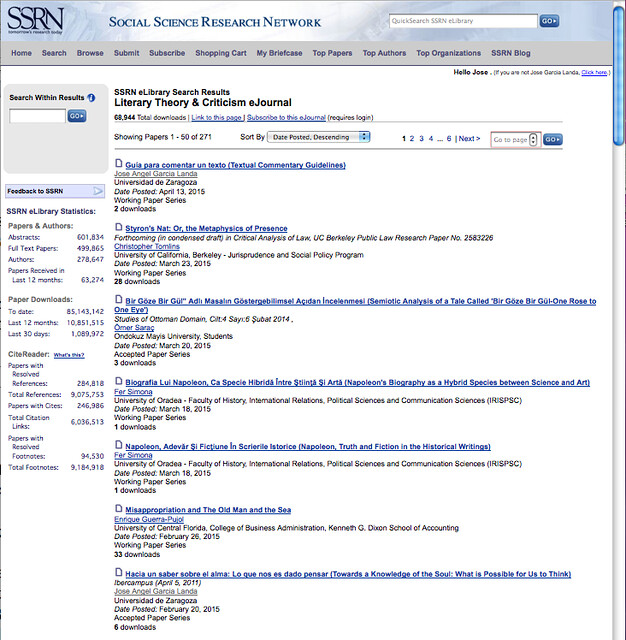

Captura de pantalla 2015-04-14 11.16.22


eJournal Classification  Date posted: April 13, 2015  
LIT Subject Matter eJournals


Comentario de textos literarios en Academia


_____. "Guía para comentar un texto." ResearchGate 12 Aug. 2017.
         2107


Comentario de textos literarios ingleses - J.A. García Landa

Guía para comentar un texto


Comentar un texto es saberlo leer de una forma interesante y creativa, y saber comunicar esa lectura. Para eso hace falta tanto intuición como experiencia y conocimientos. La intuición que todos tenemos en mayor o menor grado también se desarrolla y se aprende a utilizar con la práctica. La práctica consiste en: a) leer textos literarios con atención, b) leer crítica literaria procurando aprender de otros comentarios, c) comentar textos por escrito con frecuencia. No hay una fórmula o clave que permita hacer un comentario correcto. Sólo con tiempo, dedicación y familiaridad con los textos podemos aprender a hacer comentarios que sean interesantes, que distingan entre lo que es repetitivo u obvio (o  puramente subjetivo, o simplemente erróneo) y lo que vale la pena ver en un texto y decir de él a otros, en cada situación. En concreto, aquí estamos en un contexto de comentario académico. Puede ayudar mucho para orientarse en él el estudio alguno de los libros sobre comentario de texto recomendados, y deberían manejarse al menos dos de ellos.

Las indicaciones siguientes pueden servir de guía; no son exhaustivas y no hay por qué tratar todos estos puntos al comentar un texto. En cada texto debemos intentar ver cuáles de estos puntos, u otros, sería más interesante desarrollar en el comentario. Pero hay que intentar también no centrarse demasiado en un único aspecto del texto.

Lectura. Comenzar por leer el texto con atención y utilizando fuentes de información (diccionario, enciclopedia) en caso de dudas. Atender al significado que las palabras o expresiones adquieren en este texto en concreto. Presta atención al lenguaje del texto para ver si te ayuda a situarlo en una época histórica concreta por sus expresiones o su gramática.

Autor e identificación. Si el texto lleva el nombre del autor, utiliza el conocimiento de su obra como información de fondo para el comentario. Pero cuida de no olvidarte del texto que tienes entre manos para dedicarte a escribir una redacción sobre la vida y obra de ese autor en general. La información adicional que utilices será mucho más valiosa si la puedes relacionar con aspectos concretos del texto que comentas. Así, puedes señalar cómo se reflejan en este texto en concreto las características temáticas, ideológicas o estilísticas más generales de la obra del autor.
Si el texto no lleva el nombre del autor, utiliza tus conocimientos sobre las épocas literarias y las características de los distintos autores que conozcas para ver cuáles pueden responder al texto en cuestión. Atiende también a pistas concretas (nombres de personajes, ambiente, etc.). Pero si no conoces el autor, no intentes aparentar que lo sabes. El texto podría ser anónimo o pertenecer a una obra de segunda fila que no se espera que vayas a identificar. Por eso refleja simplemente la manera en que ves el texto: si se aprecian rasgos de tal o cual corriente, género o estilo, si hay “elementos comunes” con la obra de tal o cual autor... pero sin darlo por seguro a menos que realmente lo veas como seguro. Aunque no sepas identificar al autor con precisión, siempre puede servirte como guía para el comentario el estilo de otros autores que sí conoces.

Tema, género, estilo. Señala el tema principal que trata el texto a tu juicio, y cómo se desarrolla a lo largo de él. ¿Qué tipo de texto es? ¿Narrativo? ¿Descriptivo? ¿Expositivo? ¿Dramático? ¿Lírico? Describe sus características métricas si se trata de poesía, pero no detengas ahí el análisis de la forma. Examina la estructura retórica del texto (recursos persuasivos o expresivos empleados, figuras, tropos e imágenes y uso de los mismos, etc.). ¿Qué nos dice esta estructura acerca del estilo del autor, de sus ideas o de su intención? ¿Cómo se personaliza esa forma o género utilizado? (Es decir, ¿cómo se vuelve estilo ?). Procura referirte a aspectos concretos del texto, su uso del lenguaje, etc.—lo que lo haga característico. ¿Qué recursos formales se utilizan para crear coherencia y una determinada perspectiva en el texto? ¿Cómo se refuerza el tema del texto mediante el uso de imágenes, metáforas, connotaciones, juegos de palabras? Es decir, ¿cómo construye el texto una forma propia para expresar lo que expresa?

Enunciación: A través de un texto podemos estudiar la figura de su autor y la de su receptor (implícitos). ¿Cómo aparecen aquí? ¿Podemos hablar de autores o narradores ficticios? ¿Es el mismo autor quien se dirige a nosotros, o adopta una personalidad ficticia, o una actitud convencionalizada? ¿Hay ironía, ambigüedad, etc. en la voz del autor? Si el autor desdobla su voz de esta manera, ¿cómo se relacionan entre sí las voces resultantes? (por ejemplo, una narración irónica y la actitud real que subyace a ella). Lo mismo con respecto al oyente: ¿qué imagen del receptor se nos ofrece? ¿Es un personaje concreto (¿real? ¿ficticio?) o el público en general? ¿Qué actitud espera el autor de este receptor implícito? ¿Cuál es la actitud del autor, narrador, receptor... hacia los personajes, si los hay? ¿Desde qué punto de vista se presenta la acción? Si hay varios puntos de vista, ¿cómo se articulan unos con otros, o se subordinan unos a otros?

Intertextualidad: A través de un texto también pueden percibirse otros textos, la obra de otros autores. Esto puede suceder de forma explícita o implícita. ¿Hay en el texto alusiones concretas a otras obras o géneros literarios? ¿Podemos encontrar una relación implícita entre este texto y otros? Esto sucede, por ejemplo, en el caso de textos que son imitaciones, variaciones, o parodias de otras obras—o de clases de obras, como el Quijote es una parodia de los libros de caballerías. Intenta sacar a la luz estos aspectos implícitos del diálogo que se establece entre el texto y la tradición literaria que le precede.

Historia: Estas cuestiones de carácter formal deben relacionarse con cuestiones de carácter histórico e ideológico. Intenta establecer, refiriéndote a aspectos concretos del texto, qué supone éste, o la escritura de su autor, en el desarrollo de la literatura inglesa. ¿Qué hay de nuevo y qué de tradicional en el tipo de escritura que ejemplifica este texto? ¿Puedes relacionarlo con algún movimiento literario, corriente, moda, etc. que te permita situarlo en tanto que fenómeno histórico? ¿Qué aspectos de la escritura de este texto no eran posibles o probables en otra época o momento histórico? ¿Por qué? (Aquí ayuda tener unas ciertas nociones de historia).

Ideología: Un texto es producto de una sociedad, una época, una mentalidad o ideología. Señala qué aspectos del texto a comentar pueden relacionarse con estos aspectos más amplios de su trasfondo histórico. Por ejemplo, ¿cuál es la representación de las diferencias de clase o jerarquía social en el texto? En este sentido, puede ser interesante ver en qué manera refleja el texto las relaciones sociales: ¿se atiene a un modelo aristocrático y feudal? ¿nacionalista, monárquico? ¿liberal, demócrata? ¿Cómo situas al texto con respecto al desarrollo de la sociedad moderna (urbana, pluralista, laica...)? ¿Hay rasgos de discursos nacionalistas, coloniales, raciales, identitarios, revolucionarios, reaccionarios, progresistas? ¿Con qué recursos estilísticos se expresa o refuerza el mensaje político implícito o explícito del texto?
¿Hay rasgos de creencias científicas o religiosas pertenecientes a una época o cultura determinados? ¿a un credo o filosofía concretos? Explícalos y sitúalos brevemente en el contexto de la historia de las ideas. ¿Va el texto dirigido a sustentar o defender esas ideas explícitamente, o simplemente las presupone como parte de su visión del mundo?
Otro aspecto muy interesante a discutir es la representación de los sexos: ¿cómo se caracteriza a hombres o mujeres en el texto? ¿cuál es el género e ideología sexual de autor, narrador, personajes? ¿Cómo ayuda la retórica de la narración, las imágenes, metáforas, etc., a transmitir esa ideología sexual? ¿Qué sentido tienen hoy las ideas, nociones, etc. defendidas por el texto? ¿Qué otros aspectos relativos a la ideología del sujeto individual aparecen?

Redacción y documentación: ¿Que aspecto del texto te llama más la atención, y por qué? Intenta describir a qué se debe el que te parezca ese aspecto el más llamativo o interesante del texto. Concluye el comentario con una valoración de conjunto del tema central del texto según tu interpretación.
REDACTA CON COHERENCIA, ESTRUCTURANDO EL TRABAJO EN PÁRRAFOS QUE SEAN UNIDADES DE SENTIDO. NO ESCRIBAS UN MONTÓN DE FRASES SUELTAS. PROCURA QUE EL COMENTARIO ESTÉ ORGANIZADO EN TORNO A UNA INTERPRETACION O TESIS CENTRAL QUE EXPRESE LO QUE VES MAS IMPORTANTE PARA DECIR SOBRE EL TEXTO. REPASA LA CORRECCIÓN ORTOGRÁFICA Y GRAMATICAL DEL INGLÉS ANTES DE ENTREGARLO.
En cuanto al uso de bibliografía (en los trabajos hechos en casa): debe servir para apoyar o documentar y no para sustituir u oscurecer la propia lectura del texto. Se puede dialogar con un texto de otro crítico, refutarlo, o extraer información de él. Pero lo que es imprescindible es separar claramente lo que decimos nosotros de lo que dicen los demás, utilizando comillas y referencias precisas a las obras que utilizamos. Trata de usar un estilo que sea a la vez personal y correcto.


—oOo—

Mi fotoblog

Mi fotoblog
se puede ver haciendo clic en la foto ésta de Termineitor. Y hay más enlaces a cosas mías al pie de esta página.