
Mostrando entradas con la etiqueta Semiosfera. Mostrar todas las entradas
Mostrando entradas con la etiqueta Semiosfera. Mostrar todas las entradas
sábado, 16 de diciembre de 2023


lunes, 8 de agosto de 2022
Semiosfera - En lituano
Citan en este wiki lituano nuestro libro sobre la semiosfera, Семиосфера нарратологии: диалог языков и культур / Semiosfera narratologijoje: kalbų ir kultūrų dialogas.
Upwikilt. "Semiosfera – Semiosphere." Upwikilt.*
http://upwikilt.top/wiki/Semiosphere
2022

—oOo—
jueves, 17 de febrero de 2022
Semiosfera - Me citan
En esto que viene al parecer de la Wikipedia turca:
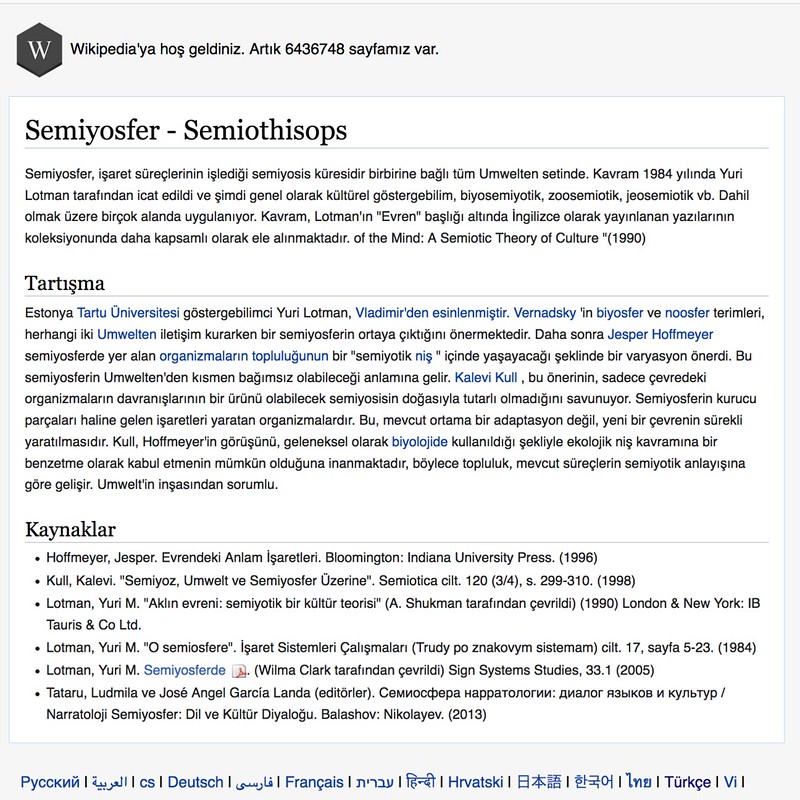
También aquí:
"Semiyosfer / Semiothisops." Isecosmetic (Wikipedia).*
https://tr.isecosmetic.com/wiki/Semiosphere
2022
Academia Lab ("Semiosfera").*
https://academia-lab.com/enciclopedia/semiosfera/
2022
viernes, 15 de marzo de 2019
Semiosphere (Wikipedia)
Me citan (nos citan a Ludmila y a mí) en el artículo "Semiosphere" de la Wikipedia:

—oOo—
miércoles, 10 de mayo de 2017
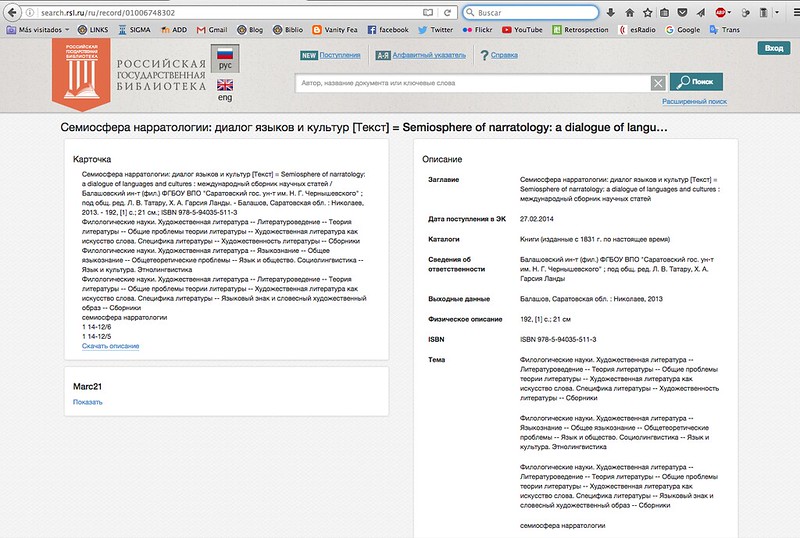
En la Biblioteca Estatal de Rusia
La ficha bibliográfica de Семиосфера нарратологии: диалог языков и культур, libro editado en Rusia por Ludmila Tataru y Х. А. Гарсия Ланда:
—oOo—
sábado, 26 de diciembre de 2015
Reseña de SEMIOSPHERE OF NARRATOLOGY

Realizada por mi coeditora y editora principal, Ludmila Comuzzi (Tataru), aparece en el número 9 del boletín de la Sociedad Europea de Narratología, PDF aquí:
http://www.narratology.net/sites/www.narratology.net/files/webfm/stories/NL11_ENN_December_2014_0.pdf
Semiosphere of Narratology: A Dialogue of Languages and Cultures . Edited by Ludmila Tataru & José Ángel García Landa. Balashov: Nikolayev, 2013. 196 pages . ISBN 978 - 5 - 94035 - 511 - 3
Book review published in ENN Newsletter (NarrNet) 11 (2014) http://www.narratology.net/newsletter
Semiosphere of Narratology is an anthology of articles by Russian and Western scholars bearing on a variety of subjects ranging from theories and methods in postclassical narratology to the play and semiotic aspects of literary narratives, the narrativity of mass media and photoblogs to the use of narratives in the social sphere and in pedagogy.
The volume was edited by Ludmila Tataru, Professor at the Balashov Institute of Saratov State University (Balashov, Russia), and José Ángel García Landa, Senior lecturer in the Department of English and German Philology at the University of Zaragoza (Spain).
As a theoretical basis for conceptualizing narrative, the editors proposed the concept of semiosphere, a concept brilliantly formulated by Yuri M. Lotman. Viewing semiosphere in analogy to V. I. Vernadsky’s biosphere, Lotman represented it as a heterogeneous, asymmetrical environment, crucial for the existence, interaction and rejuvenation of languages and cultures, a particular scientific and cultural space within which there exist, interact and collide “old,” “new” and “yet-to-be-born” ideas, languages, systems and subsystems.
On this basis, the aims of the volume were set as follows:
1) to select contributions reflecting on Lotman’s ideas in their relation to the latest tendencie s in the theory of narrative; and
2) to structure a “polylogue of voices” focusing on the same concept – narrative – from the positions of various disciplines.
The book also represents a dialogue between two languages, Russian and English, in which the articles were submitted.
The first thematic section, “Semiosphere of Narratology: In Search of a Method,” includes five articles.
Greger Andersson (Professor of Comparative Literature at Örebro University, Sweden): “ Postclassical Narratology vs. Poetics: David Herman’s ‘Hypothetical Focalization’ as a Test Case”
The article discusses David Herman’s thesis of “hypothetical focalization” in relation to different theories about reader interpretation of narrative fiction. The author singles out two theoretical approaches to the problem. The first is based on the assumption that fictional narrative is a secondary variant of factual narrative with the simple modifier “as if” and a fictional narrator informing a narratee about events using linguistic means that work according to common grammatical rules. The alternative approach, advocated by theoreticians such as Käte Hamburger, Lars-Åke Skalin and Richard Walsh, is qualified as “separatist,” presenting fiction as a form of “language game” wherein an author stipulates motifs that will have an aesthetic impact on readers. According to Andersson, the first of the two approaches will generate “disquieting” interpretations that run against readers’ intuitions.
Boris Fyodorovich Yegorov (Leading researcher at St. Petersburg Institute of History, Russian Academy of Sciences): “The Play Aspects of Culture: The Conceptions of Yuri M. Lotman and V. S. Vakhrushev”
The author analyses the approaches to the cultural - philosophical category of play advocated by the two Russian scholars: Vladimir Vakhrushev and Yuri Lotman. Yegorov, who had incredible fortune to be a colleague and friend of both Vakhrushev and Lotman, presents their conceptions as a dialogue of distant voices, or, to be more exact, as Vakhrushev’s discourse on Lotman’s conceptualization of “play” paralleled by Vakhrushev’s own understanding of this category as it was presented in his book Image. Text. Play (2002) and in his articles on culture, philosophy, literary theory and history, etc. as well as in a number of his unpublished essays. Yegorov’s own mediating voice is clearly heard through references to Lotman’s life, theoretical heritage and personal correspondence. As Yegorov shows, the concept of play, fundamental for Lotman’s cultural-semiotic theory, gains greater scope and precision when seen from the perspective of Vakhrushev’s treatment of the same category.
Ludmila Tataru (Balashov Institute of Saratov State University, Russia): “Rhythm as a Category of Lotman’s Text Theory and as a Principle of Narrative Discourse”
Tataru suggests a theoretical model based largely on Lotman’s structural-semiotic theory, but updated in response to the contemporary trend of focusing on cognitive processes in narrative structures. She singles out for discussion Lotman’s interpretation of rhythm as presented in his earlier literary theory and in his later theory of cultural semiotics. The fact that rhythm has fallen out of the narratological debate is seen as unfortunate, for rhythm might be helpful in confronting the methodological challenge of heteroglossia in the narratological semiosphere. The cognitive-communicative functions of rhythm are illustrated in the analysis of a few stories from Joyce’s Dubliners. Tataru further argues that her method can also be effective for the study of non-fictional stories. Closer attention to narrative rhythm, she claims, might help to coordinate a number of meta-languages of narratological research that are often deaf to one another’s messages.
Valery Igorevitch Tyupa (Head of Theoretical and Historical Poetics, Russian State University for the Humanities, Moscow): “The Category of Narrative Strategies”
This article provides insight into the category of narrative strategies, defined as particular kinds of communicative strategies of culture. Tyupa suggests that positioning the narrator as a witness and judge of the eventfulness of existence is determined by the author’s modality of discursive behavior. He singles out four basic types of narrative modality: a) the modality of neutral knowledge, b) that of authoritative persuasion, c) that of an unre liable narrator’s subjective opinion (in Booth’s sense of the term) and d) the modality of understanding, which is neither subjective nor absolutely objective. Further on, Tyupa argues that the given types of modality are determined by three fundamental ba selines: a) the rhetorical modality of narration, b) world view and c) plot. He characterizes each of these baselines for the strategic choice to assert that a narrative strategy stipulates a text’s communicative unity, since the three baselines are mutually exclusive. That a strategic unity pertains even in complex narratives is demonstrated by an analysis of Mikhail Bulgakov’s novel The Master and Margarita. Another important idea put forward in the article is that of a specifically “historical narratology” as a promising sphere of humanist knowledge.
Dmitry Urusikov (independent scholar, Yeletz, Russia): “The Cognitive Turn in Narratology: In Search of a Method”
This highly theoretical article presents a critical analysis of the state of the art in contemporary Western narratology and the unlikelihood that it will take root in Russian scientific soil. Making a critical appraisal of David Herman’s opposition between classical and postclassical narratologies, which emphasizes cognitive narratology’s interest in mental structures, and going on to disclaim the poststructuralist status of postclassical narratology, Urusikov qualifies this development as a heterogeneous proliferation of narrative disciplines. He suggests an alternative map of that includes descriptive, generative and cognitive narratologies. The first considers classifications of narratives; the second, a new variant of structuralism, concentrates on narrative models; the reader reception and mental processes. The author doubts whether cognitive and postclassical narratologies can easily be naturalized in Russia for two reasons: 1) the dearth of Russian translations of the principal works on narrative theory and 2) a general trend within the philological community to stick to the traditional, hermeneutic methods of analysis.
The second part of the volume, “Narrative as a Meta-genre of Modern Culture,” features the following five articles.
Saule Altybayeva (Associate Professor and Chair of Philological Specialties at the Kazakh National Pedagogical University named after Abai; Almaty, Kazakhstan): “Documentary and Quasi - documentary Narratives in Modern Kazakh Prose”
This paper discusses documentary and quasi-documentary narratives in modern Kazakh historical prose and characterizes them in terms of their typical content and functions. The author suggests working definitions of the narrative types in question and points out that they do not supplant fictionality but only assume new functions and enrich literary narratives with new meanings. Documentary narratives, which narrate real historical events, directly or indirectly confirmed by facts, are capable of forming eventuality within a wider existential range. Events are rearranged (e.g., dates and times of battles) as if overlapping one another. Altybayeva claims that quasi-documentary narrative is compatible with the fictional content of the novel, although its “molecules” – quasi-documents – are fictional and often fantastic.
Svetlana Bozrikova (Senior Lecturer in Foreign Languages, Balashov Institute of the Saratov State University):
“Criminal Story in Journalism: The Typical Traits of Narrative Temporality” The author looks at the crime story as a genre in terms of its tempor ality. One of its specific traits, she suggests, consists in correlations between temporal perspectives which perform particular cognitive functions while presenting the events at varying speed and frequency and in a particular sequence. The reader is immersed into the storyworld thanks to the literary technique employed by journalists to narrate events via scenes and slow - downs, retrospections and foreshadowings, breaking up the story sequence and regular repetitions of the crucial points of the chronotope viewed from different temporal perspectives, thus giving narration a rhythm Bozrikova illustrates her theoretical model with a detailed analysis of Eli Sanders’ essay “The Bravest Woman in Seattle” (published in The Stranger, 2011).
José Ángel García Landa (University of Zaragoza, Spain): “Narrativity of the Photoblog”
This paper examines the storytelling dimension of personal photoblogs from the point of view of narrative semiotics as a shifting multiplicity of interconnected semiotic sub - systems and communicative practices. García Landa takes into account both deliberate and spontaneous narrativity and the narrative sequences constructed by the medium as well as those constructed by the viewers. The aim is to gain further insight into the nature of the photoblog as an emerging genre of narrative, thus opening up a promising perspective for narratologically-minded cybertheory. García Landa keeps a Flickr photoblog himself, and the cover of the volume Semiosphere of Narratology is decorated with his two photos of dead leaves, suggestive of “the narrativity of experience” – the temporal cycles or, symbolically, the narrativity of life. He concludes that the photographs in photoblogs are intermedial, intertextual and hypertextual genres, thus exerting an indirect influence on photographic practices and on the way photographs and ideas about them are viewed, read and circulated.
Maria Roginska (Institute of Sociology and Philosophy, Krakow Pedagogical University, Poland): “The Crisis Chronotope of the Transformation Period: The Orthodox Liminal Narrative”
This contribution emphasizes the socially dependent significance of non - literary narratives as accounts of past experiences. It focuses on liminal narratives considered as both stories about crisis and stories that are generated by the transitional critical context. Roginska attempts to reconstruct liminal narratives of Russian orthodox believers dating back to the transformation after the collapse of the Soviet Union (1991–2003). She shows the significance of the crisis chronotope as a universal interpretive scheme by which orthodox narrators conceptualize spatial and temporal changes, national history and the “miraculous” private experience of the transformation period.
Ondřej Sládek ( Institute of Czech Literature, Academy of Sciences of the Czech Republic, Prague): “The Use of Narrative in Education" The author praises “the magic power of stories” in education. Applying the classic model of literary communication to the triad “the educator – t he curriculum – the student,” he discusses, respectively, “the use of narratives by the educator,” “the use of narratives by students” and “the use of narratives in presenting the curriculum.” Sládek specifies the six modeling functions of narrative in sci ence and education: illustrative, historical, popularizing, didactic, legitimizing and narrative. He insists that narratives should be used in varying degrees and in different ways depending on the disciplines taught, and he recommends that educators look for a balance between the macro-story (presenting the wide context of the problem) and micro-stories (minor stories within the big story), as is the practice with documentary films. The article concludes with idea that the loss of storyness would mean the loss of the order of one’s own life, the loss of the ability to perceive things in context and the loss of awareness of sequence in everyday situations.
The third section, “Philosophical and Semiotic Dimensions of the 20th - and 21st - Century Literary Nar ratives,” features the following five articles:
Svetlana Bessmertnova (Ph.D. student in literature, teacher of Russian and literature at the Alexander Nevsky Gymnasium, Saint Petersburg): “Semiotic Aspects of Bertold Brecht’s Drama”
The author examines Berthold Brecht’s method of estrangement ( Verfremdung ), the key principle of Brecht’s epic theater. She proceeds from the affinity of the pragmatics of existential philosophy and the pragmatics of Brecht’s dramaturgy, viewing this affinity in the more gene ral context of the triad “the signified – the signifier – the perceiving consciousness.” She believes that the situation of existential nothingness, understood as an acquisition of clarity of mind at the expense of the loss of illusion, is to be found in the basic mechanisms of estrangement which are made manifest, in the first place, in the narrative structure of Brecht’s plays. Narrative tools serve to “expose” the conventional semiotic codes and, by means of the latter, to expose fatalism, demonstrating at the same time the possibility and the necessity of making a choice and responsibility for one’s choice, the latter being a consequence of nothingness.
Irina Galutzkikh (Associate Professor of English, Zaporizhzhya National University; Zaporizhzh ya, Ukraine): “Processes of Semiotization of Corporeality in the Postmodern Period and their Reflection in the Imaginative Space of the Literary Text (a conceptual analysis)”
This essay specifies the semiotic and discursive nature of the conceptual framework of the human body within the context of English postmodernist literary prose. It focuses on the mode of imagery conceptualization activating the conceptual metaphor the “human body as a sign.” The author analyses the “bodily” preoccupation of postmodern philosophy, touching upon the phenomenological, social and textual interpretations of the body in Merleau-Ponty’s, Deleuze and Guattari’s and Barthes’ works, basing her own argument mainly on the latter. Applying the semantic-cognitive method of linguistic analysis to Jeanette Winterson’s “Written on the Body” and Peter Ackroyd’s “The Process of Elizabeth Cree,” Galutzkikh makes clear that the body functions in postmodernism as a semiotic code to accentuate the eroticized and sensual aspects of human life as well as one’s individual existential experience.
Sergey Orobiy (Associate Professor at the Blagoveschensk State Pedagogical University; Blagoveschensk, Russia): “‘Anything but the Novel’: Joyce, Jobs and Poetics of Flood”
Written in “the cyber-culture vein,” this article correlates with García Landa’s interest in the way the Internet affects narrativity. Orobiy, a blogger like his Spanish ”companion-in-arms,” analyses the paradoxical nature of the term “poetics of flood,” combining associations wit h the Aristotelian roots of literary theory and idle talk in the Internet over the end of “real literature.” The author finds parallels between the new “low genres” found in Live Journals, blogs, lifelogging, Narrato Journal and other apps and “the small genres” of earlier literary periods, e.g., the epistolary genre in Pushkin’s time and “the literature of fact” praised by the formalists. The new formats of storytelling are qualified as proto-narrative techniques of registering eventfulness non-stop. Orobiy analyses four books recently published in Russia illustrative of the new textuality and comes to the conclusion that today literary narrative has been transformed into a fluid proto-novel, “a new Ulysses ” written daily by millions of authors creating a huge semantic space organized in the form of a matrix.
Beatriz Penas-Ibáñez ( Senior Lecturer in English, University of Zaragoza, Spain): “Semiotic Roles of Narrative Standardness : Securing Cultural Change and Integration. Haiku-Aesthetics and the Anglo-American Literary Semiosphere”
This paper focuses on the socio-pragmatic functions of standardness, considering standard vs. non-standard narrativity , namely, the facilitating of cultural transfer between different literary semiospheres. Culture-specific types of text are seen as translatable through processes of cultural contact, change, assimilation and transfer. Among other things, Penas-Ibáñez theorizes hybridity as a semiotic artifact and the cultural transfer between eastern and western literary practices at the beginning of the 20th century. She characterizes the mutual influence and revulsion of the Sino-Japanese and the western avant-garde genres which had interwoven the two literary semiospheres and led to displacement of the standard poetic and narrative forms dominant in the West during the 19th century by non-standard narrativities like Pound’s and Hemingway’s haiku-like ones.
Svetlana Shiena (Professor at Balashov Institute of Saratov State University) and O. V. Zatonskaya ( Ph.D. student in Literature, Balashov Institute of Saratov State University):
“Poetic Philosophy of S. Beckett and F. Nietzsche” Sheina and Zatonskaya examine the langu age philosophy of Nietzsche and Beckett. They find similarities between the German philosopher’s and the Irish dramatist’s conceptions of poetic language in their respective ways of searching for a language capable of expressing ideas. Both were to give preference to metaphors and aphorisms. The editors of Semiosphere of Narratology believe that such a collective a look at the heteroglossia of contemporary narratology’s Babylon Tower from the perspective of Lotman’s semiotic theory, based on various mechanisms of the mutual attraction/repulsion of cultures and discourses, has been illustrative, if not explanatory, of some of its patterns. The general picture is paradoxical: diverse intellectual spheres have created a productive dialogue of scientific cultures, but at the same time have built impermeable membranes between discursive formations within the global semiosphere of narratology.
Ludmila
Comuzzi (Tataru) Saratov State University
—oOo—
viernes, 19 de diciembre de 2014
On Shared Universes
On "shared universes" it is always a question of more or less
—just as in "real life" we share our universe to a certain extent,
always partially so, but perhaps never in a complete way. In the case of
fictional worlds, an explicit reference to characters or events in
another novel is taken as a sign that the author wants to emphasize the
continuity between both novel worlds, and this may be either central or
anecdotal (perhaps just a mark of the author's personal affection for
his own tiny "comédie humaine"). But in the last analysis, all human
universes, fictional or not, are partially shared by the fact that we
live in a common and interconnected semiosphere. If there were any
universe which was completely autonomous or non-shared, not resting on a
common ground with our universe, then that's an issue similar to the
multiverses in cosmology. They are a mathematical or logical problem
without any demonstrable physical connection to our own universe. That
is, if we make abstraction of the fact that these problems have been
thought out IN OUR UNIVERSE, and in that sense they are also subordinate
hypothetical worlds resting on the common world of shared experience.
Or at least that's the way it looks if we see it from here. From a thread in the Narrative-L. David Richter adds:
Sometimes
a writer creates a world which is largely coherent but with occasional
inconsistencies, of which the most canonical is Faulkner's Yoknapatawpha
novels. Kirk and Klotz in Faulkner's People (1965) index all
the characters, with special treatment for ones that are handled
inconsistently. One example of inconsistency involves Quentin Compson,
who in The Sound and the Fury (1929) commits suicide while at
Harvard at the age of 19--the Anderson Bridge over the Charles River
actually has a plaque commemorating this fictional event; but Quentin
also narrates the short story "That Evening Sun," from These Thirteen (1931), and he is 24 years old as narrator (9 years old at the time of the story which is timestamped "fifteen years ago").
Close
readers can overread these inconsistencies through elaborate midrash
that creates implausible storyworlds. The Baker Street Irregulars, who
read the Sherlock Holmes stories ("the canon") as though they represent a
coherent and consistent world have presented theories that Watson (who
marries Mary Morstan in The Sign of Four) was married three or
four times because the dates of action of particular stories (as
inferred from details in the stories) suggest that Watson was married,
then unmarried, then married again, then unmarried.... Or that his
middle name is Hamish (Scottish for James) because his name is John H.
Watson and his wife, at one point, calls him "James." I should mention
that such research findings generally have their tongue firmly in their
collective cheek.
And me:
Some aspects of this fictional-world-managing are dealt with by Marie-Laure Ryan under the heading of "transfictionality", e.g. in "Transfictionality Across Media." In Theorizing Narrativity. Ed. John Pier and José Ángel García Landa. (Narratologia, 12). Berlin and New York: Walter de Gruyter, 2008. 385-417. On the other hand, the mental or discursive operations involved in "fitting" a narrative within a larger narrative, historicizing it, or building an overal chronology out of disparate narratives, may be seen as an aspect of what I call "narrative anchoring." See e.g. here, "Harry Thompson, 'This Thing of Darkness': Narrative Anchoring" https://www.academia.edu/336349/Harry_Thompson_This_Thing_of_Darkness_Narrative_Anchoring
miércoles, 15 de octubre de 2014
The Notion of Semiosphere
Otra manera de decirlo, quizá, es que la semiosfera es la realidad en la que vivimos, entendida como realidad virtual—realidad aumentada o semióticamente constituida. Junto con todos los diversos códigos semióticos y estrategias de interpretación que nos permiten navegar por ella.
—oOo—
jueves, 27 de marzo de 2014
СЕМИОСФЕРА НАРРАТОЛОГИИ / SEMIOSPHERE OF NARRATOLOGY
La semiosfera de la narratología:
Y otra colaboración con Ludmila Tataru: The Evolution of Narratology.
Y otra colaboración con Ludmila Tataru: The Evolution of Narratology.
—oOo—
miércoles, 26 de marzo de 2014
Semiosphere of Photography

A paradoxical transition of a kind, or frame-flowing. Click on the photo and enjoy the new design of Flickr—pity they are "deprecating" sharing photos through Blogger. We'll have to do it by hand, more's the pity. Oh well, this is my latest publication, I mean an essay on photoblogs in the book—and my latest photos on Flickr too.
—oOo—
domingo, 23 de febrero de 2014
СЕМИОСФЕРА НАРРАТОЛОГИИ / SEMIOSPHERE OF NARRATOLOGY table of contents
СЕМИОСФЕРА НАРРАТОЛОГИИ:
ДИАЛОГ ЯЗЫКОВ И КУЛЬТУР
Международный сборник научных статей
Под общей редакцией
Л. В. Татару, Х. А. Гарсия Ланды
SEMIOSPHERE OF
NARRATOLOGY:
A
DIALOGUE OF LANGUAGES AND
CULTURES
An international
volume of scientific articles
Edited
by Ludmila Tataru
and José Ángel García Landa

Балашовский институт (филиал)
ФГБОУ ВПО «Саратовский государственный университет
имени Н.Г. Чернышевского»
Балашов
2013
ФГБОУ ВПО «Саратовский государственный университет
имени Н.Г. Чернышевского»
Балашов
2013
Saratov
State University named after N.G. Chernyshevsky -
Balashov
Institute
Cover
photos by José Ángel
García Landa
Balashov, 2013
TABLE OF CONTENTS
Andersson, Greger. (Örebro U, Sweden). "Postclassical
Narratology vs. Poetics: David Herman's 'Hypothetical Focalization' as
Test
Case." In СЕМИОСФЕРА НАРРАТОЛОГИИ: ДИАЛОГ ЯЗЫКОВ И КУЛЬТУР
/ Semiosphere of Narratology: A
Dialogue of Languages and Cultures. Ed. Ludmila Tataru and José
Angel
García Landa. Balashov: Nikolayev, 2013. 7-24.*
Егоров Б. Ф. (Boris
Fedorovich Yegorov, St. Petersburg). " Игровые аспекты
культуры: концепции Ю. М. Лотмана и В. С.
Вахрушева"
("The Play Aspects of Culture: The Conceptions of Yuri M. Lotman and V.
S.
Vakhrushev"). In СЕМИОСФЕРА НАРРАТОЛОГИИ: ДИАЛОГ ЯЗЫКОВ И КУЛЬТУР
/ Semiosphere of
Narratology: A Dialogue of Languages and Cultures.
Ed. Ludmila Tataru and José Angel García Landa. Balashov: Nikolayev,
2013.
25-36.*
Tataru,
Ludmila Vladimirovna. (Balashov). "Rhythm as a Category of Lotman's
Text
Theory and as a Principle of Narrative Discourse." In СЕМИОСФЕРА НАРРАТОЛОГИИ: ДИАЛОГ ЯЗЫКОВ И КУЛЬТУР
/ Semiosphere of Narratology: A
Dialogue of Languages and Cultures. Ed. Ludmila Tataru and José
Angel
García Landa. Balashov: Nikolayev, 2013. 36-49.*
Тюпа В. И. (Valerii
Igorevich Tyupa). (Moscow). "Категория нарративных
стратегий" ("The Category of Narrative
Strategies"). In СЕМИОСФЕРА НАРРАТОЛОГИИ: ДИАЛОГ ЯЗЫКОВ И КУЛЬТУР
/ Semiosphere of Narratology: A
Dialogue of Languages and Cultures. Ed. Ludmila Tataru and José
Angel
García Landa. Balashov: Nikolayev, 2013. 50-58.*
Урусиков Д. С. (Dmitri
Sergeyevich Urusikov, Yelets, Russia). "Когнитивный
поворот
в нарратологии: в поисках метода" ("The Cognitive Turn
in Narratology: The Search for a Method.") In СЕМИОСФЕРА НАРРАТОЛОГИИ: ДИАЛОГ ЯЗЫКОВ И КУЛЬТУР
/ Semiosphere of Narratology: A
Dialogue of Languages and Cultures. Ed. Ludmila Tataru and José
Angel
García Landa. Balashov: Nikolayev, 2013. 58-68.*
Алтыбаева С. М. (Saulye
Magazovna Altybayeva, Almaty, Kazakhstan). (Документальные
и квазидокументальные нарративы
современной казахской прозы" "Documentary and
Quasidocumentary Narratives of Modern Kazakh Prose.") In СЕМИОСФЕРА НАРРАТОЛОГИИ: ДИАЛОГ ЯЗЫКОВ
И КУЛЬТУР
/ Semiosphere of Narratology: A
Dialogue of Languages and Cultures. Ed. Ludmila Tataru and José
Angel
García Landa. Balashov: Nikolayev, 2013. 69-83.*
Бозрикова С. А. (Svetlana
Aleksyeyevna Bozrikova, Balashov, Russia). "Журналистская криминальная история: специфика нарративной
темпоральности" ("Criminal Story in Journalism: The Typical
Traits of Narrative Temporality.") In СЕМИОСФЕРА НАРРАТОЛОГИИ: ДИАЛОГ ЯЗЫКОВ И КУЛЬТУР
/ Semiosphere of Narratology: A
Dialogue of Languages and Cultures. Ed. Ludmila Tataru and José
Angel
García Landa. Balashov: Nikolayev, 2013. 84-93.*
García
Landa, José Angel. (Universidad de Zaragoza, Spain). "Narrativity of
the
Photoblog." In СЕМИОСФЕРА НАРРАТОЛОГИИ: ДИАЛОГ ЯЗЫКОВ И КУЛЬТУР
/ Semiosphere of Narratology: A
Dialogue of Languages and Cultures. Ed. Ludmila Tataru and José
Angel
García Landa. Balashov: Nikolayev, 2013. 93-107.*
Roginska,
Maria Aleksandrovna. (Krakow, Poland). "Кризисный
хронотоп эпохи трансформации: православный
лиминальный нарратив" ("The Crisis Chronotope of the
Transformation Period: The Orthodox Liminal Narrative.") In СЕМИОСФЕРА НАРРАТОЛОГИИ: ДИАЛОГ ЯЗЫКОВ
И КУЛЬТУР
/ Semiosphere of Narratology: A
Dialogue of Languages and Cultures. Ed. Ludmila Tataru and José
Angel
García Landa. Balashov: Nikolayev, 2013. 107-22.*
Sládek,
Ondrej. (Prague, Czech Republic). "The Use of Narrative in
Education." In СЕМИОСФЕРА НАРРАТОЛОГИИ: ДИАЛОГ ЯЗЫКОВ И КУЛЬТУР
/ Semiosphere of Narratology: A
Dialogue of Languages and Cultures. Ed. Ludmila Tataru and José
Angel
García Landa. Balashov: Nikolayev, 2013. 122-31.*
Бессмертнова С. В. (Svetlana Vladimirovna Bessmertnova, St. Petersburg)."Семиотические аспекты драматургии Бертольта Брехта". ("Semiotic
Aspects of Bertold Brecht's Drama.") In СЕМИОСФЕРА НАРРАТОЛОГИИ: ДИАЛОГ ЯЗЫКОВ И КУЛЬТУР
/ Semiosphere of Narratology: A
Dialogue of Languages and Cultures. Ed. Ludmila Tataru and José Angel
García Landa. Balashov: Nikolayev, 2013. 132-41.*
Галуцких И. А. (Irina
Anatolyevna Galutskikh, Zaporozhe, Ukraine). "Процессы
семиотизации телесности в период постмодернизма
и их отражение в образном пространстве
художественного текста (концептуальный анализ)" ("Processes of
Semiotization of Corporeality in the Postmodern Period and their
Reflection in
the Imaginative Space of the Literary Text (A Conceptual Analysis)").
In СЕМИОСФЕРА НАРРАТОЛОГИИ: ДИАЛОГ ЯЗЫКОВ
И КУЛЬТУР
/ Semiosphere of Narratology: A
Dialogue of Languages and Cultures. Ed. Ludmila Tataru and José
Angel
García Landa. Balashov: Nikolayev, 2013. 141-57.*
Оробий С. П. ( Sergei
Pavlovich Orobiy, Blagoveschensk, Russia). "«Всё что
угодно, только не роман»: Джойс, Джобс и
поэтика флуда" ("'Anything
but the Novel': Joyce, Jobs and the Poetics of Flood"). In СЕМИОСФЕРА НАРРАТОЛОГИИ: ДИАЛОГ ЯЗЫКОВ
И КУЛЬТУР
/ Semiosphere of Narratology: A
Dialogue of Languages and Cultures. Ed. Ludmila Tataru and José
Angel
García Landa. Balashov: Nikolayev, 2013. 157-61.*
Penas-Ibáñez,
Beatriz. (Universidad de Zaragoza). "Semiotic Roles of Narrative
Standardness: Securing Cultural Change and Integration.
Haiku-Aesthetics and
the AngloAmerican Literary Semiosphere." In СЕМИОСФЕРА НАРРАТОЛОГИИ: ДИАЛОГ ЯЗЫКОВ И КУЛЬТУР
/ Semiosphere of Narratology: A
Dialogue of Languages and Cultures. Ed. Ludmila Tataru and José
Angel
García Landa. Balashov: Nikolayev, 2013. 161-78.*
Шеина С. Е., & O B. Затонская
(Svetlana Yevgenevna Sheina, (Balashov, Russia), and Olga
Viktorovna
Zatonskaya (Saratov, Russia). "Поэтическая философия С.
Беккета и Ф. Ницше " ("Poetic
Philosophy of S. Beckett and F. Nietzsche.") In СЕМИОСФЕРА НАРРАТОЛОГИИ: ДИАЛОГ ЯЗЫКОВ И КУЛЬТУР
/ Semiosphere of Narratology: A
Dialogue of Languages and Cultures. Ed. Ludmila Tataru and José
Angel
García Landa. Balashov: Nikolayev, 2013. 179-89.*
СЕМИОСФЕРА
НАРРАТОЛОГИИ (Orders)
—oOo—
miércoles, 19 de febrero de 2014
СЕМИОСФЕРА НАРРАТОЛОГИИ
¡Directo desde Rusia! SEMIOSPHERE OF NARRATOLOGY. ¡¡¡Gracias, Ludmila!!!

СЕМИОСФЕРА НАРРАТОЛОГИИ: ДИАЛОГ ЯЗЫКОВ И КУЛЬТУР
Semiosphere of Narratology: A Dialogue of Languages and Cultures.
Ed. Ludmila Tataru & José Angel García Landa.
Balashov: Nikolayev, 2013.
(I. Semiosphere of Narratology: In Search for a Method. II. Narrative as a Meta-genre of Modern Culture. III. Philosophic and Semiotic Dimensions of the 20th-21st Centuries' Literary Narratives).
The volume features articles of Russian and Western scholars, representing their experience of theorizing on narrative. The diversity of the topics—from arguments and methods of postclassical narratology, the play aspects of culture, narrative strategies, semiotic aspects of literary narratives, the narrativity of mass media and photoblogs to the use of narratives in sociology and pedagogy—would give a summarized picture of the present-day narratology as a meta-discipline operating a variety of languages (codes). The ideological bases, as well as the structural principle of the volume, are based on Yuri M. Lotman's concept of the semiosphere. The volume is addressed to those engaged in literary theory, cultural studies, sociology and narratology in general.
Andersson, Greger. (Örebro U, Sweden). "Postclassical Narratology vs. Poetics: David Herman's 'Hypothetical Focalization' as Test Case." 7-24.
Yegorov, Boris Fedorovich. (St. Petersburg). (Article in Russian: "The Play Aspects of Culture: The Conceptions of Yuri M. Lotman and V. S. Vakhrushev"). 25-36.
Tataru, Ludmila Vladimirovna. (Balashov). "Rhythm as a Category of Lotman's Text Theory and as a Principle of Narrative Discourse." 36-49.
Tyupa, Valerii Igorevich. (Moscow). (Article in Russian: "The Category of Narrative Strategies"). 50-58.
Urusikov, Dmitri Sergeyevich. (Yelets, Russia). (Article in Russian: "The Cognitive Turn in Narratology: The Search for a Method.") 58-68.
Altybayeva, Saulye Magazovna. (Almaty, Kazakhstan). (Article in Russian: "Documentary and Quasidocumentary Narratives of Modern Kazakh Prose.") 69-83.
Bozrikova, Svetlana Aleksyeyevna. (Balashov, Russia). (Article in Russian: "Criminal Story in Journalism: The Typical Traits of Narrative Temporality.") 84-93.
García Landa, José Angel. (Universidad de Zaragoza, Spain). "Narrativity of the Photoblog." 93-107.
Roginska, Maria Aleksandrovna. (Krakow, Poland). (Article in Russian: "The Crisis Chronotope of the Transformation Period: The Orthodox Liminal Narrative.") 107-22.
Sládek, Ondrej. (Prague, Czech Republic). "The Use of Narrative in Education." 122-31.
Bessmertnova, Svetlana Vladimirovna. (St. Petersburg). (Article in Russian: "Semiotic Aspects of Bertold Brecht's Drama.") 132-41.
Galutskikh, Irina Anatol'evna. (Zaporozhe, Ukraine). (Article in Russian: "Processes of Semiotization of Corporeality in the Postmodern Period and their Reflection in the Imaginative Space of the Literary Text (A Conceptual Analysis)"). 141-57.
Orobiy, Sergei Pavlovich. (Blagoveschensk, Russia). "'Anything but the Novel': Joyce, Jobs and the Poetics of Flood"). 157-61.
Penas-Ibáñez, Beatriz. (Universidad de Zaragoza). "Semiotic Roles of Narrative Standardness: Securing Cultural Change and Integration. Haiku-Aesthetics and the AngloAmerican Literary Semiosphere." 161-78.
Sheina, Svetlana Yevgenevna. (Balashov, Russia), and Olga Viktorovna Zatonskaya (Saratov, Russia). "Poetic Philosophy of S. Beckett and F. Nietzsche." 179-89.

СЕМИОСФЕРА НАРРАТОЛОГИИ: ДИАЛОГ ЯЗЫКОВ И КУЛЬТУР
Semiosphere of Narratology: A Dialogue of Languages and Cultures.
Ed. Ludmila Tataru & José Angel García Landa.
Balashov: Nikolayev, 2013.
(I. Semiosphere of Narratology: In Search for a Method. II. Narrative as a Meta-genre of Modern Culture. III. Philosophic and Semiotic Dimensions of the 20th-21st Centuries' Literary Narratives).
The volume features articles of Russian and Western scholars, representing their experience of theorizing on narrative. The diversity of the topics—from arguments and methods of postclassical narratology, the play aspects of culture, narrative strategies, semiotic aspects of literary narratives, the narrativity of mass media and photoblogs to the use of narratives in sociology and pedagogy—would give a summarized picture of the present-day narratology as a meta-discipline operating a variety of languages (codes). The ideological bases, as well as the structural principle of the volume, are based on Yuri M. Lotman's concept of the semiosphere. The volume is addressed to those engaged in literary theory, cultural studies, sociology and narratology in general.
Andersson, Greger. (Örebro U, Sweden). "Postclassical Narratology vs. Poetics: David Herman's 'Hypothetical Focalization' as Test Case." 7-24.
Yegorov, Boris Fedorovich. (St. Petersburg). (Article in Russian: "The Play Aspects of Culture: The Conceptions of Yuri M. Lotman and V. S. Vakhrushev"). 25-36.
Tataru, Ludmila Vladimirovna. (Balashov). "Rhythm as a Category of Lotman's Text Theory and as a Principle of Narrative Discourse." 36-49.
Tyupa, Valerii Igorevich. (Moscow). (Article in Russian: "The Category of Narrative Strategies"). 50-58.
Urusikov, Dmitri Sergeyevich. (Yelets, Russia). (Article in Russian: "The Cognitive Turn in Narratology: The Search for a Method.") 58-68.
Altybayeva, Saulye Magazovna. (Almaty, Kazakhstan). (Article in Russian: "Documentary and Quasidocumentary Narratives of Modern Kazakh Prose.") 69-83.
Bozrikova, Svetlana Aleksyeyevna. (Balashov, Russia). (Article in Russian: "Criminal Story in Journalism: The Typical Traits of Narrative Temporality.") 84-93.
García Landa, José Angel. (Universidad de Zaragoza, Spain). "Narrativity of the Photoblog." 93-107.
Roginska, Maria Aleksandrovna. (Krakow, Poland). (Article in Russian: "The Crisis Chronotope of the Transformation Period: The Orthodox Liminal Narrative.") 107-22.
Sládek, Ondrej. (Prague, Czech Republic). "The Use of Narrative in Education." 122-31.
Bessmertnova, Svetlana Vladimirovna. (St. Petersburg). (Article in Russian: "Semiotic Aspects of Bertold Brecht's Drama.") 132-41.
Galutskikh, Irina Anatol'evna. (Zaporozhe, Ukraine). (Article in Russian: "Processes of Semiotization of Corporeality in the Postmodern Period and their Reflection in the Imaginative Space of the Literary Text (A Conceptual Analysis)"). 141-57.
Orobiy, Sergei Pavlovich. (Blagoveschensk, Russia). "'Anything but the Novel': Joyce, Jobs and the Poetics of Flood"). 157-61.
Penas-Ibáñez, Beatriz. (Universidad de Zaragoza). "Semiotic Roles of Narrative Standardness: Securing Cultural Change and Integration. Haiku-Aesthetics and the AngloAmerican Literary Semiosphere." 161-78.
Sheina, Svetlana Yevgenevna. (Balashov, Russia), and Olga Viktorovna Zatonskaya (Saratov, Russia). "Poetic Philosophy of S. Beckett and F. Nietzsche." 179-89.
—oOo—
Order SEMIOSPHERE OF NARRATOLOGY by e-mail here.
Boying SEMIOSPHERE OF NARRATOLOGY online: http://www.library.sk/arl-cav/en/detail/?&idx=cav_un_epca*0425707
lunes, 16 de diciembre de 2013
Semiosphere of Narratology
Mi última (o próxima) publicación, en Rusia y en colaboración con Ludmila Tataru (thanks so much Ludmila!):

Балашовский институт (филиал)
ФГБОУ ВПО «Саратовский государственный университет
имени Н.Г. Чернышевского»
СЕМИОСФЕРА НАРРАТОЛОГИИ:
ДИАЛОГ ЯЗЫКОВ И КУЛЬТУР
Международный сборник научных статей
Под общей редакцией
Л. В. Татару, Х. А. Гарсия Ланды
Фотографии на обложке Хосе Анхела Гарсия Ланды
Балашов
2013
ФГБОУ ВПО «Саратовский государственный университет
имени Н.Г. Чернышевского»
СЕМИОСФЕРА НАРРАТОЛОГИИ:
ДИАЛОГ ЯЗЫКОВ И КУЛЬТУР
Международный сборник научных статей
Под общей редакцией
Л. В. Татару, Х. А. Гарсия Ланды
Фотографии на обложке Хосе Анхела Гарсия Ланды
Балашов
2013

miércoles, 25 de septiembre de 2013
Hарративность фотоблогов (Семиосфера нарратологии)
—oOo—
Ключевые слова: Блоги, фотоблоги, компьютерно-опосредованная коммуникация, Интернет, изображения, семиотика, нарратология, нарративность, последовательности повествования.
—oOo—
Suscribirse a:
Entradas (Atom)
Mi fotoblog

se puede ver haciendo clic en la foto ésta de Termineitor. Y hay más enlaces a cosas mías al pie de esta página.