
Mostrando entradas con la etiqueta Teleología. Mostrar todas las entradas
Mostrando entradas con la etiqueta Teleología. Mostrar todas las entradas
miércoles, 2 de diciembre de 2020


sábado, 5 de octubre de 2019
Elephanteleology
“Emergence” is the place holder for a robust theory for the origin of life. Evolutionary theory explains what happens after, but without an account for what life actually is we are stuck telling a story without a beginning. Felipe A. Veloso (@fvelosoe) https://t.co/SoCOwneOOS— This View of Life (@tvolmag) October 5, 2019
martes, 16 de julio de 2019
El evolucionismo de Lucrecio: Exaptación y retrospección
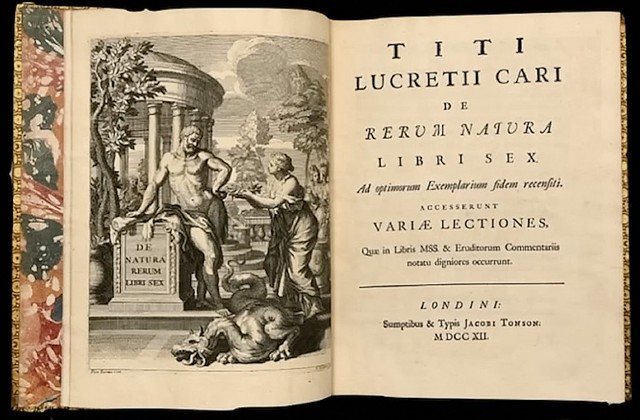
El poeta y filósofo atomista romano Lucrecio es un importante teorizador de la evolución. En su poema De rerum natura, y como parte de una argumentación anti-teleológica, formula de modo polémico la teoría de lo que Stephen Jay Gould habría de llamar la "exaptación": la tesis de que los órganos no se han desarrollado con vistas a desempeñar sus actuales funciones, pues éstas han derivado colateralmente. Extraemos algunas consecuencias desde el punto de vista de un evolucionismo narratológico.
Texto completo:
El evolucionismo de Lucrecio: Exaptación y retrospección
Ibercampus (July 4, 2019) Posted 12 Jul 2019

English Abstract:
Lucretian Evolutionism: Exaptation and Retrospection
The Roman poet and atomistic philosopher Lucretius is a major evolutionary theorist. In his poem De rerum natura, as part of an anti-teleological argument, he polemically formulates the theory of what Stephen Jay Gould has called 'exaptation': the notion that organs have not evolved with a view to their present functions, which are colaterally derived. Some consequences for an narrativist evolutionary science are derived from an analysis of this passage.Suggested Citation:
Garcia Landa, Jose Angel, El evolucionismo de Lucrecio: Exaptación y
retrospección (Lucretian Evolutionism: Exaptation and Retrospection)
(July 4, 2019). Ibercampus (July 4, 2019). Available at SSRN: https://ssrn.com/abstract=3415888
—oOo—
jueves, 4 de julio de 2019
El evolucionismo de Lucrecio: Exaptación y retrospección
No se hizo el oído para oír. Quien tenga oídos, que oiga.
Lucrecio es más un evolucionista que un protoevolucionista, y en su poema Sobre la Naturaleza aparece claramente prefigurada, o apuntada, o insinuada, la teoría evolucionista de la exaptación, formulada polémicamente hace no tanto tiempo por Stephen Jay Gould. Teoría que viene a subrayar precisamente eso (lo que sostenía Darwin y antes que él Lucrecio): que el ojo no se hizo para ver, ni la pierna para correr.
El poeta atomista Lucrecio es un importante pensador del evolucionismo, hasta extremos que es fácil subestimar. Las bases materialistas de su teoría lo llevan a explicar los fenómenos naturales como resultado de las colisiones de los átomos y de la formación de estructuras estables, que son las que reconocemos como cuerpos, y las que somos, por otra parte. Es una estabilidad provisional, pues para Lucrecio como para Heráclito todo fluye, todo se halla en flujo perpetuo y toda forma tiene su nacimiento y muerte, desde los seres vivos hasta la fábrica entera del mundo y el cosmos.
Quiero aquí leer más despacio un fragmento del libro IV (822-57), para el que sigo el texto y traducción de Eduard Valentí Fiol (De rerum natura / De la naturaleza, ed. bilingüe y trad. de Eduard Valentí Fiol; Barcelona: Bosch, 1985, 376-77). Es el pasaje que titula el editor "Contra las causas finales":
Illud in his rebus uitium uementer [auemus]A este texto, un excurso en la descripción que venía haciendo Lucrecio sobre los sentidos, los pensamientos y los sueños, le añade dos notas el editor:
te fugere, errorem uitareque praemetuenter,
lumina ne facias oculorum clara creata,
prospicere ut possimus, et ut proferre queamus
proceros passus, ideo fastigia posse,
surarum ac feminum pedibut fundata plicari,
bracchia tum porro ualidis ex apta lacertis
esse manusque datas utraque [ex] parte ministras,
ut facere ad uitam possemus quae foret usus.
Cetera de genere hoc inter quaecumque pretantur
omnia peruersa praepostera sunt ratione,
nil ideo quoniam natumst in corpore ut uti
possemus, sed quod natumst id procreat usum.
Nec fuit ante uidere oculorum lumina nata
nec dictis orare prius quam lingua creatast,
sed potius longe linguae praecessit origo
sermonem multoque creatae sunt prius aures
quam sonus est auditus, et omnia denique membra
ante fuere, ut opinor, eorum quam foret usus;
haud igitur potuere utendi crescere causa.
At contra conferre manu certamina pugnae
et lacerare artus foedareque membra cruore
ante fuit multo quam lucida tela uolarent,
et uolnus uitare prius natura coegit
quam daret obiectum parmai laeua per artem.
Scilicet et fessum corpus mandare quieti
multo antiquius est quam lecti mollia strata,
et sedare sitim prius est quam pocula natum.
Haec igitur possunt utendi cognita causa
credier, ex usu quae sunt uitaque reperta.
Illa quidem sorsum sunt omnia quae prius ipsa
nata dedere suae post notitiam utilitatis.
Quo genere in primis sensus et membra uidemus;
quare etiam atque etiam procul est ut credere possis
utilitatis ob officium potuisse creari.
29. Lucrecio interrumpe su exposición para intercalar un ataque contra la concepción finalista del mundo, del mismo modo que en otros lugares intercala pensamientos antiteológicos (II 167-183, V 110-234, VI 379-422).
30. Hay que distinguir, pues, las invenciones humanas, hechas con vistas a un fin y una utilidad, y las obras de la naturaleza, realizadas sin propósito determinado.
Y traduce así el texto latino anterior, en dos párrafos en los que se contrasta la falta de teleología en los diseños naturales, con la teleología e intencionalidad de los diseños "inteligentes" o artificiales:
A este propósito, encarecidamente te prevengo que huyas de un error y lo evites con cuidado: no creas que las luces de los ojos fueron creadas para que pudiéramos ver; ni que para poder avanzar a grandes pasos se articularon muslos y piernas, apoyados en los pies; ni que tenemos antebrazos ensamblados a los robustos brazos, y manos que nos sirven desde ambos lados, a fin de poderlos usar para las necesidades de la vida. Estas interpretaciones y otras del mismo género trastornan el orden de las causas con un razonamiento vicioso; pues nada ha nacido en nuestro cuerpo con el fin de que podamos usarlo; al revés, lo que ha nacido engendra el uso. No existió la visión antes de que nacieran los ojos, ni la palabra antes de ser creada la lengua; más bien el origen de la lengua precedió con mucho a la palabra, y las orejas fueron creadas mucho antes que se oyera un sonido, y, en fin, todos los miembros, a mi parecer, son anteriores al uso que de ellos se hace. No pudieron, por tanto, ser creados con vistas a su utilidad.
Al contrario, el venir a las manos, combates, batallas, el desgarrarse los miembros y ensangrentarse el cuerpo, existió mucho antes de que volaran los dardos brillantes; y la naturaleza enseñó a evitar las heridas antes que el brazo izquierdo opusiera el escudo que el arte inventó. Claro está también que el dar reposo al cuerpo fatigado es mucho más antiguo que los muelles colchones, y el aplacar la sed es anterior a la invención del vaso. Todas estas cosas, pues, fruto de la necesidad y de la experiencia, pueden creerse fomadas con vistas a su utilidad. Pero aparte están todas las que primero nacieron y después dieron idea de su uso. En este género vemos en primera línea los sentidos y los miembros; por tanto, una vez más, mucho falta para que puedas creer que fueron creados para prestarnos servicio.
Me he referido con la expresión "diseño inteligente" de estos últimos objetos, los artificiales y diseñados intencionalmente con vistas a un fin, con el fin de relacionar la discusión de Lucrecio al actual debate entre creacionismo y evolucionismo a partir de Darwin (y hasta hoy día). Lucrecio no evita los extremos chocantes y paradójicos de su doctrina: los ojos ven, pero no se hicieron "para ver"; corremos con las piernas pero no se hicieron éstas "para correr", pues (siguendo su evolucionismo materialista) no se han creado, sino que han surgido, no se han hecho "para" nada, pues no hay una mente que los haya diseñado con una finalidad.
Estas cuestiones de diseños no inteligentes pero que tienen razón de ser las discute de manera sugerente y acertada Daniel Dennett en una serie de conferencias y libros. Por ejemplo en esta charla sobre "The Evolution of Purposes":
Daniel Dennett, "The Evolution of Purposes."
Video lecture. YouTube (Science at
Melbourne) 18 Nov. 2011.*
2013
La atrevida afirmación de Lucrecio extrae las últimas consecuencias de este contraste entre diseños artificiales y formas naturales, dentro de lo que le permite la brevedad contundente del pasaje, y apunta varias dimensiones que hay que explicitar, por el interés que tienen para una narratología evolucionista—o dicho de otra manera, para un evolucionismo consciente de la importancia que tiene para su propia empresa y proyecto la dimensión reflexiva—la atención a la representación de la evolución como una secuencia de hechos que ha de tener necesariamente aspectos narrativos y narratológicos. Hablaremos de el evolucionismo de Lucrecio (y no solamente "de Lucrecio") a la hora de extraer estos planteamientos de teoría evolucionista tal como se ven entendidos desde el evolucionismo actual—que Lucrecio evidentemente no conocía.
Por una parte, el evolucionismo de Lucrecio niega que haya fines en la naturaleza, pues la naturaleza en general no obra mediante una mente, mediante planes, fines, modelos, proyectos e intenciones. El hombre es un ser natural y en las obras del hombre la naturaleza (ahí sí) actúa mediante estas modalidades teleológicas del hacer. Pero el hombre mismo no ha llegado a ser mediante estos diseños intencionales: al hombre (ni a ninguna cosa más de la naturaleza) no lo han diseñado los dioses. Los dioses es algo en lo que los hombres creen (por naturaleza, además), pero en la naturaleza real de las cosas no hay dioses que se dedican al diseño. Son los hombres quienes generan estos sujetos virtuales retroactivamente, interpretando la acción creadora de las fuerzas naturales como si se debiese a un proceso intencional como el que anima las creaciones debidas a ellos mismos.
Por tanto no cabe atribuir las diseños o apariencias de diseño que reconocemos en las cosas a la acción de los dioses, y ni siquiera podemos decir que, a pesar de las "razones" dennettianas que reconocemos en ellas, las cosas de la naturaleza estén diseñadas "por alguien" ni por algo, cuánto menos "para" algo. ¿Sirven a una función? Sí, en este sentido no teleológico. ¿Lo hacen tan bien, o mejor (o a veces peor) que las cosas que se han diseñado intencionalmente, siguiendo un plan, con el fin de servir a esa función? Sí. Pero la funcionalidad no implica en absoluto un diseño previo, cuánto menos una larga evolución improbable de formas imperfectas destinadas a cumplir al fin, perfectamente, esa función, con ese plan intencional supuestamente trazado miles de años antes por unas mentes que escapan a nuestra observación.
Porque la idea misma de diseño inteligente de los seres naturales es una patología de la intencionalidad, una falacia retrospectiva, consistente en atribuir intencionalidad a cualquier cosa o proceso que produce efectos complejos y comprensibles para una mente. Es lo que Dennett denomina reverse engineering: de alguna manera, siendo ingenieros los humanos y estando abocados por naturaleza a diseñar cosas intencional e inteligentemente, tendemos a interpretar todo como la obra de un diseño inteligente, y entendemos muy mal (sólo un Lucrecio entre los romanos, y luego un Darwin tras tantos siglos de biología) los diseños no diseñados por nadie—es decir, los productos espontáneos de la naturaleza y de la selección natural que exhiben una funcionalidad compleja.
Porque en efecto hay un concepto de la selección natural en el evolucionismo de Lucrecio: la idea de selección natural no nació con Darwin completamente hecha y por generación espontánea, sino que tiene también su evolución. No entraré mucho más en este aspecto del pasaje de Lucrecio que nos ocupa, pero remito a estos artículos para tratarlo algo más:
_____. "Hágase (a sí misma) la Tierra:
Sobre el orden autogenerado (Let the World Make Itself: On Self-Generated
Order)." In García Landa, Vanity Fea
25 April 2015.
http://vanityfea.blogspot.com.es/2015/04/hagase-si-misma-la-tierra-sobre-el.html
_____. "Micromotivos,
retroalimentación, y fenómenos emergentes." In García Landa, Vanity Fea 15 Nov. 2015.
_____. "El efecto mariposa y la complejidad ex nihilo." In García Landa, Vanity Fea 2 Aug. 2009. (Spencer).
_____.
"El mundo se formó él solo, y él solo se deshará." In García Landa, Vanity Fea 13 March 2016.
2016
Para Lucrecio, la naturaleza es también un vasto proceso de selección natural de sus propios productos: las "combinaciones inestables" de átomos que resultan insostenibles (monstruos, etc.) son desechadas, y sólo las que interactúan adecuadamente con su medio persisten en un estado de equilibrio parcial—unos equilibrios imperfectos (y una noción evolucionista en su conjunto) que recuerdan mucho a los descritos por Herbert Spencer en First Principles. También en Spencer tiene la selección natural este sentido ampliado, y en absoluto trivial, más allá de la aplicación que hace Darwin del mismo principio en biología evolutiva.
Últimamente ha habido en biología, por cierto, mucho debate sobre si es aceptable la noción de selección natural de los grupos, los cual es indicativo de que para algunos biólogos el darwinismo (o la idea que se hacen ellos del darwinismo ortodoxo) es una biblia, y no una teoría en evolución. Véase este hilo de David Sloan Wilson, defendiendo la selección grupal en un ecosistema disciplinario hostil a ella:
Yes and thanks for asking. Here is an example close to what Wynne-Edwards had in mind. The groups are populations of phage virus that prey on E. Coli. Natural selection within groups favors more virulent strains, but when they become too virulent they drive their prey... https://t.co/lqoX7tNbxO— David Sloan Wilson (@David_S_Wilson) 2 de julio de 2019
Pero no entremos en digresiones. En el texto de Lucrecio, y es a lo que iba, aparece claramente prefigurada, o apuntada, o insinuada, lo que fue la muy correctamente darwiniana y muy criticada en su momento teoría de la exaptación, formulada polémicamente por el polémico Stephen Jay Gould. Que viene a decir precisamente eso (lo que decía Darwin y antes que él Lucrecio): que el ojo no se hizo para ver, ni la pierna para correr, sino que los órganos surgen por selección natural con unas funciones, y que luego van derivando hacia otras, pues nada tiene una sola función. La palabra exaptación deriva de, y contrasta, con adaptación, y con ello quiere Gould señalar una posible falacia evolucionista ligada a la idea básicamente correcta de que los seres "se adaptan" a su entorno y desarrollan capacidades y órganos extrañamente aptos para sus funciones—ello podría llevar a pensar que el órgano se originó con vistas a esa función que tan bien desempeña, y ésa es precisamente la idea que quiere desmontar Gould—y Lucrecio.
Por ponerlo tontamente con un ejemplo de diseño inteligente, y espero que se entienda: una cuchara no es un destornillador ideal, aunque coge bien la sopa; sin embargo, puede usarse también como destornillador—y si vamos seleccionando las cucharas que mejor hacen de destornillador y adaptándolas a su nueva función, al final tendremos un destornillador, que se originó como cuchara.
Esto lo ve Lucrecio, aunque su ojo no se hizo para verlo. Y no se priva a la hora de ponerlo negro sobre blanco de un modo tan, digamos, ofensivo para el sentido común, que nos da una idea de hasta qué punto se le hizo la luz cuando comprendió este mecanismo en concreto de la evolución: que funciona sin planes, sin diseño, y sin embargo culmina produciendo sistemas complejos que han sido diseñados por lo que Dawkins denomina "el relojero ciego".
Tiene, decíamos, una dimensión narratológica, esta comprensión de cómo son las cosas. No se hizo el ojo para ver, pues "ver" es lo que hace el ojo ahora, y cuando se origió lo que resultaría ser el ojo, no había nada que "viese", no existía "ver".
Señala acertadamente el evolucionismo de Lucrecio, por tanto, esta falacia de la retrospección, lo que en inglés se llama hindsight bias, inherente a nuestra manera de pensar y en especial inherente a nuestra manera de pensar el cambio y la evolución: interpretamos lo que fue aplicando con calzador nuestros conceptos actuales, lo que es, y proyectamos así al pasado, de modo inconsciente, intenciones y fines y (es más) fenómenos y experiencias que estaban por hacer, y no contenidas en ningún archivo atemporal de la Naturaleza. La Naturaleza cambia y crea novedad, fenómenos emergentes, y realmente estamos pecando bien poco de falacia retrospectiva al traducir en estos términos lo que Lucrecio nos quiere decir. Bien avisa a su lector, Memmio, de que este modo de pensar la evolución, la teleología creacionista, es un razonamiento basado en una falacia retroactiva, "peruersa praepostera sunt ratione" —"Estas interpretaciones y otras del mismo género trastornan el orden de las causas con un razonamiento vicioso."
Más sobre la exaptación (entendida al modo de Gould) puede leerse en los siguientes artículos, a los que remito en la bibliografía final, pues sólo quería aquí apuntar la manera en que este concepto evolucionista crucial está apuntado ya en Lucrecio. Incluyo mis especulaciones al respecto, aparte de las de Gould et al., pues he tratado de darle al concepto un giro hacia una consciencia narratológica evolucionista. (Y sigo en eso por supuesto a Gould mismo, pues se encuentra él entre los biólogos más conscientes de la dimensión narratológica del evolucionismo).
Sólo quiero apuntar, para terminar, que entre los ejemplos de "no-diseño" de Lucrecio asoma uno al que le he prestado también atención, el lenguaje. "No existió la visión antes de que nacieran los ojos, ni la palabra antes de ser creada la lengua", nos dice Lucrecio, y en este credo materialista la creación de la palabra después de la lengua (de la lengua de carne) viene en cierto modo a contradecir aquello de "En el principio era el Verbo."
La cosmología expuesta en el evolucionismo de Lucrecio es una cosmología emergente, en la que la complejidad actualmente existente puede ayudarnos a entender el origen simple de las cosas, pero también puede nublarnos la visión, y generar, como espejismo producido por la distorsión retrospectiva, el mundo platónico de objetos ideales que esperaría su manifestación en la materia, o guiaría al Demiurgo a darle forma a la materia con esas ideas en mente. Pero la naturaleza no tiene nada en mente, aunque la naturaleza dé lugar a mentes que se extrañan de su propia complejidad, y tienden a convertir toda la historia del universo en un reflejo del presente. El presentismo es otro nombre para esta falacia de la retrospección que nos impide conocer el pasado en sus propios términos, sin aplicarle en su propia dinámica las categorías de lo que llegaría a existir, sí, pero que en aquel momento ni existía ni estaba en las intenciones de nadie, porque no había nadie al mando, sino sólo un proceso de autocreación espontánea.
Hay una lógica común que liga la comprensión de estos procesos, la emergencia de la novedad y la complejidad, la exaptación, y la ilusión de teleología o ingeniería inversa. Y es la lógica de la narratividad en la medida en que va ligada a la comprensión retrospectiva de los fenómenos—de su historia. Mucho tiempo se ha dicho en humanidades que entender algo (una institución, una nación, una cultura, un acontecimiento) es entender su historia. Desde que la biología es biología evolucionista, lo mismo puede decirse de los seres vivos: entender una estructura corporal o una especie es entender su historia. Y en el último siglo la misma consciencia de un evolucionismo historicista se ha extendido a la física y la cosmología. Lucrecio ya estaba en cierto modo allí. La comprensión de todos los procesos temporales, de cambio, de evolución, requiere de una consciencia crítica de su narratividad, de la historia de los conceptos que aplicamos, y de las posibles falacias ligadas a la retrospección y conceptualización. Toda narración es a su modo una máquina del tiempo, que permite seguir un proceso o un ser desde su génesis hasta su estado actual o su disolución. Pero junto con la comprensión que proporciona, la narración va acompañada de posibles falacias —post hoc non ergo propter hoc, nos decía Aristóteles— hasta el punto de que la falacia de la retrospección o distorsión retroactiva, hindsight bias, bien podría llamarse la falacia narrativa sin más.
La retrospección es un proceso cognitivo esencial para la comprensión de los procesos temporales—de hecho crea en cierta medida esos procesos como tales procesos—pero es una herramienta peligrosa con la que es fácil cometer torpezas y generar espejismos. No existía el tiempo (tal como hoy existe) antes de que existiesen la retrospección, y la reflexión sobre el tiempo y sus procesos. No existía el ver antes de que hubiese ojos, ni existían la intención ni la finalidad antes de que hubiese mentes. Como tantas otras cosas que tenemos delante de los ojos, esto no era fácil de ver—pero Lucrecio lo vio, y es de justicia reconocerle una cierta comprensión de la evolución, de la emergencia y la complejidad, de la importancia de la exaptación, y de las falacias inherentes a la retrospección.
Bibiografía sobre exaptación:
García Landa, José Ángel. "La ley de
la calle." Vanity Fea 1 April
2005. (Gibson; exaptation).
2009
_____. "El
clítoris: enjuta o albanega." In García Landa, Vanity Fea 16 Feb. 2007. (S. J. Gould, exaptation).
2007-02-28
_____. "La fe
como exaptación." In García Landa, Vanity
Fea 4 March 2007.
2007-04-01
_____. "Language Ability as
Exaptation." In García Landa, Vanity
Fea 16 June 2008. (Edmund Blair Bolles).
2008
_____. "Spandrels and Exaptive
Behavior." In García Landa, Vanity
Fea 11 August 2011.*
2011
Gibson, W. "Academy Leader." In
Cyberspace: First Steps. Ed. M.
Benedikt. Cambridge (MA): MIT Press, 1991.
Gould, Stephen Jay. "Not Necessarily
a Wing." In Gould, Bully for Brontosaurus.
1991. Harmondsworth: Penguin, 1992. 139-52.* (St George Mivart, wings,
evolution).
_____. "No necesariamente un
ala." In Gould, "Brontosaurus"
y la nalga del ministro. Trans. Joandomènec Ros. (Biblioteca Divulgación
Científica). Barcelona: Planeta DeAgostini, 2008. 158-73.*
_____. "Exaption: A Crucial Tool for
an Evolutionary Psychology." Journal
of Social Issues 47 (1991): 43-65.
_____. The Structure of Evolutionary Theory. Cambridge (MA): Harvard
UP-Belknap Press, 2002.*
_____. La estructura de la teoría de la evolución.
Barcelona: Tusquets, 2004.
Gould, S. J., and E. S. Vrba.
"Exaptation—A Missing Term in the Science of Form." Paleobiology 8.1 (1982): 4-15.*
Lass, Roger. "How to Do Things with
Junk: Exaptation in Language Evolution." Journal of Linguistics 26 (1990): 79-102.
Wilson,
David Sloan. "The Spandrels of San Marco Revisited: An interview with
Richard C. Lewontin." This View of
Life 29 March 2015.*
2015
Literature
García Landa, José Ángel.
"Happenstance Supervenience." Vanity
Fea 1 April 2005.
Video
Arsuaga, Juan Luis. "¿Para qué sirve
la consciencia?" Lecture at the X Encuentro Eleusino: El yo. Construcción
de la identidad. YouTube (Encuentros Eleusinos) 12 Feb. 2015.*
2015
Dawkins, Richard. "Steven Pinker:
The Genius of Charles Darwin: The Uncut Interviews." Video interview. YouTube (Richard Dawkins Foundation for
Reason & Science) 8 June 2009.*
2015
—oOo—
domingo, 22 de mayo de 2016
Hegel and the Concept of World HIstory
Hegel and the Concept
of World History. Conference at Kingston U / London Graduate School, 14 /
15 April 2016. Online audio at Backdoor
Broadcasting Company.*
2016
Objektiver Geist occupies an intermediary
position in the general context of Hegel’s system. It was, however, a
late “discovery” encountered in a double exteriority, both outside the
subjective and separate from absolute spirit. Hegel’s passion for the
objective led to numerous returns to the system’s middle term to rework
and update its content. When this effort was interrupted by the
philosopher’s death, the first Hegelians took up the challenge to
furnish the system’s middle grounds with the philosophy of history and
other posthumous fragments of teaching or early writings. If the
Hegelian concept of objective spirit was developed on the grounds of
history, rather than political economy, is the concept itself
subject-specific? What does it cover, designate, constrain, impose, or
conceptualize? Is objective spirit still to be thought there, where it
imposed itself on Hegel, on the first Hegelians, and on later ones
(Left, Right and Centre)? This two-day conference seeks to address
questions arising from the concept of world history in relation to the
form, function, and content of objective spirit as presented in the
Encyclopaedia of the Philosophical Sciences and Elements of the
Philosophy of Right.
Plenary speakers
Plenary speakers
- Stefania Achella (University of Chieti, Pescara & Ecole Normale Supérieure of Pisa)
- Myriam Bienenstock (University Francois-Rabelais, Tours)
- Paolo Diego Bubbio (Western Sydney University)
- George di Giovanni (McGill University)
- Bruno Haas (University of Dresden) —and we begin with:
- Jean- Francois Kervégan (University of Paris I, Pantheon-Sorbonne) - Philosophy of History - Kant vs. Hegel.
—oOo—
domingo, 29 de noviembre de 2015
sábado, 13 de diciembre de 2014
Addison on Aliens
(On the Origins of the Evolutionary Epic)
Antropocentrism is displaced in Addison´s essay on the Scale of Being. The human is no longer the center of God´s plan, and it is only a limited perspective we can have on the whole of nature. The world is no longer made for us; it also belongs to a variety of animals, angels, and aliens.
Addison's essay on the Scale of Being (Spectator no. 519, 1712), is an excellent exposition and instantiation of the notion of the FULL NATURE. It puts forward a view of the natural world which is completely purpose-driven, providential, a version of the Intelligent Design that Paley will still be holding a hundred years later. It goes back to age-old concepts of the Great Chain of Being, insisting on the fullness of the chain as a providential design. Every possible nook and pigeonhole of the world of nature has its place and every possible creature has been instantiated in this full productive system, whose very abundance is proof, for Addison, of the perfection of the creative plan. It is, then, a classical version of theodicy, and the world-view it offers is that of the static Scala Naturae, God's mind expressed in nature and culminating (at least as far as the Earth is concerned) in the human being as the closest expression of the divine will, and the one who can best understand the divine plan of which he is a subordinate part.
On the whole, Addison's views have been dismissed from a twentieth-century stance as a form of naive and complacent anthropocentrism, a prolongation of classical or medieval views into the age of enlightenment. But there may be some form of historical myopia at work here, once we take the historical context into account. There are highly interesting elements to be found in Addison, just as there are in the comparable takes on this idea of a Full Nature formulated by his contemporaries—Leibniz first, perhaps, then Shaftesbury, Bolingbroke, and Pope in his Essay on Man. And in Mandeville in another sense. The notion of full nature is not merely a justification for this seemingly anthropocentric view of mankind in its place in nature—just like some aspects the Linnaean (static, non-evolutionary) system will seriously question man's exceptionality in nature. Antropocentrism is, instead, displaced. The human is no longer the center of God's plan, and it is only a limited perspective we can have on the whole of the scale of nature. There is, by the way, an apparent contradiction here, quite prominent in Pope's Essay on Man: the overall plan is divine, and it therefore escapes the human scope, which is necessarily limited—but these thinkers present themselves as providing a perspective on the divine plan which transcends (the "ordinary") human scope. Such reasoning leads to the paradoxical doctrine that we live in the best of possible worlds. The best—only not for us; it is the best from a divine stance we cannot share or comprehend.
Still, the notion of "the best of all possible worlds" and its concomitant "full nature" serve their function as an explanation of human limitations and of the fact that the world cannot be reduced to a moral order defined in human terms. What is more, we see that some elements in this world view are on the very brink of settting in motion the System of Nature, and transforming the static scale of creation, a natural taxonomy of diversity, into an epic of evolution, far in advance of the Vestiges of the Natural History of Creation and in advance of Diderot and Buffon (though not ahead of Ibn Khaldun and other proto-evolutionists. It is an evolutionary epic conducted, sure enough, by the mind of God unfolding its plan through nature. The opposition between evolutionary and non-evolutionary thinkers is in many respects not as clearly-drawn as it might look at first sight, and many of the principles of the evolutionary thought of Darwin, or of Spencer, rest on the notions developed by eighteenth-century thinkers, or, indeed, their predecessors. To name but a few: the reasoning on public benefits arising from private vices in Mandeville's Fable of the Bees is a reflection on the indirect and unplanned results of action, resulting in complex self-organization. Adam Smith's Invisible Hand, a concept emhasizing the emergence of spontaneous order from a multiplicty of conflicting forces —an order not planned by the intention of the (nonetheless conscious) agents. Malthus's reflections on the dynamics of population and resources, and on their effects on social dynamics, not just as regards such phenomena as war or famine, but also institutions, customs and beliefs. Or, again, the principle of the Tangled Bank which is so memorably formulated in the last paragraph of Darwin's Origin of Species. It is from the variety (the fullness of nature), from the tangled nature of the bank, that competition and ecological integration result, further biological complexity emerges and ever more beautiful forms may arise. As in an expanded Mandeville, public good results from the "private vice" of the struggle for life.
This principle of complex dynamics resulting from (and into) a Full Nature is also formulated in a memorable way in Oliver Goldsmith's story "Asem the Man-Hater". This is a squib against idealism which asserts the divine Providence and its working through indirect means and Secondary causes, far from any simple-minded projection of a moral order on the world. One of these days I will put down in writing a detailed commentary of this story, which I take as a memorable fable of complexity and evolutionary dynamics avant la lettre. There we see, again, that the very existence of complex human society rests on the predatory dynamics and self-interest that enable the emergence of a human order in the first place. And the existence of a multiplicity of creatures involves the dynamics of hunting and preyiing; ultimately, even the forms of human cooperation rest on non-altruistic self-interest and derive from it. If Goldsmith is a proto-evolutionist, he does nail down some of the complex dynamics driving evolution. And not every aspect of this reasoning is formulated by explicitly evolutionary eighteenth-century thinkers, like Buffon or Erasmus Darwin.
All in all, Addison's essay on the Scale of Being, while being firmly planted in the thought of the past, seems on the brink of inventing evolution in the very process of its reasoning. Addison's central belief (that inanimate nature is merely the support of life, and that there is no inanimate nature without life) is a direct consequence of Robert Hooke's Micrographia (1665) and the new awareness of the microbial world. It also draws on the cosmological speculations of Fontenelle and other continental theorists of the Plurality of Worlds (the 17th-century equivalent of today's multiverses), who were drawing the intellectual consequences of the new discoveries in astronomy. But in spite of its progressive outlook around the year 1700, the assumption of a fully peopled universe is of course mistaken. We now know that most of the material universe, at least insofar as we can observe it, is inanimate and lifeless—that life, far from being spread everywhere, is an extremely exceptional development. Both life and intelligence are much more exceptional than Fontenelle or Addison would seem to think—the exception, rather than the rule of the universe. A century and a half later, William Whewell recognized as much—if the Universe is conceived as the purposive basis for this, then it is extremely wasteful and, well, pointless. Addison's teleology and his providentialism are likewise the relics of an earlier age. And yet there are elements in this essay which look to the future, as well as to the past. And these go far beyond Addison's speculations on Aliens (and Angels). Evolution did not evolve in a single day, and this essay is one of my favourite texts on eighteenth-century proto-evolutionism, with human thought gathering the materials of the past and moving further towards a new perspective on nature and man's place in it. Beyond its apparent self-complacency we can detect a bold step in the decentering of man and of human thought. This is apparent in these thinkers discerning a universe which, while it exhibits a cosmic order, is not guided by human priorities or aims. A mighty maze, not without a plan, indeed, but one whose plan is neither of human proportions, nor intended with an eye to human priorities. This is thought in evolution, soon to become fully evolutionary.
Note, for instance, the use of such notions as "adaptation" and "progress", the "transitions" from one species to another, or his description of the emergence of the senses in higher beings of the scale of nature. It is the very rhetoric of Addison's essay, his speculative journey through the Scale of Nature, that invites his reader to see that scale as an emergent or evolutionary system. He stands so much on the very brink of explicitly formulating an evolutionary interpretation, that this interpretation seems to be forming at the back of the author's mind, and to come to the fore in the consciousness of his reader as a natural development of Addison's reasoning. It is not clear whether the "advance" of the world of life through these stages, the "progress" of the scale of nature, is only the progress of Addison's examination from simple to complex, or the historical-evolutionary progress of the emergence of biological complexity, a reading it seems (perhaps cautiously) to invite—much more indeed than the Locke text he quotes. The "software" of life, the instincts or mental capacities of animals, are for Addison likewise on a rising scale of complexity which admits or invites an evolutionary interpretation. Bergson, indeed, observed in L'Évolution créatrice that the idea of the Scale of Nature was preparing the ground for the birth of evolutionism.
Or consider, indeed, the closing statement of Addison's essay, asserting the fundamental kinship between Man and Worm, and their common origin. Clearly, no reader of Addison will understand him to claim that worms are descended from humans—but didn't take such a big step for Charles Darwin to assert that humans evolved from worm-like creatures, and ultimately from inanimate matter. Many a reader of Addison, beginning with Darwin himself, was more than ready for such a claim.
Addison's displacement of anthropocentrism is, paradoxically enough, a mode of thought which is in a way quite naturally in keeping with traditional Biblical wisdom, when he observes that it is not for man to question the acts of God. The divine design, as he sees it, far transcends our limited outlook as creatures too narrowly centered on their own priorities, and unaware of their complex integration with all other beings in a cosmic order we can barely begin to discern.
Here is Addison's text , then, from the Norton Anthology:
JOSEPH ADDISON: [ On the Scale of Being]
The Spectator, No. 519, October 25, 1712
Inde hominum pecudumque genus, vitaeque volantum,
Et quae marmore fert monstra sub aequore pontus. (1)
—VIRGIL, Aeneid 6.728-29
Though there is a great deal of pleasure in contemplating the material world, by which I mean that system of bodies into which nature has so curiously wrought the mass of dead matter, with the several relations which those bodies bear to one another, there is still, methinks, something more wonderful and surprising in contemplations on the world of life, by which I mean all those animals with which every part of the universe is furnished. The material world is only the shell of the universe: the world of life are its inhabitants.
If we consider those parts of the material world which lie nearest to us and are, therefore, subject to our observations and inquiries, it is amazing to consider the infinity of animals with which it is stocked. Every part of matter is peopled. Every green leaf swarms with inhabitants. There is scarce a single humor in the body of a man, or of any other animal, in which our glasses (2) do not discover myriads of living creatures. The surface of animals is also covered with other animals which are, in the same manner, the basis of other animals that live upon it; nay, we find in the most solid bodies, as in marble itself, innumerable cells and cavities that are crowded with such imperceptible inhabitants as are too little for the naked eye to discover. On the other hand, if we look into the more bulky parts of nature, we see the seas, lakes, and rivers teeming with numberless kinds of living creatures. We find every mountain and marsh, wilderness and wood, plentifully stocked with birds and beasts, and every part of matter affording proper necessaries and conveniences for the livelihood of multitudes which inhabit it.
The author of The Plurality of Worlds (3) draws a very good argument upon this consideration for the peopling of every planet, as indeed it seems very probable from the analogy of reason that, if no part of matter which we are acquainted with lies waste and useless, those great bodies, which are at such a distance from us, should not be desert and unpeopled, but rather that they should be furnished with beings adapted to their respective situations.
Existence is a blessing to those beings only who are endowed with perception and is, in a manner, thrown away upon dead matter any further than as it is subservient to beings which are conscious of their existence. Accordingly, we find from the bodies which lie under our observation that matter is only made as the basis and support of animals and that there is no more of the one than what is necessary for the existence of the other.
Infinite Goodness is of so communicative a nature that it seems to delight in the conferring of existence upon every degree of perceptive being. As this is a speculation which I have often pursued with great pleasure to myself, I shall enlarge further upon it, by considering that part of the scale of beings which comes within our knowledge.
There are some living creatures which are raised but just above dead matter. To mention only that species of shellfish, which are formed in the fashion of a cone, that grow to the surface of several rocks and immediately die upon their being severed from the place where they grow. There are many other creatures but one remove from these, which have no other sense besides that of feeling and taste. Others have still an additional one of hearing, others of smell, and others of sight. It is wonderful to observe by what a gradual progress the world of life advances through a prodigious variety of species before a creature is formed that is complete in all its senses; and, even among these, there is such a different degree of perfection in the sense which one animal enjoys, beyond what appears in another, that, though the sense in different animals be distinguished by the same common denomination, it seems almost of a different nature. If after this we look into the several inward perfections of cunning and sagacity, or what we generally call instinctl, we find them rising after the same manner, imperceptibly, one above another, and receiving additional improvements, according to the species in which they are implanted. This progress in nature is so very gradual that the most perfect of an inferior species comes very near to the most imperfect of that which is immediately above it.
The exuberant and overflowing goodnes of the Supreme Being, whose mercy extends to all his works, is plainly seen, as I have before hinted, from his having made so very little matter, at least what falls within our knowledge, that does not swarm with life. Nor is his goodness less seen in the diversity than in the multitude of living creatures. Had he only made one species of animals, none of the rest would have enjoyed the happiness of existence; he has, therefore, specified in his creation every degree of life, every capacity of being. The whole chasm in nature, from a plant to a man, is filled up with diverse kinds of creatures, rising one over another by such a gentle and easy ascent that the little transitions and deviations from one species to another are almost insensible. This intermediate space is so well husbanded and managed that there is scarce a degree of perception that does not appear in some one part of the world of life. Is the goodness or wisdom of the Divine Being more manifested in this his proceeding?
There is a consequence, besides those I have already mentioned, which seems very naturally deducible from the foregoing considerations. If the scale of being rises by such a regular process so high as man, we may by a parity of reason (4) suppose that it still proceeds gradually through those beings which are of a superior nature to him, since there is an infinite greater space and room for different degrees of perfection between the Supreme Being and man than between man and the most despicable insect. This consequence of so great a variety of beings which are superior to us, from that variety which is inferior to us, is made by Mr. Locke (5) in a passage which I shall here set down after having premised that, notwithstanding there is such infinite room between man and his Maker for the creative power to exert itself in, it is impossible that it should ever be filled up, since there will be still an infinite gap or distance between the highest created being and the Power which produced him:
That there should be more species of intelligent creatures above us than there are of sensible and material below, is probable to me from hence: That in all the visible corporeal world we see no chasms or no gaps. All quite down from us, the descent is by easy steps and a continued series of things that, in each remove, differ very little from the other. There are fishes that have wings and are not strangers to the airy region; and there are some birds that are inhabitants of the water, whose blood is cold as fishes and their flesh so like in taste that the scrupulous are allowed them on fish days. There are animals so near of kin both to birds and beasts that they are in the middle between both: amphybious animals link the terrestrial and aquatic together; seals live at land and at sea, and porpoises have the warm blood and entrails of a hog, not to mention what is confidently reported of mermaids or seamen. There are some brutes that seem to have as much knowledge and reason as some that are called men; and the animal and vegetable kingdoms are so nearly joined that, if you will take the lowest of one and the highest of the other, there will scarce be perceived any great difference between them; and so on, till we come to the lowest and the most inorganical parts of matter, we shall find everywhere that the several species are linked together and differ but in almost insensible degrees. And when we consider the infinite power and wisdom of the Maker, we have reason to think that it is suitable to the magnificent harmony of the universe and the great design and infinite goodness of the Architect, that the species of creatures should also, by gentle degrees, ascend upward from us toward his infinite perfection, as we see they gradually descend from us downward; which, if it be probable, we have reason to be persuaded that there are far more species of creatures above us than there are beneath, we being in degrees of perfection and much more remote from the infinite being of God than we are from the lowest state of being and that which approaches nearest to nothing. And yet of all those distinct species we have no clear distinct ideas.
In this system of being, there is no creature so wonderful in its nature, and which so much deserves our particular attention, as man, who fills up the middle space between the animal and intellectual nature, the visible and invisible world, and is that link in the chain of beings which has been often termed the nexus utriusque mundi (6). So that he who, in one respect, is associated with angels and archangels, may look upon a Being of infinite perfection as his father, and the highest order of spirits as his brethren, may, in another respect, say to corruption, "Thou art my father," and to the worm, "Thou art my mother and my sister" (7).
Notes
1. Thence the race of men and beasts, the life of flying creatures, and the monsters that the ocean bears beneath her smooth surface (Latin).
2. Microscopes. "Humor": fluid.
3. Bernard de Fontenelle (1657-1757). This popular book, a series of dialogues between a scientist and a countess concerning the possibility of other inhabited planets and the new astrophysics in general, was published in 1686 in France and was translated in 1688 by both John Glanvill and Aphra Behn.
4. A reasonable analogy or equivalence.
5. John Locke, in his Essay Concerning Human Understanding, 3.6.12.
 6. The binding together of both worlds (Latin).
7. Job 17.14.
_______
ADDISON ON ALIENS at Ibercampus.
ADDISON ON ALIENS at the SSRN:
Jose Angel Garcia Landa
Universidad de Zaragoza
December 15, 2014
Ibercampus (15 Dec. 2014)
Abstract:
This is a commentary on Addison's essay on the scale
of being in the Spectator 519 (1712), as a significant instance of the
changing world-view in natural history and cosmology in the age of the
Enlightement. Addison's notion of a full nature is placed in the history
of ideas as a proto-evolutionist notion, a displacement of
anthropocentric natural philosophy, and a link between the tradition of
theodicy and the earliest forms of the evolutionary epic, antedating
Buffon, Diderot, Lamarck or Erasmus Darwin.
Comentamos el ensayo de Addison sobre la Escala del Ser, en el Spectator 519 (1712), como un caso significativo del cambio de visión del mundo en la era de la Ilustración, en lo relativo a la historia natural y a la cosmología. La noción de una "naturaleza llena" de Addison se sitúa en la historia de las ideas como una concepción protoevolucionista, un desplazamiento de la filosofía natural antropocéntrica, y un eslabón entre la tradición de la teodicea y las primeras manifestaciones de la épica de la evolución, previa a Buffon, Diderot, Lamarck o Erasmus Darwin.
Comentamos el ensayo de Addison sobre la Escala del Ser, en el Spectator 519 (1712), como un caso significativo del cambio de visión del mundo en la era de la Ilustración, en lo relativo a la historia natural y a la cosmología. La noción de una "naturaleza llena" de Addison se sitúa en la historia de las ideas como una concepción protoevolucionista, un desplazamiento de la filosofía natural antropocéntrica, y un eslabón entre la tradición de la teodicea y las primeras manifestaciones de la épica de la evolución, previa a Buffon, Diderot, Lamarck o Erasmus Darwin.
Number of Pages in PDF File: 11
Keywords: Addison, English literature, Evolution, Evolutionary epic, Theodicy, Chain of Being, Philosophy, Anthropocentrism, Evolutionism, Creationism
ADDISON ON ALIENS at Academia.
viernes, 8 de noviembre de 2013
Contra la excepcionalidad humana
Contra "el mito de la humanidad", un nuevo libro de Henry Gee, La especie accidental:
Henry Gee, The Accidental Species: Misunderstandings of Human Evolution. Chicago: U of Chicago P, 2013.
Aquí una reseña en Forbes.
Nuestras falsas reconstrucciones, normalmente pensadas para favorecer nuestra imagen, dependen de la falacia retrospectiva que Gee llama "the Beowulf effect", basado en la carencia de información y la sobrevaloración de la existente:
‘The Beowulf Effect’: The tendency to build a pleasing narrative history out of what is actually a very small sample. By analogy, he points out how utterly dependent the existing literature of Old English is on the sparse number of written lines that have survived.
Henry Gee, The Accidental Species: Misunderstandings of Human Evolution. Chicago: U of Chicago P, 2013.
Aquí una reseña en Forbes.
Nuestras falsas reconstrucciones, normalmente pensadas para favorecer nuestra imagen, dependen de la falacia retrospectiva que Gee llama "the Beowulf effect", basado en la carencia de información y la sobrevaloración de la existente:
‘The Beowulf Effect’: The tendency to build a pleasing narrative history out of what is actually a very small sample. By analogy, he points out how utterly dependent the existing literature of Old English is on the sparse number of written lines that have survived.
The few fragments of Old English literature that have come down to us from that remote yet immense period have survived thanks only to blind chance. For example, 30,000 lines of Old English poetry are known to us–all that’s left of more than six hundred years of poetry and song. For comparison, Shakespeare’s plays total some 150,000 lines, written over a period of twenty-four years. What’s more, almost all Old English verse is found in just four surviving manuscripts, all written in the West Saxon dialect of Old English around the year 1000—which does not mean that we knew who originally composted them, nor in what language. [p. 59]
Y termina el libro, claro, con una meditación (à la Stephen Jay Gould) sobre las consecuencias éticas de la gratuidad humana, y de nuestra implausibilidad. Nuestra libertad y capacidad de autogestión.
Lo que desde luego es excepcional es plantearse el problema de la no excepcionalidad como tal—y el de la gratuidad de la existencia, perspectiva atea y ateleológica. No se hace tanto como se dice. Debe ser que, como dice Gee, asusta no tener certidumbres, y asusta... no tanto ser como los demás, sino saber que se es como los demás. En lo de saberlo, sí que hay una excepcionalidad, me parece, aporética si se quiere.
Y es que nos gusta ser la excepción, porque ser la medida de todas las cosas.... no es excepcional. Es la regla.
—oOo—
jueves, 16 de mayo de 2013
domingo, 8 de abril de 2012
Te(le)ología, evolución, y retrospección
Leyendo el libro La singularidad de la especie humana, de Carlos Beorlegui (Deusto, 2011), que pretende defender la tesis de (valga la repetición) la singularidad de la especie humana—algo muy meritorio y digno de atención, como el repaso que da Beorlegui a toda la teoría de la evolución, aceptando el darwinismo y materialismo en el terreno científico, pero (de modo un tanto incoherente) reservando un terreno filosófico y teológico aparte, en el que se contradicen e ignoran flagrantemente los principios científicos tan cuidadosamente enunciados:
"Desde nuestro punto de vista, cabe y es legítimo advertir, más allá del nivel del entrelazamiento de los factores causales de la materia viva, una fuerza teleológica que da sentido al proceso evolutivo, orientándolo desde el origen de la vida, pasando por su complejificación desde las formas unicelulares a las pluricelulares, hasta llegar a la especie humana. Se trata de un proceso tan complejo, lleno de tantas maravillas, que resulta plausible y legítimo ver en él y apostar por la presencia fundamentadora, pero también respetuosa, de la acción de Dios. Esta propuesta, aparte de situarse en el terreno de la fe y de la apuesta de sentido, tiene el reto de hacer plausible el modo de proponer y entender la acción de Dios dentro de Dios dentro del universo. Por ahí discurren las diversas e interesantes propuestas teológicas que tratan de reconstruir una visión renovada de Dios y de los diversos capítulos de la teología" (509-10).
Lástima... desde luego es propio y singular de la especie humana el errare de esta manera; aunque también hay otras muchas singularidades que llaman la atención (humana), salvando el apunte de que cada especie es singular a su manera, o no sería. Teleología y darwinismo no se llevan bien; teología y teleología sí. Del empeño o tesis de Beorlegui salvo la reflexión de que no puede reducirse el ser humano a lo que cabe en la disciplina de la (socio)biología, porque esa disciplina sólo se ocupa de algunas singularidades humanas. Otras no entran en su ámbito de atención o competencia, pero ello no significa que esa disciplina o perspectiva sobre el ser humano sea errónea, o limitada, o esté mal enfocada. Lo estará si se pretende sacarla del ámbito de sus competencias o hacer que ocupe el lugar de todas las demás disciplinas que tratan de los fenómenos humanos.
Un apunte interesante sobre perspectiva temporal, prospectiva o retrospectiva, y evolución, cuando habla del diseño inteligente de Ray o Paley frente al diseño NO INTELIGENTE propuesto por Darwin:
"Darwin acepta que los seres vivos y sus órganos están diseñados para ciertos cometidos, para determinadas funciones, y, por ello, están adaptados para determinadas formas de vida. Pero tanto esas formas con sus respectivas funciones no las ha dibujado ningún diseñador inteligente, sino que tienen su explicación de forma natural, desde una racionalidad retrospectiva, no prospectiva (García Bacca). Y este modo de entender el proceso evolutivo no lo reducía Darwin al mundo de los animales, sino que lo extendía también al género humano, a diferencia de Alfred Wallace (1823-1913), el otro descubridor de la teoría de la selección natural, con el que discrepaba acerca de la inserción de la especie humana en el proceso evolutivo."
Parece claro que Beorlegui está más con Wallace que con Darwin, y en la contradicción entre las dos citas está la contradicción de su libro a la vez "evolucionista" y "te(le)ológico". Y que, a pesar de su retórica y ropaje evolucionistas, y sus críticas al diseño inteligente tal como nos viene de USA, lo tenemos que incluir a él también entre los creacionistas.
En lo que a mí respecta, me temo que podemos sumar el "diseño inteligente" y su lógica prospectiva a la colección de falacias retroprospectivas que son efecto de nuestra interpretación narrativa de los procesos (hindsight bias).
Aunque admito que esta es una oposición no absoluta, la que hay entre creacionismo y evolucionismo, y que merece ser desconstruida. Sobre todo en el caso de creacionistas como Beorlegui, que reducen el elemento creacionista a una dimensión casi nostálgica fuera del ámbito científico, y en lo que es discusión científica se atienen al evolucionismo—un mundo totalmente regido por lo que los escolásticos llamarían causas secundarias, y dejado de la mano de Dios.
"Desde nuestro punto de vista, cabe y es legítimo advertir, más allá del nivel del entrelazamiento de los factores causales de la materia viva, una fuerza teleológica que da sentido al proceso evolutivo, orientándolo desde el origen de la vida, pasando por su complejificación desde las formas unicelulares a las pluricelulares, hasta llegar a la especie humana. Se trata de un proceso tan complejo, lleno de tantas maravillas, que resulta plausible y legítimo ver en él y apostar por la presencia fundamentadora, pero también respetuosa, de la acción de Dios. Esta propuesta, aparte de situarse en el terreno de la fe y de la apuesta de sentido, tiene el reto de hacer plausible el modo de proponer y entender la acción de Dios dentro de Dios dentro del universo. Por ahí discurren las diversas e interesantes propuestas teológicas que tratan de reconstruir una visión renovada de Dios y de los diversos capítulos de la teología" (509-10).
Lástima... desde luego es propio y singular de la especie humana el errare de esta manera; aunque también hay otras muchas singularidades que llaman la atención (humana), salvando el apunte de que cada especie es singular a su manera, o no sería. Teleología y darwinismo no se llevan bien; teología y teleología sí. Del empeño o tesis de Beorlegui salvo la reflexión de que no puede reducirse el ser humano a lo que cabe en la disciplina de la (socio)biología, porque esa disciplina sólo se ocupa de algunas singularidades humanas. Otras no entran en su ámbito de atención o competencia, pero ello no significa que esa disciplina o perspectiva sobre el ser humano sea errónea, o limitada, o esté mal enfocada. Lo estará si se pretende sacarla del ámbito de sus competencias o hacer que ocupe el lugar de todas las demás disciplinas que tratan de los fenómenos humanos.
Un apunte interesante sobre perspectiva temporal, prospectiva o retrospectiva, y evolución, cuando habla del diseño inteligente de Ray o Paley frente al diseño NO INTELIGENTE propuesto por Darwin:
"Darwin acepta que los seres vivos y sus órganos están diseñados para ciertos cometidos, para determinadas funciones, y, por ello, están adaptados para determinadas formas de vida. Pero tanto esas formas con sus respectivas funciones no las ha dibujado ningún diseñador inteligente, sino que tienen su explicación de forma natural, desde una racionalidad retrospectiva, no prospectiva (García Bacca). Y este modo de entender el proceso evolutivo no lo reducía Darwin al mundo de los animales, sino que lo extendía también al género humano, a diferencia de Alfred Wallace (1823-1913), el otro descubridor de la teoría de la selección natural, con el que discrepaba acerca de la inserción de la especie humana en el proceso evolutivo."
Parece claro que Beorlegui está más con Wallace que con Darwin, y en la contradicción entre las dos citas está la contradicción de su libro a la vez "evolucionista" y "te(le)ológico". Y que, a pesar de su retórica y ropaje evolucionistas, y sus críticas al diseño inteligente tal como nos viene de USA, lo tenemos que incluir a él también entre los creacionistas.
En lo que a mí respecta, me temo que podemos sumar el "diseño inteligente" y su lógica prospectiva a la colección de falacias retroprospectivas que son efecto de nuestra interpretación narrativa de los procesos (hindsight bias).
Aunque admito que esta es una oposición no absoluta, la que hay entre creacionismo y evolucionismo, y que merece ser desconstruida. Sobre todo en el caso de creacionistas como Beorlegui, que reducen el elemento creacionista a una dimensión casi nostálgica fuera del ámbito científico, y en lo que es discusión científica se atienen al evolucionismo—un mundo totalmente regido por lo que los escolásticos llamarían causas secundarias, y dejado de la mano de Dios.
—oOo—
Suscribirse a:
Comentarios (Atom)
Mi fotoblog

se puede ver haciendo clic en la foto ésta de Termineitor. Y hay más enlaces a cosas mías al pie de esta página.