Reseña de un libro en el que tengo un capitulillo:
Jansson, Siv. (U of London). Rev. of The Mill on the floss and Silas
Marner: New Casebooks, dir.
Nahem Yousaf and Andrew Maunder. The
George Eliot Review 34 (2003): 60-61.*
Edición en red de un libro con un capítulo (fragmentario) mío:
José Angel García Landa. "The Chains of Semiosis: Semiotics,
Marxism, and the Female Stereotypes in The
Mill on the Floss." Selection. In The Mill on the Floss and Silas Marner. Ed. Nahem Yousaf and
Andrew Maunder. (New Casebooks). Houndmills: Palgrave, 2002. 73-82.* Amazon
Online Reader:
Pero el artículo entero original, que escribí en Providence (RI), aquí:
José Angel García Landa. "The Chains of Semiosis: Semiotics,
Marxism, and the Female Sterotypes in The
Mill on the Floss." Papers on Language and Literature 27.1
(Edwardsville, Illinois, 1991): 32-50.*
_____. "The Chains of Semiosis: Semiotics,
Marxism, and the Female Stereotypes in The
Mill on the Floss." Online PDF at Social
Science Research Network 21 July 2010.*
This paper puts forward a theory of
literary writing as a practice of ideological transformation. The
example analyzed is the representation of the sexes in George Eliot's
novel The Mill on the Floss, a representation which is
intertextually mediated, metafictional, and transformative, rather than
merely "realistic" or spontaneous. This view of writing as a practice
of material production in the intertextual field is theorized on the
basis of V. N. Voloshinov's (or M. M. Bakhtin's) materialist
linguistics, and of Peirce's semiotics. The methodological kinship
between these researchers is asserted (as it was ignored in the 1980s,
when this paper was written).
_____. "The Chains of Semiosis:
Semiotics,
Marxism, and
the Female Sterotypes in The Mill on the
Floss." Papers on Language and Literature 27.1 (Edwardsville,
Illinois, 1991): 32-50.* http://www.siue.edu/PLL/
_____. "The Chains of Semiosis:
Semiotics,
Marxism, and
the Female Stereotypes in The Mill on the
Floss." iPaper at Academia.edu
19 July 2010.*
_____. "The Chains of Semiosis:
Semiotics,
Marxism, and
the Female Stereotypes in The Mill on the
Floss." Online PDF at Social
Science Research Network 21 July 2010.*
_____. "The Chains of Semiosis:
Semiotics,
Marxism, and
the Female Stereotypes in The Mill on the
Floss." Selection. In The Mill on the Floss and Silas Marner. Ed. Nahem
Yousaf and
Andrew Maunder. (New Casebooks). Houndmills: Palgrave, 2002. 73-82.*
Amazon
Online Reader:
Según la web de citas de Google, me citan en Japón:
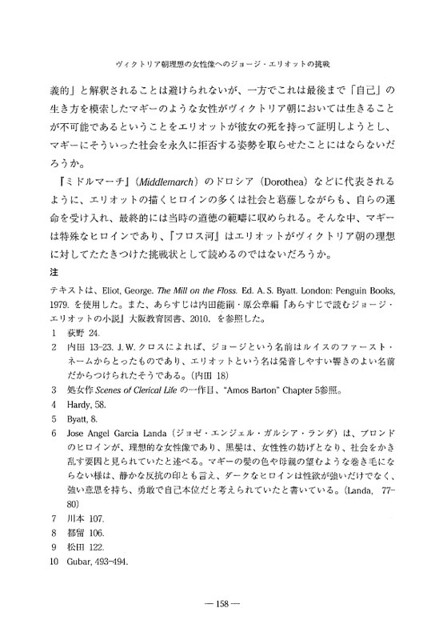
Yoshimura, Eri. (Kobe College).
ヴィクトリア朝理想の女性像へのジョージ・エリオットの挑戦--『フロス河の水車場』のマギーの場合 (特集ジェンダー平等への課題) [George Eliot's resistance to the Victorians' ideal woman:
Maggie Tulliver in The Mill on the Floss
— in Japanese]. 含英語文要旨[Women's Studies Forum, Kobe College] 25 (March 2011): 147-62.*
Hace más de 25 años escribí un artículo sobre The Mill on the Floss de George Eliot, y veo a través de Google Scholar que lleva adelante su mediocre carrerilla de artículo académico; además de aquí, lo citan otros cuatro autores, tres si consideramos que Kathleen Blake lo cita dos veces.
Blake, Kathleen. "Between
Economies in the Mill on the Floss: Loans Versus Gifts, or, Auditing Mr.
Tulliver's Accounts." Victorian
Literature and Culture 33.1 (2005): 219-237.
Sandler, Sergeiy. "The Kierkegaardian Sources of
Bakhtin's Philosophical Motivation." Fourteenth
International Bakhtin Conference 2011 (U of Bologna,4-8 July 2011).
Wen, Pi-ch'un. (Department
of Applied Foreign Languages, Nanya Institute of Technology). "Challenges,
Struggle, Compromise: A Sociological Reading of George Eliot's The Mill on the Floss." South Asian Journal
25 (2005). Taoyuan Tech Institutional
Repository (2011).
Teniendo en cuenta que la mayoría de los artículos académicos (la mayoría de los míos desde luego) nunca llega a citarlos nadie, muchas veces ni a leerlos... no lleva éste mala carrera. También apareció como un capítulo en esta colección de artículos sobre George Eliot:
From
The Oxford Companion to English
Literature, ed. Margaret Drabble.
Middlemarch:
A Study of Provincial Life, a novel by George Eliot, published
1871-2.
The scene is laid in the provincial town of Middlemarch, Loamshire,
during the years of the agitation immediately preceding the first
Reform Bill [1832]. It has a multiple plot, with several interlocking
sets of characters. Dorothea Brooke, an ardent, intelligent, idealistic
young woman, under the negligent though affordable care of her
eccentric uncle, marries the elderly pedant Mr Casaubon, despite the
doubts of her sister Celia, her neighbour and suitor Sir James Chettam
(who later marries Celia), and Mrs Cadwallader, the rector's outspoken
wife. The marriage proves intensely unhappy; Dorothea realizes during a
disastrous honeymoon in Rome that Casaubon's scholarly plan to write a
great work, a 'Key to all Mythologies', are doomed, as are her own
aspirations to share and aid her husband's intellectual life, and her
respect for him gradually turns to pity. She is sustained by the
friendship of Casaubon's young cousin Will Ladislaw, a lively,
light-hearted, goodnatured young man, detested by Casaubon, who begins
to suspect that Dorothea's feelings for Ladislaw are questionable; his
irritation is increased by the fact that he fears he has acted justly
but not generously by his impoverished kinsman. Shortly before he
dies,with characteristic meanness, he adds a codicil to his will by
which Dorothea forfeits her fortune if she marries Ladislaw.
Meanwhile other threads have been added to the remarkably broad canvas
of the novel. We follow the fortunes of Fred and Rosamund Vincy, son
and daughter of the mayor of Middlemarch; the extrovert Fred,
unsuitably destined to be a clergyman, is in love with his childhood
sweetheart Mary Garth, a practical, shrewd young woman, daughter of
Caleb Garth, a land agent. Mary, who at the opening of the novel is
nursing her disagreeable and aged realtive Mr Featherstone, will not
pledge herself to Fred unless he abandons his father's plan for him to
enter the Church , and proves himself stable and self-sufficient.
Rosamund, the town's beauty, sets herself to capture the ambitious,
idealistic, and well-connected doctor Tertius Lydgate; she succeeds,
and their marriage, wrecked by her selfishness, insensitivity, and
materialism, proves as unhappy as the Casaubons'. Lydgate finds himself
heavily in debt, and and against his better judgement borrows money
from Mr Bulstrode, the mayor's brother-in-law, a religious hypocrite;
Lydgate's career is ruined when he finds himself in a scandal
concerning the death of Raffles, an unwelcome visitor from Bulstrode's
shady past. Only Dorothea, now widowed, maintains faith in him, but she
is severly shocked to find Ladislaw and Rosamund together in what seem
to be compromising circumstances. Rosamund finally rises above
self-interest to reveal that Ladislaw has remained faithful to the
memory of Dorothea, though with no prospect of any happy outcome.
Dorothea and Ladislow at last confess their love to one another; she
renounces Casaubon's fortune and marries him. Fred, partly sobered by
the spectacle of Lydgate's decline, and encouraged by Caleb Garth to
enter his own prfoession, marries Mary, Lydgate is condemned to a
successful and fashionable practice and dies at 50, his ambitions
frustrated.
Through the histories of these characters, George Eliot analyses and
comments upon the social and political upheavals of the period,
contrasting the stauch Tory attitudes of Chettam and the Cadwalladers
with the growing demand for Reform, somewhat unsatisfactorily espoused
by Mr Brooke, more satisfactorily by Ladislaw, awho in the last chapter
becomes 'an ardent public man' and a member of Parliament, with
Dorothea's support. The importance of marital loyalty is also widely
illustrated, not least in Mrs Bulstrode's support of her husband in his
disgrace.
George Eliot's reputation reached its height with Middlemarch, despite some
complaints that the action was slow or the tone didactic; H. James
found faults in its organization, but concluded, 'It sets a limit . . .
to the development of the old-fashioned English novel' (1874). Its
status as one of the greatest works of English fiction was confirmed by
Leavis (The Great Tradition,
1948), despite his doubts about the indulgent portrayal of Dorothea.
Middlemarch. Dir Anthony Page,
Screenplay by Andrew Davies, based on George Eliot's novel. Cast: Rufus
Sewell, Jonathan Firth, Juliet Aubrey, Robert Hardy, Peter Jeffrey,
Caroline Harker. Prod, Louis Marks, BBC, 1994. Online at YouTube
(LadyLewly): http://www.youtube.com/playlist?list=PL27D3BC341FBEE65E&feature=plcp
2012 DISCONTINUED
Mary Ann Evans, born in 1819 in Warwickshire,
a keen
student, gave herself a varied education, frequented the centres of
advanced thought, translated the Leben
Jesu of Strauss (1846), the Essence
of Christianity of Feuerbach (1854); contributed to the Westminster Review,
knew Spencer, and Lewes whose life she shared and who encouraged her to
write works of imagination. She published, under the name of George
Eliot, novels: Scenes of Clerical
Life (in Blackwood's Magazine,
1857; in a volume, 1858), which had a great success; Adam Bede, 1859; The Mill on the Floss, 1860; Silas Marner, 1861; Romola, 1863; Felix Holt the Radical, 1866; Middlemarch, 1871-2; Daniel Deronda, 1876;
poems: The Spanish Gypsy,
1868; The Legend of Jubal,
etc., 1874; essays, The Impressions
of Theophrastus Such,
1879, etc. After the death of Lewes (1878), she married J. W. Cross,
and died the same year, 1880. Her correspondence was utilized by her
husband for her biography (Life and
Letters, 1885), Works,
Warwick ed., 1901-3. See study by M. Blind, 1883; Cooke, 1883; C.
Thomson, 1901; L. Stephen, (English Men of Letters), 1902; Olcott,
1911; Gardner (Inner Life of George
Eliot), 1912; Deakin (Early
Life of George Eliot), 1913; M. L. Cazamian (Le Roman et les Idées en Angleterre),
1923; S. Pfeiffer, George Eliots
Beziehungen zu Deutschland, 1925; E. S. Haldane, George Eliot and Her Times, 1927;
A. Paterson, George Eliot's Family
Life and Letters, 1928.
_______
George Eliot:
A Scandalous Life. A BBC documentary (2002).
George Eliot (Mary Ann, later
Marian, Evans) (1819-80), the youngest surviving child of Robert Evans,
agent for an estate in Warwickshire. In her girlhood she was
particularly close to her brother Isaac, from whom she was later
estranged. At school she became a convert to evangelicalism; she was
freed from this by the influence of Charles Bray, a freethinking
Coventry manufacturer (a development which temporarily alienated her
father), but remained strongly influenced by religious concepts of love
and duty; her works contain many affectionate portraits of Dissenters
and clergymen. She pursued her education rigorously, reading widely,
and devoted herself to completing a translation of Strauss's Life of Jesus, which appeared
without her name in 1846. In 1850 she met J. Chapman, and became a
contributor to the Westminster
Review;
she moved to 142 Strand, London, in 1851, as a paying guest in the
Chapmans' home, where her emotional attachment to him proved an
embarrassment. She became assistant editor to the Westminster Review
in 1851, and in the same year met Spencer, for whom she also developed
strong feelings, which were not reciprocated, though the two remained
friends. In 1854 she published a translation of Feuerbach's Essence of Christianity;
she endorsed his view that religious belief is an imaginative necessity
for man and a projection of his interest in his own species, a
heterodoxy of which the readers of her novels only gradually became
aware. At about the same time she joined G. H. Lewes in a union without
legal form (he was already married) that lasted until his death; they
travelled to the Continent that year and set up house together on their
return. He was to be a constant support throughout her working life and
their relationship, although its irregularity caused her much anxiety,
was gradually accepted by their friends. 'The Sad Fortunes of the
Reverend Amos Barton', the first of the Scenes of Clerical Life, appeared in Blackwood's Magazine
in 1857, followed by 'Mr. Gilfil's Love Story' and 'Janet's
Repentance'; these at once attracted praise for their domestic realism,
pathos, and humour, and speculation about the identity of 'George
Eliot', who was widely supposed to be a clergyman or possibly a
clergyman's wife. She began Adam Bede
(1859) in 1858; it was received with great enthusiasm and at once
established her as a leading novelist. The Mill on the Floss appeared in
1860 and Silas Marner in
1861. In 1860 she visited Florence, where she conceived the idea of Romola, and returned to do further
research in 1861; it was published in the Cornhill
in 1862-3. John Blackwood, son of William Blackwood, was unable to meet
her terms; by this time she was earning a considerable income from her
work. Felix Holt, the Radical
appeared in 1866. She travelled in Spain in 1867, and her dramatic poem
The Spanish Gypsy (conceived
on an earlier visit to Italy, and inspired by Tintoretto) appeared in
1868. Middlemarchwas published in instalments in 1871-2 and Daniel Deronda, her
last great novel, in the sameway in 1874-6. She was now at the height
of her fame, and widely recognized as the greatest living English
novelist, admired by readers as diverse as Turgenev, H. James and Queen
Victoria. In 1878 Lewes died. Her Impressions
of Theophrastus Such
appeared in 1879, and in 1880 she married the 40-year-old John Walter
Cross, whom she had met in Rome in 1869 and who had become her
financial adviser. The marriage distressed many of her friends, but
brought the reconciliation of af a congratulatory note from her brother
Isaac, who had not communicated with her since 1857. She died seven
months later.
After her death her reputation declined somewhat, and L. Stephen
indicated much of the growing reaction in an obituary notice (1881)
which praised the 'charm' and autobiographical elements of the earlier
works, but found the later novels painful and excessively reflective.
V. Woolf defended her in an essay (1919) which declared Middlemarch
to be 'one of the few English novels written for grown-up people', but
critics like David Cecil and Oliver Elton continued to emphasize the
division between her creative powers and supposedly damaging intellect.
In the late 1940s a new generation of critics, led by Leavis (The Great Tradition,
1948), introduced a new respect for and understanding of her mature
works; Leavis praises her 'traditional moral sensibility', her
'luminous intelligence', and concludes that she 'is not as
transcendently great as Tolstoy, but she is great, and great in the same
way'.
As well as the novels for which she is remembered, she wrote various
poems, including 'O may I join the choir invisible' (1867), 'Agatha'
(1869), Brother and Sister
(1869), a sonnet sequence recalling her happy childhood, 'The Legend of
Jubal' (1870), and 'Armgart' (1871), also the short stories 'The Lifted
Veil' (1859) and 'Brother Jacob' (1864). Her letters and journals were
edited by Cross (3 vols., 1885); her complete letters were edited by G.
S. Haight (9 vols., 1954-78), who also wrote a life (1968). A Writer's Notebook 1854-1879 and Uncollected Writings were edited by
Joseph Wiesenfarth (1981). See also George
Eliot: A Life by Rosemary Ashton (1996).
George Eliot
By Louis Cazamian, from A History of English Literature
(1937):
George Eliot is a writer whose fame is
menaced. She is a victim of the
discredit which opinion to-day throws upon her generation, and which
will pass with time. Graver, however, are the reasons for disfavour
which concern her personality. The upholders of tradition have never
forgiven her bold ventures in philosophic thought, nor excused that act
in her life which, though it agreed with the ethics of the heart,
jarred with the principles admitted by custom. Critical spirits, or
lovers of pure art, are not without resenting either the moderation of
her thought, or the weightiness which her intellectuallity often gives
her prose. Some have always looked upon her with mistrust, while many
would be tempted to think that she was too prudent in her opinions.
Even among her admirers, there are few who do not find in her work a
faint suspicion of heaviness. In the study of her novels, therefore,
one must keep oneself immune from a prejudiced hostility which,
undoubtedly, is unjust, and at the same time not be influenced by the
intemperate zeal which might be aroused by the feeling that one was
pleading a cause.
It is perhaps best to divide her work in two parts. There is no
question of leaving the first entirely aside, altough very probably
much of it must be given up. George Eliot had of necessity to pay for
the crisis which brought about her emancipation, which raised her from
the status of a young country girl to be the equal of the most
scholarly minds of the time, and transformed the daughter of Puritan
parents into a pupil of Spencer and Comte. Her independence, won after
a long and strenuous struggle, was to leave its mark upon her for life.
It gave her a taste for discussion, awakened the desire in her to
explain her own conduct, or that of the beings she created, in the most
explicit and logical manner; it inspired her with the familiar love and
respect of formulated principles. All the intellectuality and fondness
for reasoning which seemed to be part and parcel of her very being,
deprived or tended to deprive her of a certain happy spontaneity,
afforded her less scope for the play of instinct, and made purely
artistic creation less natural to her, while rendering more natural the
painstaking efforts of artificial labour. Since her vocation was to
write, and to be a novelist, she did much during the first thirty years
of her life to direct what was to be her gift of invention towards
lucid and dry forms of expression.
Although her imaginative resources were thus impoverished, she gained
in other respects. There is always a strengthening virtue in the
conquest of one's own personality. The moral nobility of her inner
development with its honesty of purpose, its courageous determination,
not only lent a deeper spiritual quality to her thought, but imparted
to all that she wrote a fragance of ardent sincerity which compensates
for many failings of her aesthetic judgment.
Thus it can be said that her realism was conscious and systematic; all
the gifts of her intellectual culture contributed to it, while in it
the influence of science,which she had thoroughly imbibed, is
everywhere manifest. She had made a study of history as of exegesis;
she was acquainted with the psychology of the Utilitarians, and had
accepted the doctrine of evolution as soon as it was first explained.
As an inevitable result of the mental discipline of her youth, she felt
the need of precision and objectivity, and dwelt upon the idea that any
object of study, no matter what it be, has its own infinite value. The
construction of her novels, the substance of her analyses, and much of
her imagery, recall this scientific schooling of her thought. But
realism to her is much more than a mere method, or even an intellectual
necessity; it is an emotion and a creed, and this she has explained
with perfect clearness. All the modest virtues and vices of humble
folks, hover mediocre or ill-favoured they may be, become attractively
interesting to her, and the source of this interest is love. Her words
ring with the supreme appeal of a common brotherhood and common
sufferings, and whatever stress she may lay on the solidarity between
men which nature enforces and which intelligence comes to recognize,
her ethical beliefs spring from that spontaneous gift of the heart:
sympathy.
It is no easy task, therefore, to divide what is fresh and natural in
her work from what remains dry and lifeless, or rather to distinguish
between the causes which give rise to these conflicting elements.
Besides, they are often combined. The most barren wastes in her prose
are not without some oases, just as the vistas of refreshing green are
broken by flat stretches of stony dreariness. But, upon the whole, a
great number of her arguments, of her intentions, and most of the
expressions which these naturally called forth, are more directly
related, no doubt, to dialectics than to poetry, in the sense in which
every artist is a poet. The bare framework of her ideas is often too
much in evidence; not infrequently, the situations and characters allow
the reader a glimpse of the inner architecture which backs and supports
them; and her style, through many a page, through whole chapters and
episodes, has the indefinable quality that suggests a lesson in
psychology, ethics, or history.
The value of the philosophy imparted in the deliberate teaching of
George Eliot's novels, and the literary intentions which she enunciates
most openly, have and will retain their particular merit, even if we
prefer to find in other parts of her work its most precious assets iand
its most vital interest. In Adam Bede
she expounds the doctrine granting each of us the initiative which
works out our moral and religious destiny; The Mill on the Floss is devoted
to a study of the collaboration of character with circumstances in the
fulfilment of fate: Silas Marner
treats of all the hidden forces which shape man's personality through
the contact of his fellows; the subject of Felix Holt
is the prominent part played by the education of the individual in any
matter dealing with social reform, etc. Such are the main themes of the
novels; but there are others which form, so to speak, the background,
and which are really of deeper significance as well as more
substantial; the interdependence of all human beings; the intricate
workings of consequence which propagate the influence of a given act,
for good or for evil, beyond our visible horizon, in ever-widening
circles; and more esspecially, the pathetic quality of the most common
human emotions.
All this, undoubtedly, has its value. But this doctrine is not
transmuted completely enough into the silent preconceptions of creative
imagination itself; it is not sufficiently dissolved into the plastic
elements of her art; it remains a doctrine, asserting and expressing
itself as such. And it is just in these avowed assertions that the
weakness of George Eliot's work is to be found. Similarly, the laboured
exertions of her will have added no supreme achievement to her
fictions. The scholarly historical setting of Romola may be estimable, but it
leaves us cold; Daniel Deronda
is a strong but unsuccessful attempt, because it is almost entirely
artificial. Even in the most vigorous and spontaneous among her novels,
there are passages, and features, which explain these partial failures.
The other part of her work bears the stamp of true imagination. It is
no less rich in persuasive ideas, for it breathes the communicative
ardour of fraternal sympathy, the keen and kindly perception of the
inner life of souls, and a powerful sense of that hard-won heroic
virtue, to the height of which we all have, some time or other, to
rise. All the doctrine of George Eliot is here, implied in the very
facts of her stories. But at the same time it allows of artistic
creation, and even expresses itself through it. The touching Scenes of Clerical Life, almost the
whole of Adam Bede, much of Silas Marner, the main part of The Mill on the Floss and Middlemarch, belong to this order
of spontaneous and concrete invention. It is more than enough to
guarantee the fame of a great writer.
For in works such as these there is a livening and animating force at
the base of the writer's art. From her experience of life, from her
knowledge of self, or from an intuitive revelation, she draws the
material for an imaginary world, which has in it the essence of
reality. And this world is ample enough to allow for all possible
contrasts, and call forth smiling amusement as well as loving
compassion; it can even arouse a feeling of angry irony. The humour of
George Eliot is not the least of her qualities; it is a salutary and
pleasing element, which introduces an invigorating freshness into her
prose. More often of a tender, playful, even delicate nature, it grows
satirical at times, and acquires then a sharp edge which contradicts,
as in the portrait of the Dodsons
(The Mill on the Floss) the general lesson of symphathy; but
none among her readers will object to this. The study of Mrs. Poyser in
Adam Bede is an unalloyed
source of joy; in Silas Marner
there are lively scenes of rural realism.
The world in which the imagination of George Eliot finds itself at
greatest ease is that of the provinces, the home of her early years;
and, no doubt, her creative faculty is not to the same degree dramatic;
she is essentially a revealer of self. But the beings she creates
represent, as it were, imaginary aspects or developments of her ego,
and acquire the quality of truth by reason of this vital bond. Some are
women, such as Dinah Morris (Adam
Bede) and Dorothea (Middlemarch),
some are men, as Amos Barton, Silas Marner, and Philip Wakem (The Mill on the Floss), but it is
plain that they take after the authoress herself, and that her
personality passes into them all.
Once, however, she has taken herself as the direct object of study, and
created her masterpiece in Maggie Tulliver (The Mill on the Floss).
The first two hundred pages of this novel are, probably, the most
nearly perfect she has written; for the faithful evocation of scenic
detail as well as of manners, and the astonishing acccuracy of the
psychology, are the outcome of an immediate and infallible impulse,
translating into words the ever-present wisdom of the past.
From Scenes of Clerical Life
to Middlemarch,
George Eliot is an incomparable painter of the lower circles of English
provincial life, and of a whole order of souls who, simple as social
values go, are nevertheless spirtually complex, torn by scruples, and
by the anguish of moral conflicts. In this sphere, her art derives its
value from its truth as much as from the emotional interest it creates,
and indissolubly from both.
No doubt she was aware of this, or, at the end, she recognized it. Her
intellectual zeal, and already cautious and open to all human feelings
during the years of her ardent youth, grew still more tempred, gentle,
modest, and tender in the course of her life. She preserved the
religion of truth without retaining its dogmatism. The philosophy of The Mill on the Floss left ample
scope to what is inexplicable, to the hazards which cannot be avoided
by every upright and sincere thinker. In Middlemarch,
the psychology tends more clearly towards an intuitive idea of mind and
consciousness. Her most powerful novel, even if it is not the most
inspired or the most harmoniously constructed, is the last in which the
activity of her courageous, ever-moving mind has been expressed in
terms of scenes and figures familiar to herself, and thus endowed with
artistic reality.
To be consulted: E. Bouvier, La
Bataille réaliste, 1914; Brunetière, Le Roman naturaliste, 1884; Cambridge History of English Literature,
vol. xiii, Chaps. IX, X, XII; M. L. Cazamian, Roman et Idées en Angleterre, 1923;
J. W. Cross, Life and Letters of
George Eliot, 1885; W. L. Cross, The Development of the English Novel,
1899; David Sauvageot, Le Réalisme
et le Naturalisme dans la littérature et l'art, 1890; Elton, Survey of English Literature, 1830-80,
1920; R. Las Vergnas, W. M.
Thackeray, etc., 1932; Phelps, Advance
of the English Novel, 1919; Philips, Dickens, Reade, Collins, Sensation
Novelists, 1919; F. T. Russell, Satire in the Victorian Novel, 1920;
Sadleir, Excursions in Victorian
Bibliography, 1922; Saintsbury, Trollope Revisited, 1920; Walker, The Literature of the Victorian Era,
1910.
_____
From The Oxford Companion to English Literature:
Adam Bede, a novel by George Eliot, published 1859.
The plot was suggested by a story told to George Eliot by her Methodist
aunt Elizabeth Evans of a confession of child-murder made to her by a
girl in prison. The action takes place at the close of the eighteenth
cent. Hetty Sorrel, pretty, vain, and self-centred, is the niece of the
genial farmer Martin Poyser of Hall Farm. She is loved by Adam Bede,
the village carpenter, a young man of dignity and character, but is
deluded by the attentions of the young squire, Arthur Donnithorne, and
is seduced by him, in spite of Adam's efforts to save her. Arthur
breaks off relations with her, and Hetty, broken-hearted, agrees to
marry Adam. But before the marriage she discovers she is pregnant,
flies from home to seek Arthur, fails to find him, is arrested and
convicted of infanticide, and saved from the gallows at the last
moment, her sentence commuted to transportation through Arthur's
intervention. In prison she is comforted by her cousin Dinah Morris, a
Methodist preacher, whose strong, serious, and calm nature is
contrasted with hers throughout the novel. In the last chapters, Adam
discovers that Dinah loves him; his brother Seth, who had long and
hopelessly loved Dinah, resigns her to him, with a fine unselfishness.
The novel was immediately acclaimed for its realism, for its
picturesque portrayal of rural life, and for its humour; Mrs Poyser was
greeted as a comic creation on the level of Dickens's Sam Weller and
Mrs Gamp. Some critics objected on its insistence on the 'startling
horrors of rustic reality' (Saturday Review) and its 'obstetric' details. H. James in 1866 found Hetty Sorrel 'the most successful' of George Eliot's female figures.
The Mill on the Floss,a novel by George Eliot, published 1860.
Tom and Maggie, the principal characters, are the children of the
honest but ignorant and obstinate Mr Tulliver, the miller of Dorlcote
Mill on the Floss. Tom is a prosaic youth, narrow of imagination and
intellect, animated by conscious rectitude and a disposition to control
others. Maggie in contrast is highly strung, intelligent, emotional,
and, as a child, rebellious. From this conflict of temperaments, and
from Maggie's frustrated sense of purpose, spring much of her
unhappiness and the ultimate tragedy. Her deep love of her brother is
thwarted by his lack of understanding, and she turns to Philip Wakem,
the deformed son of a neighbouring lawyer, for intellectual and
emotional companionship. Unfortunately lawyer Wakem is the object of Mr
Tulliver's suspicion and dislike, which develop into hatred when
Tulliver is made bankrupt as a result of litigation in which Wakem is
on the other side. Tom, loyal to his father, discovers the secret
friendship of Maggie and Philip, and forbids their meetings: Maggie
reluctantly complies. After Mr Tulliver's death, accelerated by a scene
of violence in which he thrashes the lawyer, Maggie leaves the mill for
a vist at St Ogg's to her cousin Lucy Deane, who is to marry the
handsome and agreeable Stephen Guest. Stephen, though loyal in
intention to Lucy, is attracted by Maggie, and she by him. A boating
expedition on the river leads, partly by Stephen's design, partly by
accident, to Maggie's being irremediably compromised; Stephen implores
her to marry him, but she refuses. Her brother turns her out of the
house, and the society of St Ogg's ostracizes her. She and her mother
take refuge with the loyal friend of her childhood, the packman Bob
Jakins. Only Lucy, Philip, and the clergyman Dr Kenn show sympathy. The
situation seems without issue, but in the last chapter a flood descends
upon the town, and Maggie, whose first thought is her brother's safety,
courageously rescues him from the mill. There is a moment of
recognition and reconciliation before the boat overturns, and both,
locked in a final embrace, are drowned.
The portrayal of childhood, of rural life, and the subsidiary
characters of Mrs Tulliver's sisters, the strong-minded Mrs Glegg and
the melancholy Mrs Pullett, with their respective spouses, delighted
most critics, though the book was felt to lack the charm of Adam Bede;
Maggie's lapse into passion, the character of the lightweight Stephen,
and the arbitrary tragedy of the denouement enraged others. It remains,
however, one of the most widely read of her works.
Romola,a novel by George Eliot, published 1863.
The background of the novel is Florence at the end of the 15th century,
the troubled period, following the expulsion of the Medici, of the
expedition of Charles VIII, distracted counsels in the city, the
excitement caused by the preaching of Savonarola, and acute division
between the popular party and the support of the Medici. The various
historical figures, including Charles VIII, Machiavelli, and Savonarola
himself, are drawn with great care, as well as the whole picturesque
complexion of the city, through the novel is generally held to be
overloaded with detail, and has never been one of her most admired. The
story is that of the purification by trials of the noble-natured
Romola, devoted daughter of an old blind scholar. Into their lives
comes a clever, adaptable young Greek, Tito Melema, whose
self-indulgence develops into utter perfidy. He robs, and abandons in
imprisonment, the benefactor of his childhood, Baldassare. He cruelly
goes through a mock marriage ceremony with the innocent little
contadina Tessa. After marrying Romola he wounds her deepest feelings
by betraying her father's solemn trust. He plays a double game in the
political intrigues of the day. Nemesis pursues and at last overtakes
him in the person of old Baldassare, who escapes from imprisonment
crazed with sorrow and suffering. Romola, with her love for her husband
turned to contempt, and her trust in Savonarola destroyed by his
falling away from his high prophetic mission, is left in isolation,
from which she is rescued by the discovery of her duty in
self-sacrifice. The novel was illustrated by Leighton, much to George
Eliot's satisfaction.
Otro artículo más subo hoy a la red, en el protracted hanging
de mis Obras Completas. El de hoy lo publiqué hace veinte años en una
revista de Illinois, y me lo pidieron para reimpresión en un volumen de
Palgrave Macmillan sobre George Eliot. Ahora va a la web, por
donde no había pasado aún, y eso que se inventó a la vez que él más o
menos. Se titula"The Chains of
Semiosis: Semiotics, Marxism, and the Female Stereotypes in The Mill on the Floss"—y
sus palabras clave podrían ser George
Eliot, estereotipos femeninos,
intertextualidad, semiótica, Bajtín, Voloshinov, Charles S. Peirce,
materialismo
cultural... etc. Aquí
está en Academia, y aquí en
el Social Science Research Network. Donde pronto la incluyen en el English and Commonwealth Literature eJournal, fecha 21 Jul. 2010. (Aquí en Zaguán). Recomiendo además la
lectura de la obra de George Eliot que analizo allí, The Mill on the Floss, excelente novelón
victoriano. _______ Observo por cierto que en Academia se han "bloguificado", y que ahora
aparecen en primera página, al menos para tus contactos tus cambios de
status o "qué estás haciendo ahora"—como en Facebook— y que los
artículos han pasado a ordenarse inversamente, el más reciente primero
(una sugerencia que les hice ya hace tiempo y que me dijeron que iban a
aplicar).