Mostrando entradas con la etiqueta Pope. Mostrar todas las entradas

jueves, 25 de noviembre de 2021

Pope and the Scriblerians


Bragg, Melvyn, et al. "The Scriblerus Club." BBC4 (In Our Time) 9 June 2005.*

         http://www.bbc.co.uk/programmes/p003k9cm

         2014

_____. "Pope." BBC4 (In Our Time) 9 Nov. 2006.*

         https://www.bbc.co.uk/programmes/p0038x97

         2021


A lecture on Pope's Essay on Criticism:


miércoles, 18 de octubre de 2017

Retropost #1829 (18 de octubre de 2007): Peri bloghous

Martinus Scribloguerus, Peri Bloghous

Publicado en Blogs. com. José Ángel García Landa

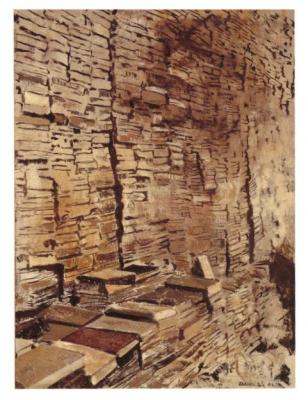
20071018173552-libros.jpg
El shock de las nuevas tecnologías de la palabra en la era de la impresión masiva, según Marshall McLuhan:


"A fines del siglo XVII se produjo una gran alarma y revulsión ante la creciente cantidad de libros impresos. Las primeras esperanzas acerca de una gran reforma del hombre por medio del libro habían quedado chasquedas, y en 1680 escribía Leibniz: (….) "al final, el desorden se hará casi insuperable" (La Galaxia Gutenberg 382).

Es la época de la Batalla de los Libros de Swift, y de la pugna entre los antiguos y los modernos. El prefacio de Leibniz a su opúsculo podría modificarse, trayéndolo por analogía a la proliferación actual de publicaciones electrónicas evanescentes y despreciadas:

"Me temo que continuaremos durante mucho tiempo en nuestro actual estado de confusión y miseria, por nuestra propia culpa. Temo, incluso, que tras haber agotado inútilmente nuestra curiosidad sin obtener en nuestras investigaciones ninguna ventaja apreciable para nuestra felicidad, las gentes lleguen a sentir disgusto por las ciencias y que una desesperación fatal pueda determinar la vuelta a la barbarie. A este resultado puede contribuir mucho esa terrible masa de blogs que continúa aumentando. Porque, al final, el desorden se hará casi insuperable; la infinita multitud de autores pronto los expondrá a todos al peligro del olvido universal; el afán de gloria que anima a muchos que se dedican al estudio, cesará súbitamente; quizá ser escritor llegue a ser considerado tan deshonroso como antes honorable. En el mejor de los casos, podremos distraernos con pequeños blogs del momento, que durarán algunos años, y que servirán para distraer al lector del tedio de unos cuantos minutos, pero que habrán sido escritos sin propósito alguno de enriquecer nuestros conocimientos o de merecer el aprecio de la posteridad. Se me dirá que, por ser tantos los que escriben, es imposible que se conserven todas sus obras. Admito esto, y no desapruebo por completo esos pequeños blogs de moda, que son como las flores de una primavera o como los frutos de un otoño, que apenas duran un año. Si están bien hechos, producen el efecto de una conversación útil, no simplemente agradable, y que mantiene al ocioso alejado de la conducta reprobable, formando su espíritu y su lenguaje. Frecuentemente, su propósito es inducir algún bien a los hombres de nuestro tiempo, y éste es el fin que busco publicando este pequeño trabajo." (Selections from Leibniz, ed. Philip P. Wiener, NY: Scribners, 1951, 29-30, cit. en McLuhan, La Galaxia Gutenberg 382).

Un temor paralelo y más acusado reconoce McLuhan en La Pedantíada de Pope, con su conclusión apocalíptica:

"Por medio de la acción aglomerada de muchas de tales víctimas del conocimiento aplicado—esto es, autores engreídos, dotados de industria y capacidad pare el tráfago—asistimos ahora a la restauración del reino del Caos y de la Noche antigua, y al traslado del trono imperial de la Estupidez, su hija, desde la Ciudad al mundo Civilizado." (McLuhan 385).

Tal es la alarma que despierta la proliferación de texto en la era de la Reproducción Mecánica, ahora o hace trescientos años…

Bueno, los textos primera oleada de "escrituras" electrónicas (la  radio, el cine y la televisión) aún eran más evanescentes que los blogs, pero algo van rescatando los archivos, filmotecas y YouTube. Y por su parte las prensas siguen activas y aceleradas; los bestsellers no dejan de bestellear. La audiencia de esta marea del libros y blogs sigue la lógica de la cola larga: casi todo el mundo habrá leído algunas cosas, y en cambio la infinita cola de lo poco demandado sólo tiene un lector: su autor. Que algunos buenistas dirán: "es tan digno y valioso como el primero". Será proporcionalmente.

En suma, la Web, y en concreto la autopublicación en red, o sea, los blogs, parecen potenciar los efectos de la imprenta—que a su vez potenció los de la alfabetización, según describe McLuhan. La blogosfera es el estallido como supernova de la Galaxia Gutenberg (en absoluto su desaparición), y a ella se aplica también, exponencialmente desarrollada, la dinámica del Lado Oscuro de la imprenta:

"La imprenta, con su uniformidad, su capacidad repetitiva y su extensión sin límites, da nueva vida y fama a cualquier cosa que sea. Esa especie de vida lánguida, conferida por mentes estúpidas a temas estúpidos, penetra de un modo formalista toda la existencia. Puesto que los lectores son tan vanidosos como los autores, se perecen por ver el conglomerado de sus propios viajes, y exigen por tanto a los espíritus más estúpidos que se esfuercen aún en mayor grado a medida que aumenta el público colectivo. El periódico de 'interés humano' es la útima manifestación de esta dinámica colectiva" (McLuhan, La Galaxia Gutenberg 389).

Eso, claro, hasta que salió el blog personal, o periódico de interés humano autoeditado por su propio público (hypocrite lecteur, mon semblable, mon frère).


—oOo—

sábado, 5 de noviembre de 2016

Pope and his elder contemporaries in verse


From A Short History of English Literature (1907), by George Saintsbury (The Augustan Ages, ch. 5).

Divisions of eighteenth-century verse — Pope: his life — His work — His character — His poetry — His couplet and paragraph — His phrase — His subjects — Garth — Blackmore —Congreve, etc. — Prior —His metrical imporatance — Young — Parnell — Lady Winchilsea

Divisions of eighteenth-century verse

THE poetry of the eighteenth century can be classified with a completeness and a convenience uncommon in literary periods. In the first division we see the complete triumph of the "classical" and "correct," or conventional, ideal at once exemplified and achieved in the work of Pope. This is followed by a rather longer period, in which the dominant poetry—the kind of verse admired and praised by almost all the vulgar and a few of the elect—is imitation of Pope, tempered more or less by that of Dryden. But side by side with both these (and even at the very earliest represented by Lady Winchilsea and one or two others) there is a party of mostly unintentional revolt which first, as represented by Thomson, reverts to nature in observation, but generalises still in expression; then, as presented by Gray, while not neglecting nature, changes all the sources of its literary inspiration, seeking them always farther back and wider. In respect of form the two first schools are almost wholly busied, except in light and occasional verse, with the couplet; while the third, in its endeavour not to be conventional, takes refuge in blank verse and stanza-form. In the present chapter we shall have to do with the first, and one or two belated or precocious members of the third. The second and the main body of the third will occupy us in the next Book.

Pope: his life.


NOTE 1. The standard library edition of Pope is that of Elwin and Courthope, with an exhaustive Life by the latter, 11 vols., London, 1870-89. The "Globe" edition of the Poems, by A W. Ward, is exceptionally valuable.

Alexander Pope (NOTE 1) —within certain narrow but impregnable limits one of the greatest masters of poetic form that the world has ever seen, and a considerable, though sometimes over-rated, satirist—was born in London in 1688, of a respectable tradesman's family. His parents were Roman Catholics, and Pope was rather badly educated in his early youth. From the time when his father moved to Binfield, on the outskirts of Windsor Forest, he seems to have educated himself. The bad health and physical deformity which marred his later life, and to which the disagreeable parts of his character have been traced, with a mixture of reason and charity, are said not to have been congenital. He wrote verse very early; but his extreme untruthfulness makes it very uncertain how much before the date of publication any particular piece was composed. Still, the dates of the Pastorals (1709), when he was twenty-one, of the Essay on Criticism, two years later, and of Windsor Forest, two years later still, establish beyond all question his early command of versification and expression. Even before the earliest of these dates Pope had been introduced to Wycherley and to Walsh, and through them he became acquainted with the rising prose lights of literature—Addison, Steele, and, above all, Swift. These (at least Swift) zealously furthered his scheme of translating the Iliad, which was started 1713, began to appear next year, and was finished in 1720. This, like the Odyssey, which followed, and a good deal of which was done by assistants (Fenton and Broome), was published by subscription, and the two brought Pope in not much less than £10,000, a sum which, at the rates of interest then prevailing, and with some paternal property, was enough to put him in affluence for the rest of his life. That life presents little history except a record of disease, publications, and quarrels. It was in 1718 that he established himself at Twickenham, which as headquarters he never afterwards left, and here he died in 1744.

His work.

The order of his later publications was as follows. The Rape of the Lock, published partially in 1712, reappeared during the time of his work on Homer in 1714. He produced an edition of Shakespeare, which could not well be good, in 1728. His satirical powers, which had already been exhibited in fragments, at last took the form of The Dunciad (1728-29) a violent attack on the minor writers of the day, with whom Pope fancied that he had the quarrel of Wit against Dulness, while he really had that of an exceedingly irritable poet against reviewers and, in some sense, rivals. Thereafter he fell into a course of half-moral, half-satirical writings—Epistle to Lord Burlington, Essay on Man, Imitations of Horace, Epistle to Arbuthnot, etc. (1730-1738), which, whether poetry or not, whether philosophy or not, are at any rate the most brilliant examples in English of one particular kind of verse and one particular kind of style. His last important work was an alteration and enlargement of The Dunciad (1742-43). Neither changes nor additions were by any means always improvements, but the finale of the complete poem is one of the very greatest things that Pope ever wrote, and one of his strongest titles to the name of poet.


His character.

That his claims to that name could be disputed probably never entered the head of any of his contemporaries save his personal foes, nor perhaps into the heart and conscience of any even of these. They were sufficiently numerous, and Pope amply deserved them. His faults, from their evident connection with a sort of childish weakness, invite, and have received, compassion; but to deny them is absurd. Nor were his virtues extremely conspicuous. He is credited with sincere affection for his friends. But there were no two men whom he loved and honoured more than Swift and Bolingbroke, and yet he could not resist playing upon both some underhand literary tricks to which he was more addicted than any great man of letters except his contemporary and analogue Voltaire. He lampooned Addison, who had perhaps given him a provocation of which a magnanimous person would have made nothing, while it very possibly had no existence except in his own morbid fancy; and though the lampoon, the "Character of Atticus," is magnificent literature and not quite unjust, it is all the baser ethically for its genius and its justice. He made violent and foolish love to Lady Mary Wortley Montagu, and being, or thinking himself, snubbed, revenged the snub with vulgar insults which the pen of no gentleman could ever have allowed to flow from it at any time, except that of the literary bravos of his old friend Wycherley's youth. Even his partisans have allowed a feeling of revolt at the venomous and snobbish delight with which he dwells at once on the poverty and the dinnerlessness of his Grub Street foes. He was stingy in entertaining (a very rare fault for his time); he had, with no motive to save, old tricks of writing on backs of letters and scraps of paper; he had many minor faults. Yet those of his friends with whom he did not quarrel never quarrelled with him, and it would be unfair to ask whether it was policy or generosity which made him invariably favourable to rising young men of letters—Thomson and Johnson are the great and sufficient, though by no means the only, examples who made their appearance in his time—provided only they did not join the real or imagined army of Diabolus in Grub Street. He was a very good son; his passion for Martha Blount—a passion which was not too well requited, though the object benefited by it most handsomely—seems to have been faithful and intense—and though troublesome to his inferiors and servants from his infirmities, he seems to have been liked by them.


His poetry.

But his character, save for its close connection with his work, matters very little; his literature matters very much. The greater jars of the conflict over the question "Was Pope a poet?" have mostly ceased. Hardly anybody now would dream of denying that he was a poet; very few would assert that he was one of the greatest kind. Some indeed have challenged for him the phrase "Return to nature" which has generally been applied to the revolters from him. The argument, which lacks neither ingenuity or plausibility, is that from the Elizabethan time to the Pindaric imitators of Cowley a non-natural exaggeration had been a curse, if not the curse, of English poetry, and that Pope finally abolished this. Unluckily, however, Cleveland had been dead for fifty years when Pope wrote; Dryden had "appealed to sense" long before he was born; and the prevalent faults of the time immediately preceding were not those of unnatural conceit. Even had it been otherwise, the nature to which he returned was, in all but one respect, a nature of prose, not of poetry. He did refine, to the utmost possible extent, one special kind of verse, and this—perhaps this only—establishes his claim to be a poet. Those who hold that though (to their sorrow) there may be verse without poetry, there cannot be poetry without verse, are not the least trusty guardians of Pope's position. He may be open to attack on other sides; here the defence may laugh at any assault.


His couplet and paragraph.

Pope's extraordinary mastery of a certain refinement on the Drydenian couplet, which, losing not a little strength and colour, and something of that portion of the poetic vague which Dryden retained, added an incomparable lightness and polish, seems to have been attained very early. In the Essay on Criticism it is nearly so advanced, if not quite as sure, as in the satires of thirty years later. The secret, so far as there is a single one, is the bold discarding of everything but the consideration of the couplet itself—triplets and Alexandrines, the enjambement which even Dryden sometimes permitted himself, and the structure of the paragraph by any other than sense-methods. This last is, of course, the important exception, and it speaks volumes for Pope's skill that he can, by means of the sense merely, connect together strings of couplets of which, by no means infrequently, each is complete in itself in rhythm as in meaning. But he sacrifices every attraction of form to the couplet—light, bright, glittering, varied in a manner almost impossible to account for, tipped ever with the neatest, smartest, sharpest rhyme, and volleying on the dazzled, though at times at times at any rate satiated, reader a sort of salvo of feux-d'artifice, skipping, crackling, scattering colour and sound all round and about him. If we take a paragraph of Milton's with one of Pope's, and compare the apparent variety of the constitutent stones of the one building with the apparent monotony of those of the other, the difference may be at first sight quite bewildering. One of Dryden's, between the two, will partly, though not entirely, solve the difficuty by showing how the law of the prose paragraph, that of meaning, is brought to supply the place of that of the pure poetic paragraph, the composition of sound and music.


His phrase.

Pope's other engine for attaining his effect was phraseology, in which he displays the same exquisite, though limited, perfection. Here, again, of the remoter and rarer graces of style there are none. Pope suggests little; no conjunction of his words causes the "wild surprise" given by the phrase of Chaucer, and by those of an unbroken succession from Spenser to Dryden. So also (in this point inferior to his friends Addison and Swift) he has little humour. But his wit is of the finest, and everything that he wishes to say, everything that comes within his purview as proper to be said, is expressed with unequalled propriety. It is impossible to improve on Pope; to get something better you must change the kind. Nor can there be much doubt that, in the negative as in the positive sides of this perfection, he is indebted to that process of conscious or unconscious conventionalising which all his time adored and which he brought to its acme. The individual and particular graces of the literature before and after his century give a nobler gust, but it is hit or miss with them. Pope's process—of extracting and representing the best thought within his compass in the best words that his own genius (still careful of the common) could achieve—is lower but surer. He cannot (or can but very rarely when transported by private passion, as in the the "Character of Atticus," or by the contagion of a greater genius, as in the conclusion of The Dunciad, which is Swift done into poetry) give the greatest things. But what he can give he gives quite unerringly; he is a secure and impeccable master of his own craft.


His subjects.

With so peculiar a genius as this (for it would be absurd to stint Pope to the word "talent," though some logical defense might be made for it) his subject could not but be of the greatest importance, while even his treatment of matters was necessarily conditioned by his knowledge. In the subjects of the Pastorals, of the Messiah, of Windsor Forest (NOTE 1) he was not really at home, and all these are in consequence mere pastiches—things immensely clever but no more. In the Essay on Criticism the subject itself was thoroughly congenial. Pope knew his own ideal of literature, could express that ideal critically as few could, and express it constructively as could no other man in the world. But he was a very bad judge of other styles and other ideals, and his knowledge of literary as of other history would have disgraced the meanest hack in his own fancied Grub Street. Consequently, here and wherever else he touches the subject, we get the most ridiculous statements of fact and the most absurd arguments based upon them, side by side with maxims and judgments worthy of almost any signature in sense, and expressed as no one but Pope could express them in form.


NOTE 1. Wordsworth, usually unjust to Pope, has been too generous to this poem. It gives literally nothing of the forest of the Thames Valley: a library and a poulterer's shop would furnish all its material.


And this difference holds throughout. The Iliad, for instance, a wonderful tour de force of literature, has long become merely a curiosity, because if we want Homer we either go to himself or to a translator who has some sense of him. The Elegy on an Unfortunate Lady and the Eloisa to Abelard, again, are both marred, though not ruined, by the prevalence of conventionalism in reference to subjects which, above all others, refuse and defy convention. But the Rape of the Lock, artificial as it is, is a perfect triumph of artifice, a piece with which no fault can be found except the frequency of the gradus-epithet, and in which the gradus-epithet is is excused by its suitableness to the persons and the manners handled.

Yet it is in his later Essay, his Epistles, his Satires, his Dunciad, that Pope's genius shows at its very greatest. They are no doubt mosaics—the "Atticus" passage was pretty certainly written twenty years before its insertion in the Epistle to Arbuthnot—but this is no defect in them. Their value for meaning varies accordingly as Pope was copying optimism from Bolingbroke, pessimism from Swift, and a very remarkable kind of orthodoxy from Warburton, or was giving expression to his own keen, though, alas! limited, observation of society, his personal feelings, and his narrow but clear theory of life and literature. Here he reigns triumphant. His philosophy may be always shallow and sometimes mere nonsense; his satire may lack the large Olympian sweep of Dryden; but he looked on society, and on humanity as that society happened for the time to express it, with an unclouded eye, and he expressed his views with a pen that never stumbled, never made slips of form, and always said the right thing in the right way, when we once accept scheme and time and man.

Pope, a young man at his beginnings but very precocious, began to be copied, or to be revolted from, with almost unexampled earliness; but the imitators and rebels may best be left for future treatment. We shall deal here with those of his contemporaries whom dates or other things excuse from the charge of being either, though some even of these may have felt his mighty influence. We have noted the poetical works of Swift and Addison under their names earlier; we may here take Garth, Blackmore, Prior, Congreve, Gay, Parnell, Young, a few minors, and—a friendly but, though she knew it not, deadly foe—Lady Winchilsea.


Garth.

Samuel Garth (NOTE 1), a strong Whig, but popular with both parties, and of very great repute as a physician, was born at Bolam in Durham as early as 1660, went to Cambridge (Peterhouse), where he remained till he took his M.D. in 1691, and spent the rest of his life practising in London. He was the friend, physician, and interrer of Dryden, was familiar with all the Queen Anne men, was knighted at George I.'s accesion, and died in 1718. Garth owes his place in English literature, which ought to be no mean one, to the fact that his poem The Dispensary was published in 1699, before Dryden's death, and that its versification makes advances on Dryden's own in Pope's direction. Its subject, a doctors' quarrel, does not give us much amusement now, though it has some interest in starting a long line of more or less similar poems on less or more unpromising subjects during the century. Garth followed it up many years later, after he had strengthened The Dispensary itself with some of its best parts, by a poem on Claremont, and translated some Ovid. But the help which he gave to the perfecting of the couplet in this form is his title to memory.

NOTE 1. Garth and Congreve, with all the writers that follow except Lady Winchilsea, are in Chalmers.


Blackmore.


The more notorious verse-writer, after Garth, of the interregnum between Pope and Dryden was the luckless Sir Richard Blackmore, one of the small and curious company who have been made immortal by their satirists. Born about 1650, at Corsham, in Wilts, he spent a long time at Oxford, and afterwards took his M. D. at Padua. He had a good practice, and the "Quack Maurus" of Dryden, whom he censured and who hit back, does not appear to have had any special justification. He seems to have begun to write verse to pass the time as he drove from patient to patient, and he published the long poems of Prince Arthur (1695), King Arthur (1697), Job (1700), Eliza (1705), and Creation (1712), besides essays, psalms, etc. He died in 1729, having been still more unmercifully ridiculed by the wits of the second generation. Creation (NOTE 2), however, was highly praised, not merely by Addison, to whom piety and Whiggery combined would have been an irresistible bribe, but by Johnson, to whom the second quality would have neutralised the first.  It is difficult for a reader of the present day to share their admiration. Creation supplies (as, for the matter of that, do the other poems, so far as the present writer knows them) tolerable rhetoric in verse occasionally not bad. But this is a different thing from poetry. Blackmore's couplets are often enjambed; and it seems (indeed he boasted of it) that he knew little of the popular poetry of his day.


NOTE 2. In Chalmers, vol. X.; the rest must be sought in the original.


Congreve, etc.

Congreve (NOTE 1) deserves such a niche as he has in purely poetical history as the producer of a few songs very much in the character of those mentioned earlier as the last product of the Cavalier muse, but with more of the order and neatness of the eighteenth century. He is sometimes impudent, but rarely, like the Dorsets and the Sedleys, merely coarse, and the note of the careless fine gentleman which he so much affected in his life does appear in his poems, especially by comparison with Prior, whom, though he falls far short of him in nature, tenderness, whimsical wit, and suspicion of higher and deeper feeling, he excels in that indescribable and sometimes denied, but quite real, quality called breeding. Ambrose Philips and Thomas Tickell were both friends of Addison and (whether of their own choice or as a result of Pope's irritable vanity is uncertain) enemies of Pope. The former—to be carefully distinguished from John Philips (1676-1708), author of the admirable Miltonic burlesque of the Splendid Shilling and of a good poem, or at least verse-essay, on Cider— was born in Leicestershire in 1671, and died in London in 1749. His short sentimental verses to children gained him from Carey (the author of "Sally in our alley") the nickname of "Namby-Pamby," which has passed into the language as a common epithet. Tickell, a Cumberland man and a fellow of Queen's College, Oxford (1676-1740), is chiefly remembered for two splendid couplet-elegies on Addison (whose devoted friend he was) and on Marlborough's lieutenant Cadogan. The majesty which this particular form could put on has seldom been better shown, except in the final lines of The Dunciad. But we must turn to men of more poetical substance.

Prior.

Matthew Prior (NOTE 1), the king of "verse of society" in English, was born near Wimborne in 1664, and was educated at Westminster, going thence to Cambridge, but to St. John's, not, as usual with his schoolfellows, to Trinity. He took his degree in 1686, and obtained a Fellowship, which he kept through life, and which kept him at some times of it. He wrote a bad parody of The Hind and the Panther in conjunction with Montague, afterwards Halifax, but did nothing else till he was of middle of age, though he enjoyed to the full the copious if transient stream of patronage of men of letters, which his coadjutor did much to set running. He was even Ambassador to France; was deeply engaged in the still obscure intrigues which just failed to seat James III. on the throne of England at his sister's death; is suspected of having turned king's evidence, but was imprisoned for some years. He had published poems in 1709, and issued another collection in splendid form after his liberation in 1718. He did not long survive this, and died in 1721. He was, though an intimate, somewhat of a detached intimate of the literary society of his time, and is said frankly to have preferred less distinguished associates.

NOTE 1.  In Chalmers, and common in editions from his own gorgeous folio downwards. Mr. Austin Dobson's Selected Poems of Prior ("Parchment Library," London, 1889) contains most things of much value but not all, the change of manners sometimes making Prior difficult to reproduce nowadays.

The works of Prior are rather numerous than voluminous, and they are very curiously assorted. The only pieces of any bulk are Alma, or The Progress of the Mind, and Solomon, or The Vanity of the World. The first, divided into three cantos, is an extremely fantastic, though, according to most (not all) critics, somewhat tedious poem in Hudibrastic verse, and quite openly imitating Butler in style as well as in metre. Although, however, the guise is burlesque, the subject-matter is by no means wholly so; and Prior, the lightness of whose best-known work has perhaps rather obscured the fact that he was a scholar and a man of no small reading, has put a good deal of thought as well as of learning in an ill-chosen fashion. Solomon, which is also in three divisions (here called "books"), is in heroic couplets of a rather Drydenian than Popian cast, with frequent Alexandrines. Here too the poem is much better worth reading than is usually thought; but the author's inability to be frankly serious again shows itself. His treatment of Vanity has neither the bitter quintessence of Swift, nor the solemn and sometimes really tragic declamation of Young, nor that intense conviction and ethical majesty which make Johnson's Vanity of Human Wishes almost a great poem, and beyond all question a great piece of literature. His next most important works in point of bulk are a handful of tales after the manner of La Fontaine, for which the rigid Johnson himself made a famous excuse, but which, though they contain some of their author's earliest and pleasantest writing, make their appearance not at all, or with considerable difficulty and adjustment, in modern volumes intended for general reading. Longer than these, indeed, are the Carmen Seculare, a dull Pindaric to William the Deliverer, and Henry and Emma, an ill-judged modernising of the exquisite Nut-brown Maid, but they form no part of Prior's title to fame.

This, which is completely indefeasible, rests upon a cloud of bright trifles, or things pretty serious within but bright and trifling in appearance, heterogenous enough in subject and form, but all animated by the same dainty, whimsical touch in metre, phrase, and poetic style. He can be merely sentimental and achieve mere sentiment charmingly; impudently but triumphantly caricaturing, as in his parody of Boileau's fustian on the taking of Namur; arch, in the best sense of that almost obsolete and long misused but really useful word, as in a hundred pieces of which "Cloe and Euphelia" stands perhaps first in order in his collected works; deliberately but exquisitely trivial, as in "The Secretary." Prior has never been approached in the ligher love-poem of a certain kind, such as "The Lover's Anger," or "Dear Cloe, how blubbered is that pretty face!" For all his easy morality, no juster, shrewder, and more good-natured life-philosophy was ever put than in "An English Padlock." What may be more surprising to those who do not see from the first that Prior was no mere wit but a true humourist is that his gaiety can, with an imperceptible turn, admit a real and a most melancholy wisdom, as in the beautiful and justly famous "Lines written in the beginning of Mersaray's History of France." In the mere epigram, such as those on Dr. Radcliffe, on Bibo, and others, where only wit is wanted, he is supreme; his verses to children, especially the famous "Child of Quality," defy competition; the "Epitaph on Jack and Joan" shows, like some things of his, how keen a knowledge of humanity underlay his apparently frivolous ways; and in "Down Hall," the narrative of a trip into Essex, he set an example of lighter narrative verse in easy anapaestics which has been regularly followed, and perhaps never improved upon, since.

His metrical importance.

This last brings us to one of Prior's greatest historical merits. The tyranny of the couplet was severe enough in the eighteenth century as it was. But it would have been worse still if this poet, influential in position and friendships, attractive in subject, and of an exquisite skill in his art, had not evaded that tyranny by writing verse for lighter purposes in anapaestic measures, in the octosyllable, and in various lyric forms. The anapaestic tetrameter, in particular, may be said to have almost owed its matriculation in the list of permitted metres to Prior. Dryden had used it, but chiefly in compositions intended definitely for music, in which it was no novelty, having been used for ballads and songs time out of mind. But it had been regardee as a sort of "blind fiddler's measure"—good enough for "Drolleries" and "Garlands" and so forth, but scarcely worthy of "The Muses." Prior accomplished its presentation to these punctilious divinities once for all. Henceforward the correctest poet felt that there was no crime in now and then deserting couplet for these freer measures; and as a matter of fact we find in them by far the larger part of the real poetry of the eighteenth century.

Gay.

Something of the same beneficient influence was exercised by John Gay (NOTE 1), who, though a far less exquisite and poet than Prior, had perhaps more special sympathy for the country, as opposed to the town, than "Dear Mat."
NOTE 1. Very popular in the eighteenth century; a little neglected in this. Amends, however, have recently been made in two very pretty editions, of the Fables by Mr. Austin Dobson (London, 1882), and of the whole Poems by Mr. Underhill (2 vols. London, 1893).

He was born in the same year (1688) with Pope, at Barnstaple, in the county which contains the most exquisite mixture of scenery in England, but he seems to have thought himself more at home
Where Catherine Street descends into the Strand
than on the banks of the Taw or in the hill-solitudes of its springs. His family was no ill one, but poor, and he was apprenticed to a silk mercer in London. From this unpromising occupation he passed to that of secretary to the Duchess of Monmouth, Anne Scott, the "charming Annabel" of Dryden. In 1713 he published a poem on "Rural Sports," containing some description more vivid and direct than the age generally showed, and dedicated it to Pope. Introduction to the wits and the patrons followed, and Gay had a small share, and apparently might have had, but for laziness and indiscretion, a larger one, in the golden shower still falling on men of letters. The same qualities prevented him from making his fortune in the South Sea Bubble—for Craggs gave him stock, he would not sell during the craze, and lost everything—and perhaps contributed to defeat his expectations from George II. But he was one of those fortunate, helpless persons whom everybody helps, and the Duke and Duchess of Queensberry took him into their household, managed his money for him (he made a good deal by the Beggar's Opera), and prevented him from having any need of it. He died at the end of 1732, too lazy even to make a will. The traditional character of him as of a kind of human lapdog, without any vice except extreme self-indulgence, has been little disturbed.

His earliest poem, Wine, published some years before that above noticed, in 1708, belongs to the same class as John Philips's pieces, clever enough Miltonic parody. In Rural Sports he shifted to the inevitable couplet, which again he wrote well; in fact, Gay did nothing ill, he only wanted initiation and discretion. The Shepherd's Week (1714) relapsed on parody, the subject being now Virgil and Spenser, or rather the namby-pamby imitators of both. The mock-heroic couplets of this are often happy, if not very strong. But Gay's skill in this kind reached its acme in Trivia, or The Art of Walking the Streets of London (1715), which is one of the most vivid things of the sort ever done, and for all its rather teasing falsetto, remains a document for the subject and a pleasant poem in itself. His Epistles exhibit the same pleasing, if somewhat uninspired, accomplishment, and his Ecologues might sometimes be Pope and sometimes Young. It is more to his real credit that he had a lyrical gift possessed by neither of these, his greater contemporaries. The immortal, if conventional, "Black-Eyed Susan," the more genuine "'Twas when the seas were roaring," the most musical "Phyllida" song, and a great many others, have sometimes more sweetness than Prior, though seldom as much air and fire. His dramatic pieces, Acis and Galatea, and still more the Beggar's Opera, are yet unforgotten. He wrote Tales, again very like Prior's; and lastly, there are his once universally, and still widely, known Fables. They have been for some time neglected, which is a pity, for they are perennial sense expressed in good, though not quite perennial, verse. Gay could do almost anything that his friends told him to do or that he had a model for; but he required these assistances.

Young.

With Edward Young [NOTE 1: In Chalmers, but not recently edited as a whole] we come to a poet of greater originality and force, but of much less equal achievement, than Gay, a poet who in more ways than one represents a development independent of Pope, and to some extent reactionary from the movement which Pope represented. Young was not merely Pope's senior; he actually, in the Universal Passion (1725-28), preceded that writer in his special form of satire, and did nearly, if not quite, as well in it as Pope himself at his very best. But the major part of his work is of a kind very different from Pope's. He was born in Hampshire in the year 1681, went to Oxford, and obtaining one of the then very rare Fellowships (at All Souls) which were not necessarily clerical, did not take orders till late in life. He is said to have at last done so from ambition, and disappointment in his hopes of preferment is credited with at least part of the gloom of the Night-Thoughts. He did not die till 1655, having published verse, Resignation, as late as three years earlier. He was a playwright, and his play of The Revenge was long very popular. His non-dramatic verse is copious, and its merit varies in the strangest degree.

Young's first poem was The Last Day, published in 1713. It, like The Force of Religion, which followed it a year later, is in couplets, and both poems display Young's peculiar and, to modern tastes, not very pleasant mixture of probably sincere, but gloomy and bombastically expressed, religious awe, together with an exaggeration of that flattery of "the great" on earth which seventeenth and eighteenth century century feeling permitted, if it did not actually demand. There are, however, very fine things in The Last Day, and it is the best piece on any great scale that he did, except the Night-Thoughts. The Force of Religion, on the story of Lady Jane Grey and her husband, is mawkish and sometimes ridiculous. There could be few greater contrasts than the seven satires of Love of Fame, or The Universal Passion, which followed at about ten years' interval. As observed above, Pope is anticipated, and all but equalled, in these vigorous compositions, where the artificiality of the treatment is excused by theat of the subjects, and where Young shows himself a past master, not merely of the crack but of the sting, of the couplet lash. Then we come upon Ocean, an Ode (1728), which, like all Young's other odes (Imperium Pelagi, 1729, etc.), affords examples, hard to be excelled in the works of the meanest writers, of the unintentional mock heroic, and then to The Complaint, or Night-Thoughts.

It is difficult to give even a guess whether this remarkable poem will ever recover much or anything of the great reputation which it long held, and which, for two generations at least, it has almost entirely lost. It has against it, the application of phrase and even of thoguht, merely of an age, to the greatest and most lasting subjects, and a tone only to be described as the theatrical-religious. Its almost unbroken gloom frets or tires according to the mood and temperament of the reader. On the other hand, the want of sincerity is always more apparent than real, and the moral strength and knowledge of human nature, which were the great merits of the eighteenth century, appear most unmistakably. Above all, the poem deserves the praise due to very fine and, in part at least, very original versification. If Young here deserts the couplet, it is, as we have seen, by no means because he cannot manage it; it is because he is at least partly dissatisfied with it, and sees that it will not serve his turn. And his blank verse is a fine and an individual kind. Its fault, due, no doubt, to his practice in drama, is that it is a little too declamatory, a little too suggestive of soliloquies in an inky cloak with footlights in front. But this of itself distinguishes it from the blank verse of Thomson, which came somewhat earlier. It is not a direct imitation either of Milton or of Shakespeare, and deserves to be ranked by itself. The Night-Thoughts, which were late (1742-44) were at once Young's best work and his last good work. Resignation is much weaker, but not quite dotage.

Parnell.

Thomas Parnell [NOTE 1: Ed. Aitken, London, 1894.] may also be classed as an unconscious rebel. He was of a good Cheshire family, but was born in Dublin in 1679; entered Trinity College, took his degree and orders, and in 1705 was made Archdeacon of Clogher. Swift introduced him to Harley and converted him to Toryism, but the change of dynasty made his converstion infructuous, though Swift procured further preferment for him from Archbishop King. He is said to have felt the death of his wife very severely, and himself died young in 1717.


It is curious that, out of the small bulk of Parnell's poetical work, poetical criticism of the most various times and tastes has been able to pick quite different things to sustain his reputation. The famous "Hermit" has kept its place in all anthologies; Goldsmith extolled the translations, and Johnson endorsed his views, though he himself liked the "Allegory on Man" best. And later censorship, which finds the "Hermit" not much more than a smooth and ingenious exercise in verse, and the translations and imitations unimportant, has lavished praise on two small pieces, "The Night-Piece on Death" and the "Hymn to Contentment," the former of which certainly displays nature-painting of a kind unknown in the work of any but one contemporary, while the return of the second to the Comus alternation of trochaic and iambic cadence is an almost equally important, though doubtless unintended, protest against the ceaseless iambs of the couplet. It is not possible to call Parnell a great poet as he stands; but the quality and the variety of his accomplishment show that in slightly different circumstances and in other times he would probably have been one.

Lady Winchelsea.

The other exception, a notice of whom may fitly conclude this chapter and this Book, was Anne, Countess of Winchelsea. Lady Winchelsea was the daugher of Sir William Kingsmill, and was born in Hampshire about the time of the Restoration. She died sixty years later, in 1720, having been a friend of the wits (she is Pope's Ardelia) and herself a considerable practitioner in verse. She wroter The Spleen, a Pindaric ode (1701), The Prodigy (1706), Miscellany Poems (1714), the publication which, almost by a lucky accident, has revived her memory, and a tragedy, Aristomenes. The accident referred to was the mention of her by Wordsworth in his famous polemical essay appended to the Lyrical Ballads in 1815, where he excerpts her Nocturnal Reverie (with an odd companion, Pope's Windsor Forest) from his sweeping denunciation of the poetry between Paradise Lost and The Seasons, as "not contaning a single new image of external nature." The statement is not by any means true, or rather its exaggeration swamps what truth it has, but the commndation of Lady Winchelsea is deserved. It is a pity that her poems have not been reprinted and are difficult of access, for it is desirable to read the whole in order to appreciate the unconscious clash of style and taste in them. (NOTE 1).
NOTE 1.The Reverie and some other pieces will be found in Ward's Poets, vol. iii.
It is not a little noteworthy that lady Winchelsea began as a Pindaric writer. The imitators of Cowley (unless Dryden is classed among them) have been not altogether unjustly regarded as having furnished one of the most uninviting divisions of English poetry, and it is no doubt in part due to them that the couplet, as a revolt, obtained its sway. But Cowley, though even in him the high and passionate stpirit of the earlier poetry was dropping and falling, still preserved something of it, and "flights" were necessary to a Pindaric. Fortunately for Lady Winchelsea, natural taste and the opportunities of life seem to have inclined her to take natural objects as the source of her imagery. What place suggested the Norcturnal Reverie we cannot say, but it  is clearly a corrected impression and not merely conventional. It is all seen: the waving moon on the river, the sleepy cowslip, the foxglove, paler than by day, but chequering still with red the dusky brakes, and the wonderful image of the horse, take us almost a century away from the drawing-rooms and the sham shepherdesses of her contemporaries. And she could manage the shortened octosyllable even better than Parnell, could adjust the special epithet (Pope borrowed or stole "aromatic pain" from her, though probably she took it from Dryden's "aromatic splinters"). Altogether she is a most remakable phenomenon, too isolated to point much of a moral, but adorning the lull of early eighteenth-century poetry with images even more correct than Thomson's, and put in language far less artificial.


—oOo—

lunes, 24 de agosto de 2015

Retropost #147 (11 de marzo de 2005): El hombre descentrado


En la última clase de comentario de textos literarios ("literáreos", me escribe una alumna), vemos un curioso texto del Ensayo sobre el Hombre y la Mujer, de Pope. Es sobre el antropocentrismo, otra variante de la fea vánity. Vamos allá con una traducción libre... me salto los pentámetros yámbicos y los pareados heroicos.

Si preguntas con qué finalidad brillan los astros, o para quién está hecha la Tierra – el Orgullo contesta, "Para mí. Para mí la amable naturaleza despierta su virtud animadora, cría cada hierba y expande cada flor. Anualmente, para mí, la uva y la rosa renuevan su jugo de néctar y su rocío perfumado; para mí, la mina trae mil tesoros, para mí brota la salud por mil manantiales; los mares con su oleaje me mecen, los soles despuntan para alumbrarme; la Tierra es mi taburete; los cielos mi dosel."

Pero, ¿no se desvía la Natureza de este gentil propósito cuando los terremotos se tragan, o cuando las tempestades barren, ciudades a una tumba común, naciones enteras a los abismos?

"No," replican, "la primera Causa Todopoderosa no actúa en base a leyes parciales, sino generales; las excepciones o son pocas o ninguna; algunos cambios desde que todo empezó – y ¿qué ha sido creado perfecto?"

– ¿Y porqué el hombre habría de ser una excepción? Si la gran finalidad es la felicidad humana, entonces la naturaleza se desvía; ¿y puede el hombre ser menos? Esa finalidad requeriría un orden fijo tanto en las lluvias y el sol como en los deseos humanos; requeriría lo mismo eternas primaveras y cielos sin nubes, como hombres siempre moderados, en calma y sabios. Si las plagas o los terremotos no son excepciones al orden establecido por el cielo, ¿porqué habrían de serlo un Borgia, o un Catilina? ¿Quién sabe si acaso, el que da forma al rayo con su mano, alza el océano, y da alas a la tormenta, acaso vierte también una fiera ambición en la mente de un César, o da suelta al joven Alejandro para que sea el azote de la humanidad? Del orgullo, de orgullo brota nuestro razonamiento mismo. Explica pues los asuntos morales como los naturales: ¿por qué culpamos al Cielo de éstos, y le declaramos inocente de aquéllos? En ambos, razonar bien es someterse. Quizá parecería mejor para nosotros que allí todo fuese armonía, y aquí todo virtud; que nunca el aire ni el océano notasen viento, que nunca una pasión descompusiera la mente... pero TODO subsiste mediante una lucha elemental: y las pasiones son los elementos de la vida. El ORDEN general, desde que todo comenzó, lo sigue la naturaleza, y lo sigue el hombre.

(...)

El cielo a todas las criaturas les oculta el libro del Destino, todas menos la página prescrita, el estado presente: a las bestias oculta lo que los hombres saben, a los hombres lo que los espíritus. Si no, ¿quién podría soportar la existencia aquí abajo? El cordero que por tu fiesta ha de sangrar hoy, si tuviese tu conocimiento, ¿saltaría y jugaría? Contento hasta el fin, va comiendo flores y lame la mano que se acaba de alzar para derramar su sangre. ¡Oh ceguera ante el futuro! Un don generoso, para que todos podamos completar el círculo que nos ha marcado el Cielo –que ve con ojo ecuánime, como Dios de todos, perecer a un héroe, o caer un gorrión; átomos, o sistemas solares, lanzados a la ruina; ve cómo revienta una burbuja, o un mundo. Ten, por tanto, esperanzas humildes; alza el vuelo con alas temblorosas: espera al gran docente, la Muerte, y adora a Dios. Si existe la dicha futura, no te concede él saberlo; pero te da la esperanza de ella para que seas feliz –ahora. La esperanza brota eterna en el corazón humano; el hombre nunca conoce la dicha –que siempre está por venir en un futuro. El alma, inquieta y presa separada de su hogar, descansa y se explaya en una vida venidera.

Mira al pobre indio, cuya mente ignorante ve a Dios en las nubes, o lo oye en el viento. A su alma la orgullosa Ciencia nunca le ha enseñado a alejarse hasta la órbita solar, o la Vía Láctea; sin embargo, la mera Naturaleza le ha proporcionado la esperanza, detrás de la nube que corona la colina, de un cielo más modesto, algún mundo más seguro abrigado en lo hondo del bosque, alguna isla más dichosa perdida en las aguas, donde los esclavos vuelven a ver una vez más su tierra nativa, y no los atormentan demonios, ni hay allí cristianos sedientos de oro. Simplemente el existir le contenta sus deseos naturales: no pide alas de ángel, ni ardientes serafines; sino que piensa que, admitido en ese cielo igualitario, su perro fiel le hará compañía.


A photo on Flickr


—oOo—

miércoles, 13 de noviembre de 2013

Alexander Pope


From The Oxford Companion to English Literature, ed. Margaret Drabble

Pope, Alexander (1688-1744), the son of a Roman Catholic linen draper of London. His health was ruined and his growth stunted by a severe illness at the age of 12 (probably Pott's disease, a tubercular affection of the spine). He lived with his parents at Binfield in Windsor Forest and was largely self-educated. He showed his precocious metrical skill in his 'Pastorals' written, according to himself, when he was 16, and published in *Tonson's Miscellany (vol. vi) in 1709. (For Pope's quarrel with Ambrose Philips on this subject see under PHILIPS, A.). He became intimate with *Wycherley, who introduced him to London life. His *Essay on Criticism (1711) made him known to Addison's circle, and his *'Messiah' was published in the Spectator in 1712. *The Rape of the Lock appeared in Lintot's Miscellanies in the same year and was republished, enlarged, in 1714. His Ode for Music on St Cecilia's Day (1713), one of his rare attempts at lyric, shows that his gifts did not lie in this direction. In 1713 he also published *Windsor Forest, which appealed to the Tories by its references to the Peace of Utrecht, and won him the friendship of *Swift. He drifted away from Addison's 'little senate' and became a member of the *Scriblerus Club, an association that included Swift, *Gay, *Arbuthnot, and others. He issued in 1715 the first volume of his translation in heroic couplets of Homer's *Iliad. This work, completed in 1720, is more *Augustan than Homeric in spirit and diction, but has nevertheless been much admired. *Coleridge thought it an 'astonishing product of matchless talent and ingenuity'. It was supplemented in 1725-6 by a translation of the *Odyssey, in which he was assisted by William Broome and Elijah Fenton. The two translations brought him financial independence. He moved in 1718 with his mother to Twickenham, where he spent the rest of his life, devoting much time to his garden and grotto; he was keenly interested in *landscape gardening and committed to the principle 'Consult the Genius of the Place in all'.

In 1717 had appeared a collection of his works containing two poems dealing, alone among his works, with the passion of love. They are 'Verses to the Memory of an Unfortunate Lady', an elegy on a fictitious lady who had killed herself through hopeless love, and *'Eloisa to Abelard', in which Eloisa describes her inner conflicts after the loss of her lover. About this time he became strongly attached to Martha *Blount, with whom his friendship continued throughout his life, and to Lady Mary Wortley *Montagu, whom in later years he assailed with bitterness. Lady Mary left for Turkey in July 1716 and Pope sent her 'Eloisa to Abelard' with a letter suggesting that he was passionately grieved by her absence.

Pope assisted Gray in writing the comedy Three Hours after Marriage (1717) but made no other attempt at drama. In 1723, four years after Addison's death, appeared (in a miscellany called Cytherea) Pope's portrait of *Atticus, a satire on Addison written in 1715. An extended version appeared as 'A Fragment of a Satire' in a 1727 volume of Miscellanies (by Pope, Swift, Arbuthot, and Gay)., and took its final form in An Epistle to Dr Arbuthnot (1735). In the same Miscellanies volume Pope published his prose treatise *Peri Bathous, or The Art of Sinking in Poetry, ridiculing among others Ambrose Philips, *Theobald, and John *Dennis. In 1725 Pope published an edition of Shakespeare, the errors in which were pointed out in a pamphlet by Theobald, Shakespeare Restored (1726). This led to Pope's selection of Theobald as hero of his *Dunciad, a satire on Dullness in three books, on which he had been at work for some time: the first volume appeared anonymously in 1728. Swift, who spent some months with Pope in Twickenham in 1726, provided much encouragement for this work, of which a further enlarged edition was published in 1729. An additional book, The New Dunciad, was published in 1742, prompted this time, it appears, by *Warburton. The complete Dunciad in four books, in which Colley Cibber replaces Theobald as hero, appeared in 1743. Influenced in part by the philosophy of his friend *Bolingbroke, Pope published a series of moral and philosophical poems, *Essay on Man (1733-34), consisting of four Epistles; and *Moral Essays (1731-5), four in number: Of the Knowledge and Characters of Men, Of the Characters of Women, and two on the subject Of the Use of Riches. A fifth epistle was added, addressed to Addison, occasioned by his dialogue on medals. This was originally written in Addison's lifetime, c. 1716. In 1733 Pope published the first of his miscellaneous satires, Imitations of Horace, entitled 'Satire I', a paraphrase of the first satire of the second book of Horace, in the form of a dialogue between the poet and William Fortescue, the lawyer. In it Pope defends himself against the charge of Malignity, and professes to be inspired only by love of virtue. He inserts, however, a gross attack on his former friend Lady Mary Wortley Montagu as 'Sappho'. He followed this up with his Imitations of Horace's Satires 2.2 and 1.2 ('Sober Advice from Horace'), in 1734, and of Epistles 1.6; 2.2; 2.1; and 1.1, in 1737.  Horace's Epistle 1.7 and the latter part of Satire 2.6 'imitated in the manner of Dr Swift', appeared in 1738. The year 1735 saw the appearance of the Epistle to Dr Arbuthnot, the prologue to the above Satires, one of Pope's most brilliant pieces of irony and invective, mingled with autobiography. It contains the famous portraits of Addison (ll. 193-214) and Lord *Hervey, and lashes his minor critics, Dennis, Cibber, *Curll, Theobald, etc. In 1738 appeared One Thousand Seven Hundred and Thirty Eight, two satirical dialogues. These satires, and the 'Satires (2 and 4) of Dr Donne Versified' (1735), with the New Dunciad, closed his literary career.

He was partly occupied during his later years with the publication of his earlier correspondence, which he edited and amended in such a manner as to misrepresent the literary history of the time. He also employed discreditable artifices to make it appear that it was published against his wish. Thus he procured the publication by Curll of his 'Literary Correspondence' in 1735, and then endeavored to disavow him.

With the growth of *Romanticism Pope's poetry was incresingly seen as artificial; Coleridge commented that Pope's thoughts were 'translated into the language of poetry'. *Hazlitt called him 'the poet not of nature but of art', and W. L. Bowles compared his work to 'a game of cards'; *Byron, however, was highly laudatory: 'Pope's pure strain / Sourght the rapt soul to charm, nor sought in vain.' Matthew *Arnold's famous comment, 'Dryden and Pope are not classics of our poetry, they are classics of our prose' (Essays in Criticism, 1880), summed up much 19th-cent. opinion, and it was not until *Leavis and *Empson that a serious attempt was made to rediscover Pope's richness, variety, and complexity.


Minor works that deserve mention are:

Verse: the Epistles 'To a Young Lady (Miss Blount) with the Works of Voiture' (1712), to the same 'On her Leaving the town after the Coronation' (1717); 'To Mr Jervas with Dryden's Translation of Fresony's Art of Painting' (1716) and 'To Robert, Earl of Oxford and Earl Mortimer' (1721); 'Vertumnus and Pomona' , 'Sappho to Phaon', and 'The Fable of Dryope', translations from *Ovid (1712); *'January and May', 'The Wife of Bath, her Prologue', and The Temple of Fame, from *Chaucer (1709, 1714, 1715).

Prose: The Narrative of Dr Robert Norris (1713), a satirical attack on Dennis; A Full and True Account of a Horrid and Barbarous Revenge by Poison, on . . . Mr Edmund Curll (1716), an attack on Curll (to whom he had secretly administered an emetic).

The standard edn. of Pope's poetry is the Twickenham Edition, under the general editorship of J. Butt 811 vols. plus Index, 1940-69); see also G. Sherburn, The Early Career of Alexander Pope (1949); P.
*Quennell, Alexander Pope: The Education of a Genius (1968), M. Mack, The Garden and the City (1969) and Alexander Pope: A Life (1985); Morris R. Brownell, Alexander Pope and the Arts of Georgian England (1978).


The Rape of the Lock, a poem by *Pope, in two cantos, published in Linto's Miscellany 172 as "The Rape of the Locke"; subsequently enlarged to five cantos and thus published 1714.

When Lord Petre forcibly cut off a lock of Miss Arabella Fermor's hair, the incident gave rise to a quarrel between the families. With the idea of allaying this, Pope treated the subject in a playful *mock-heroic poem, on the model of *Boileau's Le Lutrin. He presents Belinda at her toilet, a game of ombre, the snipping of the lock while Belinda sips her coffee, the wrath of Belinda and her demand that the lock be restored, the final wafting of the lock, as a new star, to adorn the skies. The poem was published in its original form with Miss Fermor's permission. Pope then expanded the sketch by introducing the machinery of sylphs and gnomes, adapted from a light erotic French work, Le Comte de Gabalis, a series of five discourses by the Abbé de Montfaucon de Villars, which appeared in English in 1680; in his dedication he credits both Gabalis and the *Rosicrucians. (See also PARACELSUS). One of Pope's most brilliant performances, it has also been one of his most popular: Dr.*Johnson called it 'the most attractive of all ludicrous compositions', in which 'New things are made familiar and familiar things are made new'.


Essay on Man, a philosophical poem in heroic couplets by *Pope, published 1733-34, part of a larger poem projected but not completed.

It consists of four epistles addressed to *Bolingbroke, and perhaps to some extent inspired by his fragmentary philosophical writings. Its objective is to vindicate the ways of God to man; to prove that the scheme of the universe is the best of all possible schemes, in spirte of appearances of evil, and that our failure to see the perfection of the whole is due to our limited vision. 'Partial Ill' is 'universal Good', and 'self-love and social' are directed to the same end; 'All are but parts of one stupenduous whole / Whose body Nature is, and God the soul.' The epistles deal with man's relations to the universe, to himself as an individual, to society, and to happiness. D. *Stewart thought the Essay 'the noblest specimen of philosophical poetry our language affords' (Active and Moral Powers, 1828), but Dr *Johnson commented, 'Never were penury of knowledge and vulgarity of sentiment so happily disguised.' Pope's attempts to prove that 'Whatever is, is right' anticipate the efforts of Pangloss in *Voltaire's Candide.


—oOo—


Mi fotoblog

Mi fotoblog
se puede ver haciendo clic en la foto ésta de Termineitor. Y hay más enlaces a cosas mías al pie de esta página.