Mostrando entradas con la etiqueta Evolución cultural. Mostrar todas las entradas

domingo, 12 de mayo de 2024

Richard McElreath - The Problem with Cultural Evolution


McElreath, Richard. (MPI-EVA Leipzig). "The Problem with Cultural Evolution." Video lecture. YouTube (UCLABEC) 4 April 2023.* (Models, Method, Data, Inferences).

         https://youtu.be/Ez3o3uWRSyY

         2021

—oOo—

viernes, 18 de diciembre de 2020

Matemática Paleolítica


Rivera Arrizabalaga, Ángel. "Numerical Abstraction in Prehistory: A View from Cognitive Archaeology." Espacio, Tiempo y Forma – Serie 1: Prehistoria y Arqueología ns 13 (2020). Online at UNED.*

         http://revistas.uned.es/index.php/ETFI/article/view/27438

         https://doi.org/10.5944/etfi.13.2020.27438

         2020


—oOo—

miércoles, 22 de abril de 2020

Accelerating Cultural Evolution

miércoles, 14 de diciembre de 2016

Retropost #1262 (14 de diciembre de 2006): Ideology and Evolution


A message I just sent to the Narrative List, commenting an editorial of today's New York Times Online, on the influence of culture in the evolution of the human species:


"We are used to the idea that species evolve because of changes in their natural environment. But part of the natural environment of humans is culture itself, and it is striking to think that genetic adaptation in humans has been driven, at least in part, by how humans have chosen to live. The dynamism of human culture has always seemed to move faster than evolution itself, but this discovery suggests otherwise. To understand this about ourselves is to realize how little we know about the long-term effects of the ways we choose to live." 
Thus the editorial. And my commentary:

Re:
>
> "We are used to the idea that species evolve because of changes in their natural environment. But part of the natural environment of humans is culture itself",
>

Sure, if natural selection has some say in the survival of the fittest, culture certainly does have some pretty clear ideas about who are the fittest... (or prettiest, or ugliest, or richest...). And these "evolutionary criteria" are spread, and reworked, through literature, and through other ideological apparatuses and communicative protocols. Stephen Jay Gould used to say that unlike biological evolution, cultural change is Lamarckian, preserving (some) acquired traits (and rejecting others, I guess).

PS. The discussion continues. Brian McHale considers terms such as Lamarckian etc. are metaphorical when applied to culture. Tony Jackson agrees:
i think i have to agree with Brian. though it's plenty intriguing to think the analogy between bio and cultural evolution, you have to leave a lot out to get it to work.
 
as i understand it, evolution involves a random mutation on the genetic level that, if a whole raft of just plain lucky other stuff is in place, can lead to a larger-scale change that, if a whole raft of other just plain lucky other stuff is in place, can then possibly become an inherited trait. How would we figure in the randomness that is, as i understand it, essential to natural selection??
 
tony j


And I rejoin:

Actually I agree that "Lamarckian" or "Darwinian" as applied to cultural phenomena only yield (at best) useful metaphors. One should not renounce the heuristic value of those analogies, though. Evolutionary doctrine proved pretty fruitful as a source of ideas for Brunetière (who came before the Russian Formalists and before Eliot, who also drew on him in this respect I think). There is no reason why some of these notions, in their present-day versions, might not spur similarly fruitful ideas now. Think for instance of Gould's emphasis on catastrophism, massive extinction, and randomness as an evolutionary "engine": the wiping out of a culture, literally or in the cultural colonialist sense of wiping out, certainly has likewise some visible effects on the memetics of that culture's productions and their contribution to the globalized melting pot.

And, taking another tack, there is certainly an evolutionary dimension to literature as a cultural phenomenon—evolutionary in the literal sense. This ought to be dealt with in its own proper level (which to some extent at least means literary history, literary theory, cultural criticism etc., rather than biology), but there is, to be sure, much work to be done in exploring the evolutionary implications of cultural phenomena and the links between the emergence of specific phenomena and a general theory of human evolution, more specifically the evolution of consciousness. I am thinking of evolutionary and emergentist philosophy, going back to Vico, and in the American tradition to thinkers such as Peirce and George Herbert Mead. Now which is the specific emergentist import of a given literary figure, a given use of point of view, or of represented speech, or which is the specific contribution to the development of consciousness of this or that theorist's work...  that's too long for a play.


—oOo—

viernes, 30 de octubre de 2015

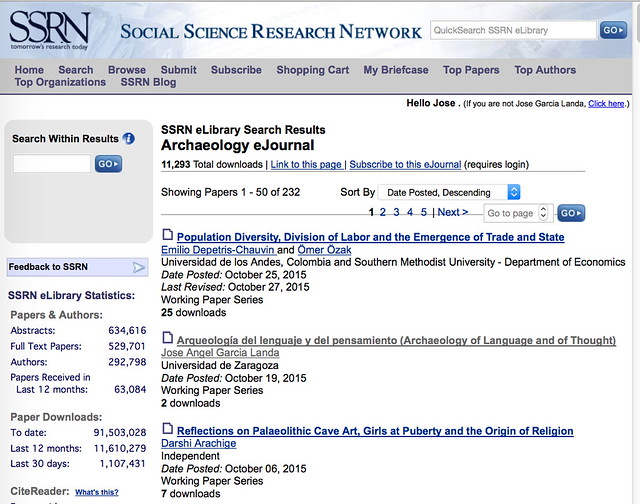
Arqueología del lenguaje y del pensamiento


Comentamos, con ocasión del libro de Ángel Rivera Arqueología del lenguaje, los principales conceptos de arqueología cognitiva y sus posibles desarrollos en relación en particular a las aportaciones de la lingüística cognitiva y la narratología..


Texto completo:

Arqueología del lenguaje y del pensamiento 


English Abstract: 

Archaeology of Language and of Thought

This paper examines the central notions of cognitive archaeology, with reference to Ángel Rivera's book 'Archaeology of Language', as well as its possible developments as regards the contributions of cognitive linguistics and of narratology.


Note: Downloadable document is in Spanish.
Number of Pages in PDF File: 7

Date posted: October 19, 2015  


eJournal Classifications
AARN Subject Matter eJournals
    
        
AARN Subject Matter eJournals


AARN Subject Matter eJournals
    
        
CSN Subject Matter eJournals


SSRNarchaeology


_____. "Arqueología del lenguaje y del pensamiento." In García Landa, Vanity Fea 16 August 2011.*

         http://vanityfea.blogspot.com/2011/08/arqueologia-del-lenguaje-y-del.html

         2011

_____. "Arqueología del lenguaje y del pensamiento." Academia 9 Jan. 2015.*

         https://www.academia.edu/20119770/

         2015

_____. "Arqueología del lenguaje y del pensamiento (Archaeology of Language and of Thought)." SSRN 19 Oct. 2015.*

         DOI: 10.2139/ssrn.2676114

         http://ssrn.com/abstract/=2676114

         2015

         Psychological Anthropology eJournal 19 Oct. 2015.*

         http://www.ssrn.com/link/Psychological-Anthropology.html

         2015

         Linguistic Anthropology eJournal 19 Oct. 2015.*

         http://www.ssrn.com/link/Linguistic-Anthropology.html

         2015

         Cognitive Linguistics: Cognition, Language, Gesture eJournal 19 Oct. 2015.*

         http://www.ssrn.com/link/Cognitive-Linguistics.html

         2015

_____. "Arqueología del lenguaje y del pensamiento." In García Landa, Vanity Fea 30 Oct. 2015.*

         http://vanityfea.blogspot.com.es/2015/10/arqueologia-del-lenguaje-y-del.html

         2015

_____. "Arqueología del lenguaje y del pensamiento." ResearchGate 2 Feb. 2016.*

         https://www.researchgate.net/publication/292696180

         2016

_____. "Arqueología del lenguaje y del pensamiento." Ibercampus 16 Aug. 2021.*

https://www.ibercampus.es/arqueologia-del-lenguaje-y-del-pensamiento-41421.htm

2021

_____. "Arqueología del lenguaje y del pensamiento." Humanities Commons 19 Oct. 2021.*

         http://dx.doi.org/10.17613/5g7a-cg17

         https://hcommons.org/deposits/item/hc:41907/

         2021

_____. "Arqueología del lenguaje y del pensamiento." Net Sight de José Angel García Landa.*

         https://personal.unizar.es/garciala/publicaciones/arqueologiadel.pdf

         2024


—oOo—

viernes, 27 de diciembre de 2013

BBC How Art Made The World 1 - More Human Than Human.

Murphy, Nick, prod. and dir.  How Art Made the World. Episode 1: More Human than Human. Presented by Nigel Spivey. Exec. Prod. Kim Thomas. Series prod. Mark Hedgecoe. BBC / KCET Hollywood, 2005. Online at DailyMotion.*

         https://www.pbs.org/howartmadetheworld/episodes/human/

         2023

PBS. "How Art Made the World: Episode 1: More Human than Human." PBS (2006).*

         https://www.pbs.org/howartmadetheworld/episodes/human/

         2023


—oOo—

Mi fotoblog

Mi fotoblog
se puede ver haciendo clic en la foto ésta de Termineitor. Y hay más enlaces a cosas mías al pie de esta página.