
lunes, 15 de julio de 2024


jueves, 22 de junio de 2023
lgbtQUEER THEORY & PEDOPHILIA
Un profesor universitario hace referencia al vinculo entre los principales referentes de la Teoria Queer y la pedofilia. Algunos estudiantes se molestan, pretenden que cambie de tema, y le tildan de "transfóbico" pic.twitter.com/whSRKe7rNW
— J.- (@Jota_DBS) June 20, 2023
lunes, 6 de marzo de 2017
miércoles, 22 de abril de 2015
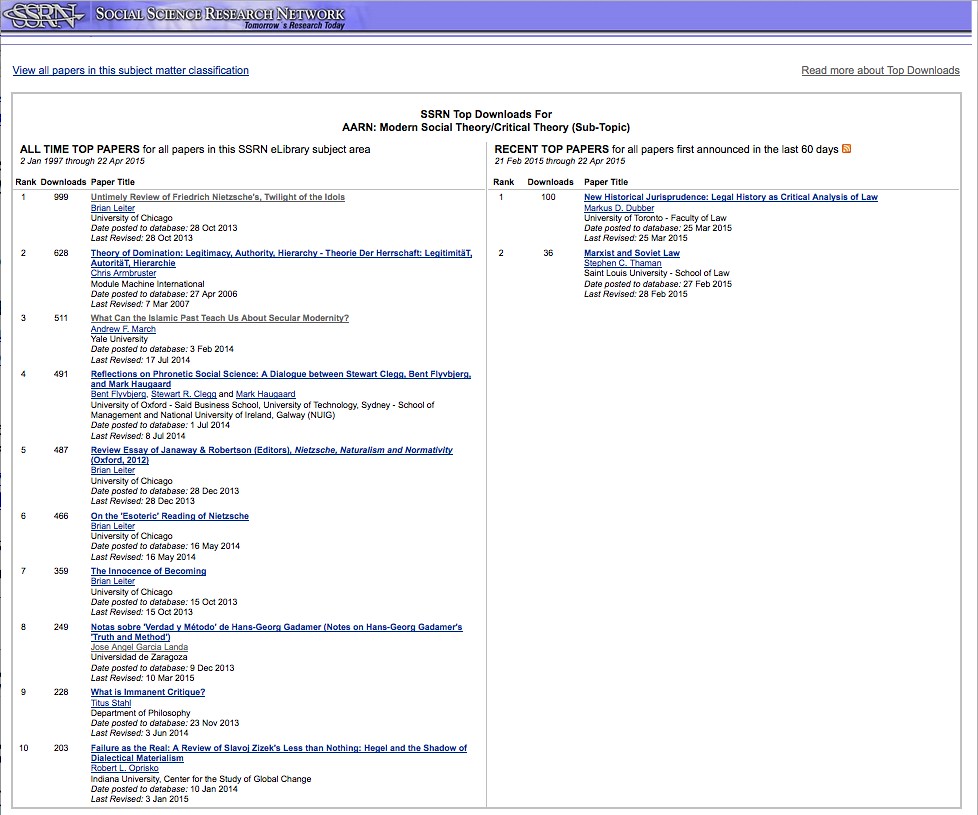
viernes, 17 de abril de 2015
miércoles, 18 de diciembre de 2013
Sobre la Filología y la teoría crítica
 Este artículo recoge íntegramente únicamente la contribución de J. A.
García Landa a la mesa redonda "Sobre Filología y Teoría Crítica: La
interfaz Lingüística/Literatura", presentada al congreso de AEDEAN
(2003). La mesa redonda trató sobre diversos aspectos de la relación
entre estudios literarios, lingüísticos y filológicos, tanto en una
perspectiva general como en lo relativo al contexto institucional de la
Filología Inglesa en España. Se comentaron desarrollos recientes
tocantes a la conceptualización de los fenómenos lingúísticos
(lingüística integracional, pragmalingüística, etc.) atendiendo tanto a
sus implicaciones disciplinarias como a las institucionales.
This paper includes only J. A. García Landa's contribution to the panel "On Philology and Critical Theory: The Linguistics/Literature Interface" presented at the 2003 AEDEAN conference. This panel addressed several issues related with the relationship betweeen linguistics, literary studies, and philology (both from a general theoretical perspective and in the institutional context of Spanish Anglistics). Recent developments in the conceptualization of linguistic phenomena (integrational linguistics, pragmalinguistics, etc.) were discussed, with attention being paid both to their disciplinary and their institutional implications.
LingRN Subject Matter eJournals
|
|
|
LIT Subject Matter eJournals
|
García Landa, José Angel, Beatriz Penas Ibáñez and Marta Dahlgren. "Sobre filología y teoría crítica: La interfaz lingüística/literatura." In Actas del XXVII Congreso Internacional de AEDEAN / Proceedings of the 27th International AEDEAN Conference. Ed. Antonio R[odríguez] Celada, Daniel Pastor García, and Pedro Javier Pardo García. CD-ROM. Salamanca: Departamento de Filología Inglesa (Universidad de Salamanca) / Asociación Española de Estudios Anglo-Norteamericanos, 2004.*
http://dialnet.unirioja.es/servlet/articulo?codigo=1222638
2015
_____. "Sobre la Filología y la teoría crítica: La interfaz lingüística/literatura." SSRN 22 July 2012.* (J. A. García Landa's section).
http://ssrn.com/abstract=2115186
2012
History & Philosophy of Linguistics eJournal 30 July 2012.*
https://www.ssrn.com/link/History-Philosophy-Linguistics.html
2023
Literary Theory and Criticism eJournal 30 July 2012.*
https://www.ssrn.com/link/English-Lit-Theory-Criticism.html
2023
_____. "Sobre la Filología y la teoría crítica: La interfaz lingüística/literatura." Vanity Fea 18 Dec. 2013.*
https://vanityfea.blogspot.com/2013/12/sobre-la-filologia-y-la-teoria-critica.html
2023
_____. "Sobre la Filología y la teoría crítica: La interfaz lingüística/literatura." ResearchGate 5 Jan. 2014.*
https://www.researchgate.net/publication/256028136
2013
_____. "Sobre la Filología y la teoría crítica: La interfaz lingüística/literatura." Academia 23 Sept. 2014.*
https://www.academia.edu/8455447/
2014
sábado, 16 de noviembre de 2013
Recursos en Internet para Teoría Literaria, Crítica y Filología
Literary Theory and Criticism - DOC .... eliminado.
Y compensado con contenidos de mi Bibliografía:
Recursos de Intenret / Internet resources for Literature, Theory and Criticism:
https://bibliojagl.blogspot.com/search/label/Internet%20resources
—oOo—
sábado, 5 de enero de 2013
From Philology to General Hermeneutics: Schleiermacher
This historical investigation led in the long run to structural offshoots: Vladimir Propp's Morphology of the Folk Tale still has this end (historical investigation) in view; anthropological research such as Frazer's monumental The Golden Bough (1890-1922) also derives from the Romantic historical view. Nineteenth-century linguistics is primarily historical linguistics, and the approach to the modern literatures is above all a philological and historical one.
The sense of the term philology is sometimes restricted to historical linguistics, but originally it had a wider sense which can still be seen in the Spanish usage, or in this definition from the Diccionario de Autoridades:
Issues of textual philology: discovery, edition and textual study of a medieval or an early modern work. Establishment of text, study of diverse manuscripts, variants, preferred readings. (Basic limitation in approach: the assumption that there is one text which is supposed to be better; modern textual criticism more attentive to different contexts and uses). . The scholarly edition of some forgotten work of the past becomes and remains for a long time the standard occupation of university scholars; a parallel work is being done in historical linguistics (e.g. The Oxford English Dictionary, 1884-1928; Fowler, A Dictionary of Modern English Usage, 1926; Wright, The English Dialect Dictionary; Bradley, The Making of English (1904).
The scholarly essays as we know them now, the philological reference works, the handbooks of literature, are a product of the nineteenth century scholarship; they did not exist before that except in rudimentary forms in the field of classical philology.
The nineteenth century saw the development of standard methods of textual criticism: the comparison (collation) and evaluation of the available texts of a work (manuscripts, editions); the drawing of a stemma of textual history; the establishment of text and of supplementary variants to be published; the intepretation of variants (either as authoritative or non-authoritative), the classification and interpretation of errors (author’s, copist’s, editorial transmission, typesetters’, etc.). We often find one prejudice among textual philologists: the notion that there is one text to be preferred on the basis of the writer’s authority (e.g. the assumption that the last text revised by the author is to be preferred to all others, etc.). In the late twentieth century textual critics are more relativistic, and pay more attention to the cultural role of variant texts. Textual philology is combined with historical research, paleography, bibliography and book history.
Hermeneutics is the theory or science of interpretation. The word derives from Greek hermeneuein: to interpret or traslate into one’s own idiom; to make clear and understandable, to give expression. In mythology, Hermes interprets the often cryptic messages of the gods to mortals. As a discipline, hermeneutics began as scriptural exegesis, closely associated to philology (cf. R. E. Palmer, Hermeneutics). Christian theologians developed the theory of plurisignification, according to which a Biblical text could have several senses:
- The literal or historical sense
- The allegorical sense (an Old Testament event or person prefigures a New Testament one)
- The moral sense (a passage is read as a lesson on right or wrong behaviour)
- The anagogic sense (a passage is read as a revelation of the other world)
A line of thought deriving from the Pseudo-Dionysius was especially aware of the figural nature of religious language, requiring interpretation, and insisted on the need to avoid excessively literal readings of religious language (danger of idolatry, of mistaking the sign for the thing signified).
Modern theories of hermeneutics arise from the Protestant reaction to medieval hermeneutics. The Catholic church had claimed sole authority in the interpretation of the Bible. The Protestants insist that the holy text is self-sufficient, that it does not need to be mediated by the Church; it is intelligible. Protestants exegetes wrote many practical guides to Biblical interpretation. The Protestant tradition, in confluence with with the philological methodology of humanistic studies, evolved towards a systematic methodology of textual interpretation in the work of F. D. E. Schleiermacher.
In the late 19th century this became a broader philosophical theory stressing the crucial importance of interpretation to most if not all aspects of human endeavor and culture. Through the impetus of the early work of Martin Heidegger, hermeneutics developed into a general philosophy of human understanding, with implications for any discipline concerned with the intepretation of human language, action or artefacts.
Friedrich Schleiermacher, a German theologian, expands the hermeneutic theories developed during the Enlightenment period. Schleiermacher seeks a general theory of interpretation which is applicable to all texts, not only to religious ones. He conceives hermeneutics as the basic framework where all linguistic understanding takes place. This means that in his work hermeneutics is no longer an abstruse discipline having to do with special interpretive techniques to be applied to obscure texts: all hermeneutical processes are shown to originate from the common ground of linguistic understanding. Enlightenment theories are divided into a number of specific fields (law, religion, etc.). Schleiermacher will speak of a general hermeneutics.
The hermeneutics of previous authors are also partial in that they take understanding as a matter of course. Schleiermacher, on the other hand, constantly takes into account the possibility that misunderstanding is equally possible.
Linguistic understanding, whether it is used in the exegesis of a work or in following an ordinary everyday conversation, rests on the same principles. It involves a negotiation, or a mediation (let us keep in mind here our conception of interpretation as translation) between a realm of generality, the linguistic system, and a realm of particularity, the personal message the speaker wants to convey. Speaking involves articulating this particularity out of the generality of language, and understanding involves a similar shift between two sets of criteria, those of the system and those of the message. Both speaking and understanding can be said to be hermeneutical activities in this sense. The ground of Schleiermacher's hermeneutics is the concrete experience of how we come to understand somebody else's meaning.
A complete hermeneutical understanding consists of a play of two different operations, one more objectivistic, the other more subjectively oriented. Schleiermacher calls these "grammatical" and "technical" (or "psychological") interpretation, respectiely. "Grammatical" interpretation interprets a word or sentence as an instance of general language; "technical" interpretation as an instance of "style", as the expression of an individual mind and communicative intention.
Just as every speech has a twofold relationship, both to the whole of language and to the collected thinking of the speaker, so also there exists in all understanding of the speech two moments: understanding it as something drawn out of language and as a 'fact' in the thinking of the speaker.
These different techniques and aims coexist in all interpretive enterprises; in fact, they work towards each other, and "In this interaction the results of the one method must approximate more and more those of the other" (Hermeneutics: The Handwritten manuscripts 190). However, one or the other aspect can become dominant, and then we find different "schools" or kinds of interpretation--the second kind less subject to polemical discussion, in Schleiermacher's opinion (185). For Schleiermacher, "technical" (i.e. psychological) interpretation relies more on divination, on the imaginative projection of the interpreter to the mind of the author; he came to give more and more emphasis to this side of interpretation.
There are also two methods to grasp new meaning: the comparative, by which an author or text is compared with similar authors or texts, and the divinatory, which involves the interpreter's intuitive contact with the spirit of language and his insight into the individuality of the author. Therefore, understanding is a complex process consisting in a mediation between system and message, and involving an interplay of linguistic versus psychological understanding on one hand, and comparison and divination on the other. The scope of hermeneutics broadens gradually as emphasis comes to fall on the last term of the opposition. Understanding a word is an operation closer to the realm of linguistics than to that of psychology. But the intuitive, subjective and psychological side of interpretation becomes more significant as the object of our understanding expands into a text, a work, a set of works, and the whole personality of an author.
Besides, there is no understanding so simple as not to require this interpretive negotiation. The whole of the sentence must be known before we know the precise meaning of the word; but in order to know the sentence we must know the individual words. The same circular relationship is established between the sentences in a text and the complete text. This leads Schleirmacher to formulate a crucial hermeneutic principle: understanding takes place through a hermeneutic circle. a part of something is always understood in terms of the whole, and vice versa.
When we consider the task of interpretation with this principle in mind, we have to say that our increasing understanding of each sentence and of each section, an understanding which we achieve by starting at the beginning and moving forward slowly, is always provisional. It becomes more complete as we are able to see each larger section as a coherent unity. But as soon as we turn to a new part we encounter new uncertainties and begin again, as it were, in the dim morning light. It is like starting all over, except that as we push ahead the new material illumines everything we have already treated, until suddenly at the end every part is clear and the whole work is visible in sharp and definite contours. (Schleiermacher, Hermeneutics: the Handwritten Manuscripts)
The hermeneutic circle defined by Schleiermacher could be described as this constant movement from part to whole as we try to intepret something, which also involves a constant shift from one aspect of interpretation (grammatical and technical) to the other, from one interpretive strategy to another. This conception is very suggestive and it would be interesting to compare it to present-day theories of discourse processing, such as the opposition between "top-down" and "bottom-up" strategies. Schleiermacher's hermeneutics has the additional merit of being oriented towards much larger prospects. It deals even with children's acquisition of language, which according to Schleiermacher is also a hermeneutic process.
We see then that the image of the hermeneutic circle is not wholly appropriate. We move from part to whole through the help of analogies and divination; and then from whole to part. But now that part is no longer the same: it is transformed by our better understanding, and it will provide a firmer grasp for another assault on the whole. We see, then, that the famous hermeneutic circle is really a spiral. Only those interpretations which do not produce new meaning are circular.
Given this spiralling definition, it is not surprising if perfect understanding can never be attained. Indeed, from the moment a work is considered as a part of a larger whole, the interpretive movement starts again; it is easy to see that trying to read the text of culture embarks us into an ever-expanding interpretive process.
Heinz Kimmerle's thesis is that Schleiermacher shifted from a language-oriented hermeneutics towards a more subjectivist and intentionalist one. Schleiermacher's definition of understanding is, in fact psychologistic: it is "the re-experiencing of the mental processes of the text's author." Even though this assertion is borne by the amount of attention given to each side of interpretation in Schleiermacher's early and later work, respectively, the conclusion is not so easily drawn. We have already observed within the very structure of hermeneutical development as conceived by Schleiermacher a movement from the objective to the subjective side: it is not far-fetched to suggest that as his hermeneutical outlook broadened, the later emphasis on technical interpretation was only natural.
A tendency of Schleiermacher's hermeneutics is pointed out by Kimmerle. His emphasis on understanding as such, understanding as a universal process, led him to play down the element of historicity in both the object and the subject of interpretation. This is not to say that he does not take into account the existence of such a difference; far from it, "For Schleiermacher, the historical text is not addressed directly to the present interpreter, but to an original audience. The present interpreter is to understand that original communication in terms of its historical context." Indeed, the emphasis is so great that it is placed completely on the retrieval of that meaning, leaving aside the question of its application to present-day circumstances. The latter falls outside hermeneutics for Schleiermacher: in his view, hermeneutics is not the art of applying but the art of interpreting. And it is precisely this conception of a pure and disinterested retrieval of meaning which is objected to when Gadamer opposes the tradition opened by Schleiermacher.
In this tradition, understanding is pure and uncontaminated by the aims of the interpreter. Pure comprehension must precede application of the universal principles it reveals, of the moment of judgment. His attitude to historicity is utopian: he assumes that the interpreter can leap over historical distance and acquire the perspective of the contemporary audience, be absorbed in the view of past people. However, we must take into account that Schleiermacher is presupposing an initial community of shared experience or interests at the root of his theory (Hermeneutics 180).
A problem that is left unsolved by Schleiermacher is whether attention to the process of composition affords a better grasp of the finished text. His hermeneutics seem to endorse this conception, which is challenged by twentieth-century interpretation. Certainly, for him one of the aims of hermeneutics is to understand the "intimate operations of poets and other artists of language by means of grasping their entire process of composition, form its conception up to the final execution" (Hermeneutics 191).
—oOo—
Bibliography
Ast, Friedrich. Grundlinien der Grammatik, Hermeneutik und Kritik. Landshut: Thomann, 1808.
_____. Grundriss der Philologie. Lanshut: Krüll, 1808.
_____. "Éléments d'herméneutique et de critique." In Critique et herméneutique dans le premier romantisme allemand. Ed. and trans. Dennis Thouard. Lille: Presses Universitaires du Septentrion, 1996. 287-314.*
Boeckh, A. Enzyklopädie und Methodologie der philologischen Wissenschaften. 2nd. ed. 1886.
Dilthey, Wilhelm. "Die Entstehung der Hermeneutik." In Dilthey, Die geistige Welt: Einleitung in die Philosophie des Lebens. Vol. 5 of Gessamelte Schriften. 317-38.
Frazer, James George. The Golden Bough. 12 vols. 1890-1915. Abridged ed. in 1 vol. London: Macmillan, 1922. 1954. 1956.
Grimm, Jakob. Deutsche Grammatik. 1819. Expanded ed. (with new section of phonetics and "Grimm's law") 1822. (Comparative and historical grammar of Germanic languages).
Grimm, Jakob, and Wilhelm Grimm (1786-1859), eds. Kinder-und Hausmärchen. English trans.: The Complete Grimm's Fairy Tales. Ed. Padraic Colum and Joseph Campbell. London: Routledge, 1983.
Oxford English Dictionary. Gen. ed. James A. H. Murray. Assoc. eds. Henry Bradley, William A. Craigie, Charles T. Onions. 10 vols. Oxford UP, 1884-1928.
Propp, Vladimir. Morfologija skazky. 2nd ed. Leningrad: Nauka, 1968.
_____. Morphology of the Folktale. 1st. ed., trans. Laurence Scott, introd. Svatava Pirkova-Jakobson. Bloomington: Indiana UP, 1958.
Pseudo-Dionysius the Areopagite. De Caelesti hierarchia. Spanish trans. La jerarquía celeste. In Obras completas del Pseudo Dionisio Areopagita. Madrid: BAC, 1995. 119-88.
Palmer, R. E. Hermeneutics: Interpretation Theory in Schleiermacher, Dilthey, Heidegger and Gadamer. Evanston: Northwestern UP, 1969.
Schleiermacher, Friedrich. Hermeneutik. 1819. Rpt. 1959. Trans. 1978.
_____. "Hermeneutics." 1819. In Schleiermacher, Hermeneutics. Ed. Heinz Kimmerle. 95-151.
_____. "The Hermeneutics: Outline of the 1819 Lectures." Trans. Jan Wojcik and Roland Haas. New Literary History 10 (1978): 1-15.
_____. From Hermeneutics (From "The Outline of the 1819 Lectures"). In The Norton Anthology of Theory and Criticism. Ed. Vincent B. Leitch et al. New York: Norton, 2001.
_____. "On the Concept of Hermeneutics." 1829. In Schleiermacher, Hermeneutics. Ed. Heinz Kimmerle. 175-214.
_____. "Sur le concept et la division de la critique philologique." In Critique et herméneutique dans le premier romantisme allemand. Ed. and trans. Dennis Thouard. Lille: Presses Universitaires du Septentrion, 1996. 315-28.
_____. Hermeneutik und Kritik mit besonderer beziehung auf das Neue Testament. Part 1, vol. 7 of Sämmtiche Werke. Ed. Friedrich Lücke. Berlin: G. Reimer, 1838.
_____. Hermeneutics and Criticism. In Schleiermacher, Hermeneutics and Criticism and Other Writings. Ed. and trans. Andrew Bowie. Cambridge: Cambridge UP, 1998. 1-224.
_____. "General Hermeneutics." In Schleiermacher, Hermeneutics and Criticism and Other Writings. Ed. and trans. Andrew Bowie. Cambridge: Cambridge UP, 1998. 225-68.
_____. Hermeneutik. 1805-33. Ed. Heinz Kimmerle. Heidelberg: Winter, 1959.
_____. Hermeneutics: The Handwritten Manuscripts. Ed. Heinz Kimmerle. Trans. James Duke and Jack Forstman. Atlanta: Scholars Press, 1986.
_____. Hermeneutics and Criticism and Other Writings. Ed. and trans. Andrew Bowie. (Cambridge Texts in the History of Philosophy). Cambridge: Cambridge UP, 1998.
Valla, Lorenzo. Elegantiae linguae latinae. c. 1435.
_____. Opera. 2 vols. 1540. Rpt. Turin: Bottega d'Erasmo, 1962.
Wolf, Friedrich August. Prolegomena ad Homerum. Halle, 1794.
_____. Darstellung der Altertumwissenschaft nach Begriff, Umfang, Zweck und Wert. Vol. 1 of Museum der Altertumswissenschaft. Ed. F. A. Wolf and Philip Buttman. Berlin, 1807.
_____. Vorlesung über die Enzyklopädie der Altertumswissenschaft. Leipzig: Lehnhold, 1831.
domingo, 16 de diciembre de 2012
El lugar de la ética en la teoría literaria contemporánea
Una ponencia que presenté en una mesa redonda sobre este tema en un congreso de AEDEAN a finales de 2001, y que ahora he subido al SSRN:
"El lugar de la ética en la teoría crítica contemporánea." En Net Sight de JAGL (2004):
http://www.unizar.es/departamentos/filologia_inglesa/garciala/publicaciones/lugar.html
_____. "El lugar de la ética en la teoría crítica contemporánea." Social Science Research Network 1 Dec. 2012.*
http://ssrn.com/abstract=2183732
Literary Theory and Criticism eJournal:http://papers.ssrn.com/sol3/JELJOUR_Results.cfm?form_name=journalBrowse&journal_id=949618
Ethics eJournal
http://papers.ssrn.com/sol3/JELJOUR_Results.cfm?form_name=journalBrowse&journal_id=950360
______
También en ResearchGate:
El lugar de la ética en la teoría crítica contemporánea (Ethics in Contemporary Literary Theory)
Este artículo comenta algunas revaluaciones del papel de la ética en la teoría de la crítica literaria, con atención especial a las teorías postestructuralistas y desconstructivistas, por ej. J. Hillis Miller. Proponemos una integración de estas propuestas con una perspectiva interaccionalista y pragmática sobre la ética.
_________
ABSTRACT This paper discusses some reassessments of the role of ethics in the theory of literary criticism, with special reference to poststructuralist and deconstructive theories, e.g. J. Hillis Miller's. The paper puts forward an integration of these proposals with an interactionalist and pragmatic approach to ethics and interpretation.
lunes, 26 de marzo de 2012
Acritical, Critical
Acritical Criticism, Critical Criticism: Critical Interaction, Reframing, and Topsight: http://www.researchgate.net/publication/33419996_Acritical_Criticism_Critical_Criticism_Critical_Interaction_Reframing_and_Topsight
sábado, 19 de noviembre de 2011
Roger Sell's LITERATURE AS COMMUNICATION
Published in Spanish in Miscelánea: A Journal of English and American Studies 25 (Language and Linguistics Issue, 2002). 183-88.
Roger Sell, professor at Åbo Akademi ("Åbo" is Turku, in Finland) is well known in the field of pragmalinguistics, above all as the editor of a volume on Literary Pragmatics and as the advocate of applying to the analysis of literary communication an extended version of the politeness theory developed in linguistic pragmatics. Literature as Communication is not a collection of previous papers, but a systematic exposition and development of the theory advocated by Sell. As such, it constitutes a milestone in his intellectual career, and a first-rank intervention in the fields of literary pragmatics and critical theory—fields that he intends to redefine and merge. It presents itself as a fundamentally humanist project, a defense of the present and future validity of the central ideals of the Enlightenment (expert knowledge, tolerance, rational arbitration, individual responsibility, an ethics of cooperation), against certain currents of postmodern thought which proclaim, prematurely, the defunction of the Enlightenment project and of its conceptual arsenal.
The book argues the need for a theory of literary criticism understood as mediation: a mediation between author and reader, or a mediation between different ages, readings, and cultural contexts. This is a crucial function of literary criticism, and Sell argues that it has been neglected by the literary theory of the last decades of the twentieth century—if not always by the actual practice of critics. The purpose of this book is to provide a theoretical foundation, now lacking, for criticism understood as mediation. In order to do that, Sell, expounds in his introduction the main lines of such a theory within the context of contemporary literary studies, taking into account the interdisciplinary role such a theory would play, its function in the current postmodern cultural scape, and more specifically its relationship with literary pragmatics, rightly understood.
The justification for the need of this theory is argued through the critical panorama presented in chapters 2 and 3. Chapter 2, "A-Historical De-Humanization", revises the insufficient theoretical bases of the linguistic and literary formalisms, and of the modernist aesthetics associated to them (structural linguistics, speech act theory, New Criticism, literary structuralism). They share a common weakness—the dehumanization attending the lack of historical consciousness. Sell also criticises the formalist heritage of the early approaches to literary pragmatics, and his critique lays down the foundations of a wider conception of the pragmatics of literature, one which is closer to the critical practice of humanism. A reading of Sell's discussion is especially recommended for those who understand literary pragmatics in a restricted way as (for instance) the analysis of speech acts exchanged between the characters of a work. Sell proposes a pragmatics which governs all the levels of analysis in a text, all the way from the represented world, through the fictionally constructed voices, up to the communicative interaction between authors and readers. In this sense he goes far beyond the conceptions by Fish, Ohmann, Pratt or Petrey, not to mention Austin or Searle. It is a proposal for a pragmatic analysis comparable to the one I put forward in my book on narrative theory (1998).
Chapter 3 of Literature as Communication, "The Historical Human", revises the insufficiencies of post-structuralist criticism and linguistics. It ends with a critique of post-modernist stagnation, and advocates a "historical but non-historicist" pragmatics. Chapter 4, "Literature as Communication", expounds some of the basic concepts of such a pragmatics, including: a recognition of the interactional dimensions of the literary phenomenon; an awareness that the actual readings of a work must not be confused with the implied reading, or with the ideal context of reading invoked by the text—instead, those readings perform a multiplicity of functions in a multiplicity of contexts. This pragmatics must also be grounded on a conception of social experience, and within it, of literary interaction, as a process of co-adaptation, based on a flexible and protean conception of the self, and on a projective but not rigidly deterministic use of the subject positions or communicational roles proposed by the text—in particular the textual subject known as implied reader. One of the critical vices most eloquently denounced by Sell is, as a matter of fact, the "presupposition of a unitary context", that is, the reduction of a text's multiple possible contexts of reception to just one, the one presupposed by the critic.
Crucial, too, in Sell's theory —and in this respect is reminds of, and complements, T. S. Eliot and C. S. Lewis— is the self's imaginative projection towards the other: a temporary or conditional projection, but one which may lead to a redefinition of the self which engages in it. All of this leads, in Chapter 5, "Interactive Consequences", to rethink the role of other well-known critical processes and concepts, such as the problematics of the hermeneutic circle, of the ethics of reading, the role of generic conventions, the problem of the interference of biographical elements in the aesthetic reading of a text, the theory of linguistic (and non-linguistic) politeness applied to literature, and the issue of the historical distance between text and reader. Sell has something of value to contribute to all of these issues, and quite often his treatment of a given question, beginning in a disconcerting or apparently irrelevant way, turns out to be in the end straight-on accurate, illuminating, and immensely entertaining to read.
The final chapter (6, "Mediating Criticism), goes on to deal directly with the mediating function of criticism and the role of critical conflicts as understood by Sell, and identifies a tradition of mediating criticism with outstanding figures such as C. S. Lewis or T. S. Eliot. As a matter of fact, one of the most interesting aspects of the book is the way in which Sell comments on the precursors and precedents of his project of mediating criticism, and integrates them withing a global perspective: there we find Keats and his 'negative capability', we pass through Bakthin's dialogism, up to Gerald Graff and his project of including the teaching of critical conflicts in the literary curriculum, or Gadamer's hermeneutics with his notion of the fusion of horizons. Moreover, his approach recovers, besides the above-mentioned humanistic tradition, certain aspects of a number of "old-fashioned" critical perspectives, such as the New Criticism—thus the interest in the aesthetics of form, a value neglected by what Sell names 'Barthesian' criticism, or, more accurately, (post-)structuralist and political-cultural criticism). But apart from his strictures, and the limitations he denounces, Sell also finds many things of value in this complex of criticized critical approaches, thus doing justice to his own mediating theory.
Working in the field of narratology as a communicative phenomenon, I have found in Roger Sell's book a perspective I share to a great extent, one which fosters a radical integration (not a superficial one, as found in many stylistic approaches) of analytical perspectives coming from the field of linguistics and of literary studies, within the framework of a more organic cultural semiotics, one which is fully capable of apreciating the advances in textual analysis made by literary theorists and literary critics. Sell integrates these within a global communicative conception, and remains aware of their relative shortcomings. I see much common ground between my own conception and Sell's approach, and in his book I find more throroughly thought-out and better expressed many perceptions and notions that suggested themselves in my own work in this area. From this common ground that I wish now to expound some methodological points concerning the overall project or some specific issues.
Regarding the project's dimension as a semiotic of literature, it is difficult to dissent from Sell's proposals. They provide a highly suggestive continuity with recent work in pragmalinguistics placing emphasis on interaction (for instance, Jenny Thomas's Meaning in Interaction or Michael Hoey's Textual interaction) and with the integrational analysis developed by Michael Toolan in Total Speech. As a matter of fact, Sell goes far beyond the analytic proposals of many linguists who have been theorizing on textual communication—precisely insofar as he is attentive to the historical and cultural context and to the reception of texts, and insofar as he integrates the critical and theoretical debate on literature within the frame of a pragmalinguistic proposal. In this sense, Literature as Communication deals with textual communication at a level of complexity and subtlety far beyond the scope of books on textual linguistics such as Hoey's.
The weaker side of Sell's proposal would be, at any rate, the extent to which this project of communicational analysis of literature and criticism would require as well, in the last analysis, a specific critical praxis, a mediating critical practice which, by definition, will be most satisfactory for those interlocutors which are not caught in a phase of severe conflict. Mediating critics will find a receptive audience among detached observers. Of course I don't want to rule out the possibility that a critical mediation which is more theoretically self-aware may be more effective in preventing extreme positions or in opening up a ground for dialogue for radically opposed militant stances. But a literary pragmatics must also recognize that the conflict of interpretations has an element of irreducibility, a meaning-generating one, precisely in to the extent that the diversity of critical contexts can never be reduced to a single one—here one could almost accuse Sell of proposing as a remedy the same vice he is at pains to denounce in the book, the fallacy of the unitary context (in this case the context of the critically mediating act). But this would not do justice to the prudence, incisiveness and moderation of Sell's proposals, which really must be read directly, and not through a review, in order to get a full appreciation of their value. The objection remains, nonetheless, that althoug some uses of literature will benefit from a critical mediation, others benefit from the existence of open conflict, and will refuse any mediation—especially a well-argued one.
The theory of criticism as mediation is useful insofar as it emphasizes a very important function performed by criticism. But there are other functions which must not be neglected, and which might be obscured if we lay emphasis on mediation. Thus, criticism also involves the understanding or explanation of literary phenomena, and quite frequently, in offering an explanation (based on arguments from psychology, semiology, sociology, etc.) it must go beyond the author's intentional project, and beyond a mediating labour. I don't think that in this case there is an avoidance of the interactional-communicational function of criticism; only, that interaction also takes place in a multiplicity of contexts, not just in the communicative context between the author and the reader. In academic criticism, for instance, there is a foremost emphasis on the communicational interaction between critics on the basis of the work, and in that context the author-reader interaction, which appears in this book as the most prominent one, may be overshadowed or may be presupposed as an object of analysis. Also, the emphasis Sell lays on understanding may on occasion apper to be excessively intentionalist—let me hasten to say that I do not mean that intentionalism should be discarded, only excessively schematic intentionalisms, those which ignore the many possible levels of intentionality (implicit intentions, unconscious intentions, ideologically framed intentions, etc.) and the role of critical interpretation in the generation of sense, among other ways by givin an explicit formulation to implicit intentional phenomena. The humanist tradition Sell is working on here might be further enriched with notions of intention modified by (post-)structuralism and by psychoanalysis, and this need not involve a neglect of the communicational dimension of interpretation.
There are some other instances in which Sell might be charged with an excess of simplification, due in the last instance to polemical aims somewhat alien to the mediating impulse which animates his book. Thus, for instance, when he offers a version of Kantian aesthetics which ignores the role of ethical considerations in the Kantian theory of art. (That is, according to Kantian aesthetics, not everything in art is purely aesthetic, although the purely aesthetic element isolated by Kant is the most characteristic contribution of the Critique of Judgement, and is unduly extended by some of his followers to the whole of artistic experience). The New Critics as described by Sell are, again, excessively aestheticist, a characterization which certainly cannot be sustained through an examination of the critical practice of Yvor Winters, but neither by that of R. P. Blackmur, Richards or Wimsatt, and really by none of the actual practices of individual and relevant New Critics, quite apart from the abstract New Critics used as a putching-ball in many handbooks on criticism. I do not find satisfactory, either, the small critical recognition given by sell to Wayne C. Booth. Booth's importance as a theoretical ground for a perspective such as Sell's is so great that it is tempting to diagnose the few or disdainful references to him as a instance of the 'anxiety of influence'. Perhaps any argumentation involves a certain degree of simplification of the other's position, and Sell does not completely escape that dynamics, for all his advocacy of mediating criticism or his attempts to carry it out in practice. At any rate, I suggest that any reader who enjoys reading Literature as Communication should also turn to Booth's Critical Understanding.
In spite of many commentaries of specific literary and critical texts, the picture of mediating criticism in action, intervening in actual conflicts of interpretation, remains somewhat hazy in this book. This is an approach that Sell has developed at greater length in another volume which, as he announces in Literature and Communication, is animated by the same project, and has already been published (Mediating Criticism: Literary Education Humanized). My review of this second volume is forthcoming in the journal Language and Literature.
Literature as Communication is rounded off with a glossary of critical terms defined from this perspective, a bibliography, and indexes of names and subjects which make the book quite user-friendly. I warmly recommend it to students and scholars working on literary theory, literary pragmatics of critical stylistics. The book radiates with good-will and common sense to such a degree that these démodé virtues, together with a slight tendency to repetitiousness, might give it a slightly decaffeinated flavour, were it not for the unflinching accuracy of Sell's views on a multiplicity of phenomena and attitudes in criticism, that we have often seen but understand here for the first time, within a much comprehensive theoretical context. This understanding is also a special kind of pleasure, something this volume argues and exemplifies in a masterful way. Another favourable review of the same can be read in Language and Literature (Briffa 2002).
Works Cited
AUSTIN, J. L. 1975. How to Do Things with Words. 2nd ed. Ed. J. O. Urmson and M. Sbisà. Oxford: Oxford UP.
BOOTH, Wayne C. 1979. Critical Understanding: The Powers and Limits of Pluralism. Chicago: U of Chicago P.
BRIFFA, Charles. 2002. Review of Roger Sell's Literature as Communication: The Foundations of Mediating Criticism. Language and Literature 11.2 (May): 189-91.
FISH, Stanley E. 1985. "Pragmatics and Literary Theory 1: Consequences." Critical Inquiry 11.3: 432-58.
GARCÍA LANDA, José Angel. 1998. Acción, relato, discurso: Estructura de la ficción narrativa. Salamanca: Ediciones Universidad de Salamanca.
_____. 2003. Rev. of Mediating Criticism: Literary Education Humanized. By Roger Sell. Language and Literature 12.3: 283-85 http://ssrn.com/abstract=1629849
HOEY, Michael. 2000. Textual Interaction: An Introduction to Written Discourse Analysis. Londres: Routledge.
KANT, Immanuel. (1790) 1984. Crítica del Juicio. Madrid: Espasa-Calpe.
OHMANN, Richard. 1972. "Speech, Literature, and the Space Between." New Literary History 4.1: 47-63.
PETREY, Sandy. 1990. Speech Acts and Literary Theory. New York: Routledge.
PRATT, Mary Louise. 1977. Toward a Speech Act Theory of Literary Discourse. Bloomington: Indiana UP.
SEARLE, John R. 1979. Expression and Meaning: Studies in the Theory of Speech Acts. Cambridge: Cambridge UP, 1979.
SELL, Roger. 1991. (ed.). Literary Pragmatics. London: Routledge.
_____. 2000. Literature as Communication: The Foundations of Mediating Criticism. (Pragmatics & Beyond New Series, 78). Amsterdam and Philadelphia: John Benjamins.
_____. 2001. Mediating Criticism: Literary Education Humanized. Amsterdam and Philadelphia: John Benjamins.
THOMAS, Jenny. 1995. Meaning in Interaction: An Introduction to Pragmatics. Harlow: Longman.
TOOLAN, Michael. 1996. Total Speech: An Integrational Linguistic Approach to Language. Durham (NC): Duke UP.
martes, 20 de abril de 2010
Hipertexto en retrospectiva
O en prospectiva, porque se trata de un texto profético. Por casualidad releía Hyper-Text-Theory, de George Landow y otros, un libro escrito hace dieciséis años cuando la Web estaba arrancando, no había Google ni Firefox ni Explorer, ni YouTube ni Yahoo. Lo reseñé poco después mientras empezaba a montar mi sitio web. Hace poco lo volvía a comentar a cuenta de lo mucho que han cambiado el hipertexto y la red en estos últimos veinte años de su existencia. Y ahora me llamaba la atención este párrafo tan presciente:
La respuesta a esta pregunta fundamental, "¿qué hará el crítico y teorizador de la literatura con el hipertexto?", está íntimamente relacionada con otra pregunta, "¿Cómo hará el crítico lo que vaya a hacer, sea lo que sea?" Naturalmente, si el hipertexto marca realmente un cambio importante de paradigma, uno puede esperar que la mayor parte de los académicos, críticos y teorizadores de la literatura impresa no harán nada en absoluto al respecto. Apartarán la vista, negarán, cuando se les apremie, que la ficción o la poesía hipertextual sean ficción o poesía de verdad, y en general expresarán gran afecto hacia el libro impreso—ocasionalmente hasta contrastando la experiencia de enfrentarse a los efectos supuestamente desnaturalizados y desnaturalizantes del texto en ordenador, con la de acariciar una novela victoriana encuadernada en lujoso cuero (....)
Sin embargo, he de preguntar otra vez, ¿qué debería hacer un crítico? La respuesta, al fin, ha de ser, escribir en hipertexto mismo. (...)
Los primeros intentos de escribir crítica y teoría en un entorno hipertextual sugieren que inevitablemente comparten la característica multivocalidad de este medio, su final abierto, su organización multilineal, su mayor inclusión de información no textual, y la manera en que reconfigura de modo fundamental el concepto de autoría, incluyendo las ideas de propiedad intelectual y de relaciones de status en el texto. (...) Lo que llamo de modo tentativo el género de crítica y teoría en hipertexto sufre el cambio de naturaleza que uno se encuentra al tratar con las concepciones de la textualidad, autoría y argumento basadas en el texto impreso; y esta reconceptualizacióin fundamental deriva del mismo factor: el enlace, en especial en un entorno de red. (...). Antes comenté la manera en que el uso de enlaces anima al autor y al lector a violar las fronteras de las disciplinas. No mencioné que tambien les anima a violar las fronteras estilísticas y genéricas. (Landow, "What's a Critic to Do? Critical Theory in the Age of Hypertext").

Profético ha resultado el texto para mí al menos, si mirando atrás veo cómo ha cambiado mi manera de escribir (para mal, dirían algunos) en los últimos años, y más específicamente desde que arrancó la Web 2.0 con los blogs. También es profético el texto en lo que se refiere a la reacción del mundo académico. Muchos de los escritos pseudo-académicos que hago aún tienen grandes herencias de la forma impresa, en especial los que redacto para el formato PDF. El PDF es una especie de texto impreso pasado a electrónico, y no es extraño que los universitarios y académicos lo hayan adoptado como su formato favorito cuando se ven obligados (por ley, por ejemplo) a difundir sus textos por internet. Ahora bien, donde Internet está en su salsa es en las formas donde hay mayor interacción de oralidad y escritura: en los blogs, en las redes sociales, en el e-mail. Se observará que en los PDFs el enlace está normalmente sólo para permitir acceder al PDF en sí, y quizá en alguna referencia bibliográfica. Las redes sociales quizá sean demasiado refractarias (todavía) a la actividad del pensamiento académico. Pero en los blogs sí puede observarse la transformación de la manera de pensar y escribir a que aludía Landow. En especial cuando están podridos de enlaces. Claro que ni el propio Landow sabía a qué se refería cuando nos animaba o se animaba a sí mismo a escribir "en hipertexto". Los blogs estaban en el futuro, y quizá todavía lo estén.
domingo, 21 de febrero de 2010
The Evolutionary Review no. 1
Empiezo a leerme The Evolutionary Review, donde me han publicado una reseña. El índice nos da una idea de las materias tratadas en este volumen desde una perspectiva evolucionista:
Andrews, Alice. "Editor's Introduction." The Evolutionary Review 1 (2010): 1-3.
Carroll, Joseph. "Editor's Introduction." The Evolutionary Review 1 (2010): 4-5.
Tanaka, Jiro. "What Is Copernican? A Few Common Barriers to Darwinian Thinking about the Mind." The Evolutionary Review 1 (2010): 6-12.
Wilson, David Sloan. "Learning from the Immune System about Evolutionary Psychology." The Evolutionary Review 1 (2010): 13-17.
Swirski, Peter. "When Biological Evolution and Social Revolution Crash: Skinner's Behaviorist Utopia." The Evolutionary Review 1 (2010): 18-23.
Palmer, Craig T., Alex Newsome, Kelsey Proud and Kathryn Coe. "Facebook or Lonesome No More." The Evolutionary Review 1 (2010): 24-29.
Heywood, Leslie, and Justin R. Garcia. "Ins and Outs: An Evolutionary Approach to Fashion." The Evolutionary Review 1 (2010): 30-35.
Baldwin, Kevin Scott. "1859: Darwin, Mill, and Drake." The Evolutionary Review 1 (2010): 36-38. (Edwin Drake).
Williams, Todd O. "Challenging Evolutionary Metaphors of Survival: Morris's News from Nowhere." The Evolutionary Review 1 (2010): 39-41.
Van Wyhe, John. "Commemorating Charles Darwin." The Evolutionary Review 1 (2010): 42-47.
Carroll, Joseph. "The Art Instinct in its Historical Moment: A Meta-Review." Rev. of Denis Dutton's book. The Evolutionary Review 1 (2010): 48-54.
Ayala, Francisco J. "Are You Aware That You Are Reading This Review?" Rev. of The Nature of Being Human, by Harold Fromm. The Evolutionary Review 1 (2010): 55-58.
Fromm, Harold. "Two Brains Better than One." Rev. of Human: The Science behind What Makes Us Unique, by Michael S. Gazzaniga. The Evolutionary Review 1 (2010): 59-61.
Degler, Carl N. "Is History Against the Law?" Rev. of War and Peace and War: The Rise and Fall of Empires, by Peter Turchin. The Evolutionary Review 1 (2010): 62-63.
Dissanayake, Ellen. "Tracking Musical Chills." The Evolutionary Review 1 (2010): 64-68.
Vandermassen, Griet. "Woman as Erotic Object in Mainstream Cinema: A Darwinian Inquiry into the Male Gaze." The Evolutionary Review 1 (2010): 69-75.
Cooke, Brett. "Clichés Worth Singing: Narrative Commonplaces in Opera." The Evolutionary Review 1 (2010): 76-81.
Evans, Dylan. "The Consolations of Karma." Rev. of Slumdog Millionaire, dir. Danny Boyle. The Evolutionary Review 1 (2010): 82-83.
Barratt, Daniel. "Understanding Cinema: Poetic Films and Embodied Viewers." Rev. of Poetics of Cinema, by David Bordwell, and Embodied Visions, by Torbel Grodal. The Evolutionary Review 1 (2010): 84-87.
Horvath, Tim. "First Do Not Bore: Earning and Sustaining Attention in Contemporary Literary Fiction." The Evolutionary Review 1 (2010): 88-96.*
Boyd, Brian ."On the Origins of Comics: New York Double-take." The Evolutionary Review 1 (2010): 87-111.
Clasen, Mathias. "The Horror! The Horror!" The Evolutionary Review 1 (2010): 112-19.
Duncan, Charles. "Darkly Darwinian Parables: Ian McEwan and The Comfort of Strangers." The Evolutionary Review 1 (2010): 120-24.
Wells, Robin Headlam. "Sex in the City-State." In The Rape of Troy: Evolution, Violence, and the World of Homer, by Jonathan Gottschall. The Evolutionary Review 1 (2010): 125-27.
Vermeule, Blakey. "The Furniture of the Mind." Rev. of Reading Edith Wharton through a Darwinian Lens: Evolutionary Biological Isues in Her Fiction, by Judith P. Saunders. The Evolutionary Review 1 (2010): 128-30.
Burghhardt, Gordon M. "Don't Cry at the Cremation." Rev. of On the Origin of Stories: Evolution, Cognition, and Fiction, by Brian Boyd. The Evolutionary Review 1 (2010): 131-34.
Fox, Robin. "A Mirror Up to Nature: The Many Faces of Love in Shakespeare." Rev. of Shakespeare and the Nature of Love: Literature, Culture, Evolution, by Marcus Nordlund. The Evolutionary Review 1 (2010): 135-37.
García Landa, José Ángel. "Illuminations from This Thing of Darkness." Rev. of Harry Thompson's novel. The Evolutionary Review 1 (2010): 138-40.
Austin, Michael. "'Vengeance Is Mine', Saith the Text." Rev. of Commeupance: Costly Signaling, Altruistic Punishment, and Other Biological Components of Fiction, by William Flesch. The Evolutionary Review 1 (2010): 141-42.
Michelson, David. "Strutting His Stuff." Rev. of Literature, Science, and a New Humanities, by Jonathan Gottschall. The Evolutionary Review 1 (2010): 143-46.
Nieves, Erwin. "Re-Reding Hispanic Literature and Film: Towards a Genuine Interdisciplinary Criticism." Rev. of Interdisciplinary Essays on Darwinism in Hispanic Literature and Film: The Intersection of Science and the Humanities, ed. Jerry Hoeg and Kevin S. Larsen. The Evolutionary Review 1 (2010): 147-49.
Hoeg, Jerry, and Kevin S. Larsen, eds. Interdisciplinary Essays on Darwinism in Hispanic Literature and Film: The Intersection of Science and the Humanities. Edwin Mellen, 2009.
Hart, David Augustus. "About the Cover." The Evolutionary Review 1 (2010): 150-51.
PS: Más cosas interesantes sobre este nuevo paradigma evolucionista en las humanidades se encuentran en el blog La nueva ilustración evolucionista, http://ilevolucionista.blogspot.com/
lunes, 18 de enero de 2010
El nuevo paradigma
El nuevo paradigma en teoría crítica, literaria y artística lo define a su manera Norman Holland en un mensaje a la lista PsyArt.
Hi, gang,
This Q and A is from the NYTimes' interviewer Deborah Solomon and Terry Castle, professor of 18th century literature at Stanford, best known for The Literature of Lesbianism:
What are the latest trends in academia? Is poststructuralist theory dead yet?
Well, it carries on in its zombielike, jargon-ridden way here and there. But it's on the wane. The smartest literary scholars right now are interested in evolutionary psychology and brain science -- how we may be hard-wired for fiction-making, aesthetic appreciation and the like.
'Nuff said,
Norm
Básicamente: se reacciona contra el constructivismo cultual y el postestructuralismo (la tesis de que 'nada se nace, todo se hace' y se da un bandazo al lado opuesto. De hecho los manifiestos a favor de este giro datan ya de hace quince años. Pueden leerse en el sitio web de Joseph Carroll los artículos "Evolution and Literary Theory" y "Poststructuralism, Cultural Constructivism, and Evolutionary Biology", luego incluidos en Literary Darwinism. Son una defensa elocuente y un tanto radical de esta nueva orientación. Más reciente es "Literary Study and Evolutionary Psychology: The Once and Future Discipline" del mismo autor. Y otra intervención igualmente reciente en esta línea, e impresionante por su panorámica y documentación, es el libro de Brian Boyd On the Origin of Stories.
A mí me encanta el evolucionismo y la teoría cultural evolucionista (así que supongo que en parte soy uno de esos "smartest literary scholars" a los que se refiere Holland)—y sin embargo desconfío de los paradigmas y sus movimientos a bandazos, y su tendencia a tirar el bebé con el agua del baño, como dicen por allí. Me gusta más encontrar puntos de encuentro y aprovechar los insights de cada paradigma. Así que me apunto al nuevo paradigma, pero con precaución: me interesan tanto los descubrimientos sobre tendencias innatas y generales, como la manera en que esas tendencias encuentran vías en un contexto social determinado, y adoptan formas culturalmente guiadas y condicionadas por un entorno, digamos una "ecología cultural", concreta e históricamente específica. Para una crítica (desde una perspectiva humanista) a los excesos del nuevo paradigma, puede verse a Raymond Tallis, "On Evolutionary Reductionism".
viernes, 31 de julio de 2009
Teoría hegeliana de la apropiación (y de la vanidad de las obras)
De esta cuestión de la apropiación han hablado entre otros, en relación a la obra de Shakespeare, Barbara Hodgdon (The Shakespeare Trade) y los autores de los ensayos reunidos en Political Shakespeare, editado por Alan Sinfield y Jonathan Dollimore, y en Shakespeare and Appropriation, editado por Christy Desmet y Robert Sawyer. De todos los bienes culturales británicos, Shakespeare es el mayor objeto de codicia y apropiación; quizá el mayor del mundo con la excepción de la Biblia (pero allí son muchos contra uno).
Bien, pues esta teoría, que algunos podrían considerar filomarxista y demás, puede encontrarse claramente expuesta en Hegel, que no era filomarxista. Claro, Hegel no lo plantea en términos de grupos sociales enfrentados, o culturas dominantes, sino que nos da el planteamiento individualista de la cuestión. Es precisamente en su discusión de las formas de realización del individuo en su acción, en la Fenomenología del Espíritu, donde se encuentra su exposición de la apropiación de la obra ajena. Allí habla de cómo un individuo se realiza en su trabajo, una noción que también deja huella en Marx. (Marx dijo de viejo "lo cierto es que no soy marxista"—no aclaró si hegeliano sí que era). La exposición de Hegel es de entrada un tanto exagerada: se explaya sobre cómo la acción humana puede considerarse como expresión del individuo, construcción de hecho del sujeto mismo, pues la individualidad es algo que se construye no mediante proyectos o ideas sino mediante las acciones que definen al individuo. Lo que me parece exagerado o extremo, o idealista, es la manera en que considera que la acción pueda caracterizar tan nítidamente al individuo: llega a decir que a este nivel no puede considerarse ni buena ni mala, ni lamentable ni loable, sino sólo característica.
Las frustraciones y fracasos se le pierden a Hegel por el camino, al parecer, y las desilusiones del individuo consigo mismo, aunque ya acabarán apareciendo. Exagerado, digo, pues más a menudo me parece que la acción del individuo no lo caracteriza ni lo retrata tanto, ni se espera de ella que lo haga, sino que queda desdibujada en la acción colectiva, en el trabajo reglamentado, etc. y bien poco hace al individuo como tal—como no lo haga individuo estandarizado, claro. Hace contar muy poco Hegel, en esta discusión del sujeto trazando su acción u obra, al azar, a la resistencia del material, a las circunstancias difíciles de amoldar, a lo imprevisible de la acción y reacción de los otros, que hacen que nuestra obra no sea tanto un retrato de nosotros mismos cuanto más bien un borfollo indefinible y heterogéneo de proyectos, logros, circunstancias e intenciones atisbadas. Luego volverá sobre ello.
Pero en fin, Hegel tiene claro qué es lo que nos lleva a actuar, y comienza ofreciéndonos una versión extremadamente intencionalista y optimista de la acción y del trabajo; nos muestra un individuo self-made, en el que lo que sale a la luz es lo que estaba implícito en él. Lo que se lleva a la acción efectiva es lo que el inviduo es, o más bien lo que iba a ser y efectivamente se hace. Aquí hay un poquillo de círculo vicioso, y de prospección retrospectiva de las que me gustan. O quizá esté mejor definido como un círculo hermenéutico de la acción y la temporalidad humana:
Vale: el sujeto se tira a la piscina, y hace su Acto, o su Obra. Lo divertido, o lo triste, es lo poco que queda de este Acto u Obra una vez va parar a la consideraciíon de los otros—los Otros, deberíamos llamarlos, tan ominosos son para el optimista Sujeto, que iba a retratarse y esculpirse mediante su acción. Ahora resulta que para los Otros esa acción no es sino una circunstancia más, no un Fin, sino un medio, porque los Otros no están por la labor de tu realización como Consciencia bla bla, sino que van a lo suyo, y cogen los materiales de que puedan echar mano, entre ellos tu Obra, o tu Retrato, o la Cosa que Hiciste, para su propio auto-bricolaje. Se apropian sin más ni mas de lo que hay, y van a lo suyo, que era lo nuestro, que es lograr su Fin, hacerse a sí mismos, externalizar su Esencia-que-será, por medio de su Acción. Este es el fragmento donde Hegel formula la teoría interaccional de la Apropiación. Lo traduciré teniendo en mente el ejemplo de la recepción de una obra literaria de la cual se apropia un antipático crítico: pero puede aplicarse a todo tipo de acción u obra humana, y a la respuesta que recibe por parte de los demás.
Aquí sí recibe atención la vanidad (la nada, digo) de los esfuerzos y logros, tras la vanidad (la fatuidad o presunción) que le lleva a uno a esculpirse a sí mismo en su acción, o en su Obra. Hegel lo expone como si esto siempre nos pillase de nuevas.
La obra pues, no permanece, sino que desaparece. Luego, esta "Desaparición" de la obra queda relativizada, al desaparecer también su "Desaparición". Y Hegel también se ocupa de contrastar (ahora sí) la distancia entre la intención y el resultado, entre lo que se pretendía hacer y lo que se ha hecho de verdad. (§ 408-9). Pero esto ya es una fase posterior a la acción creativa, una fase en la que sería inútil para el sujeto buscar su realización mediante el trabajo. Es en el trabajo en curso, o en curso de proyección, donde el sujeto se realiza más propiamente.
También relativiza Hegel la realización que el sujeto puede encontrar en el trabajo, o en su Obra, con otra constatación, que podríamos relacionar con la teoría de los torbellinos de información. A saber, que no hay relación racional entre la intención y el resultado, ni entre la calidad y la recepción. Una obra bien hecha, de intención acertada, planificación cuidadosa, y bien ejecutada, no tiene por qué tener mejor éxito o fortuna que una obra defectuosa. Así, el azar contribuye a la frustración de quien quiera realizarse en la acogida de su obra, más allá del acto de realización de la misma:
Es en el momento de la creación donde se experimenta la auténtica obra, la que dura (aunque sólo sea una permanencia ideal), "independientemente de lo que es sólo el resultado contingente de una acción individual, el resultado de circunstancias, de medios, y de una realidad contingentes" (§ 409). Es un trabajo en gran medida ilusorio o ideal: observa Hegel que a veces para hacer el trabajo ése basta con apropiarse imaginativamente de una situación, o hacer el plan. Lo de llevarlo a cabo ya es una fase ulterior y contingente, tan idealista es su noción del trabajo. De aquí se podría sacar también, ready-made, una teoría del ready-made à la Duchamp. Esto también es una forma de apropiación, claro, y una forma de realizar la obra de uno por el camino más directo posible, sólo como idea. Es el nacimiento de la noción del arte conceptual.
Pero hoy me interesaba más la teoría de la apropiación como reacción crítica a la obra original. Esta triangulación del sujeto, su Expresión u Obra, y el reciclaje de la misma en la respuesta del Receptor, la traté desde otro punto de vista en mi artículo sobre "Tematización retroactiva, interacción e interpretación: la espiral hermenéutica de Schleiermacher a Goffman". Retroactivamente, podemos incluir a Hegel en el diálogo, aunque sus ideas queden un tanto desposeídas en este nuevo contexto.
Mi fotoblog

se puede ver haciendo clic en la foto ésta de Termineitor. Y hay más enlaces a cosas mías al pie de esta página.