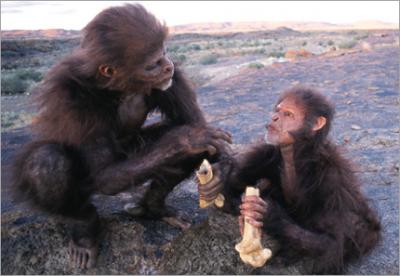
A post in
Babel's Dawn discusses the possible association between the development of
language and toolmaking
ability. A close connection if you think (as Edmund Blair Bolles does),
that there is no separate "black box" in the brain for language —no
hard-wired "language sense" as argued by Chomsky—and you believe instead
that language rests on and interacts with other multi-purpose mental
abilities and neural systems. Bolles reads a paper by Dietrich Stout et
al. (
abstract here)
as evidence for his contention that shared attention to a "third"
neutral or objective topic (the tool, here), which is necessary for
language and for toolmaking, is a central and early development in human
evolution. My commentary:
There's
another issue associated with tools and toolmaking (especially when
tools are involved in toolmaking). There is a rearrangement of attention
and of the sense of body limits, so that the body of the tool wielder
includes the tool so to speak. This would seem to be if not exclusive to
human beings then at least greatly developed in them, and one would
think it involves a reflexive sense of one's bodily alterations, and the
enhancement of corresponding neural paths (possibly a circuit which
enables a complex feedback of information between intentions, process
schemata and sense data). Even if the neural paths for tools and those
for language are not the same, and don't let's forget that signs are (to some extent) tools,
one may suppose that the neurological flexibility required to develop
those neural paths might have an indirect effect on the development of
the feedback and reprojection paths needed for language processing and
advanced conceptualization.
The Stout paper itself seems
to argue a rather close relationship between the neural paths required
for language and for toolmaking, based on experimental measurements of
neural activation: "This includes an increased activation of ventral
premotor and inferior parietal elements of the parietofrontal praxis
circuits in both the hemispheres and of the right hemisphere homologue
of Broca's area. The observed patterns of activation and of overlap with
language circuits suggest that toolmaking and language share a basis in
more general human capacities for complex, goal-directed action. The
results are consistent with coevolutionary hypotheses linking the
emergence of language, toolmaking, population-level functional
lateralization and association cortex expansion in human evolution."
And they are consistent, too, I should point out, with our previous
neurological speculations on the reflexive processes involved in conceptualization and language—what I termed the
re-projection of expected shapes, of conceptualized data patterns and of schemata—
ideas
that the mind derives from the world, processes, and re-projects in
order to shape reality to plans and expectations—making it fit more
closely to a communicable or repeatable structure. Or, to put it
otherwise, the conceptual re-projection of patterns, schemata and ideas
is necessary in order to semiotize reality, to
turn objects into signs of themselves—or of what they might become. One makes tools with that.
—oOo—


 tes necesarios para esa imagen—a cañonazos
matamos las moscas fácilmente.
tes necesarios para esa imagen—a cañonazos
matamos las moscas fácilmente.

