Ocurre en una academia privada de Seúl que ofrece lecciones de griego clásico. La protagonista, una mujer joven y doliente al perder la custodia de su hijo de 8 años, estudia griego antiguo para escapar al silencio, «porque quería recuperar el habla por su propia voluntad». pic.twitter.com/JZ5PN6QYgq
— Irene Vallejo (@irenevalmore) October 12, 2024

Mostrando entradas con la etiqueta Premio Nobel. Mostrar todas las entradas
Mostrando entradas con la etiqueta Premio Nobel. Mostrar todas las entradas
sábado, 12 de octubre de 2024
Han Kang


lunes, 2 de octubre de 2023
Premio Nobel a las Vacunas Tóxicas
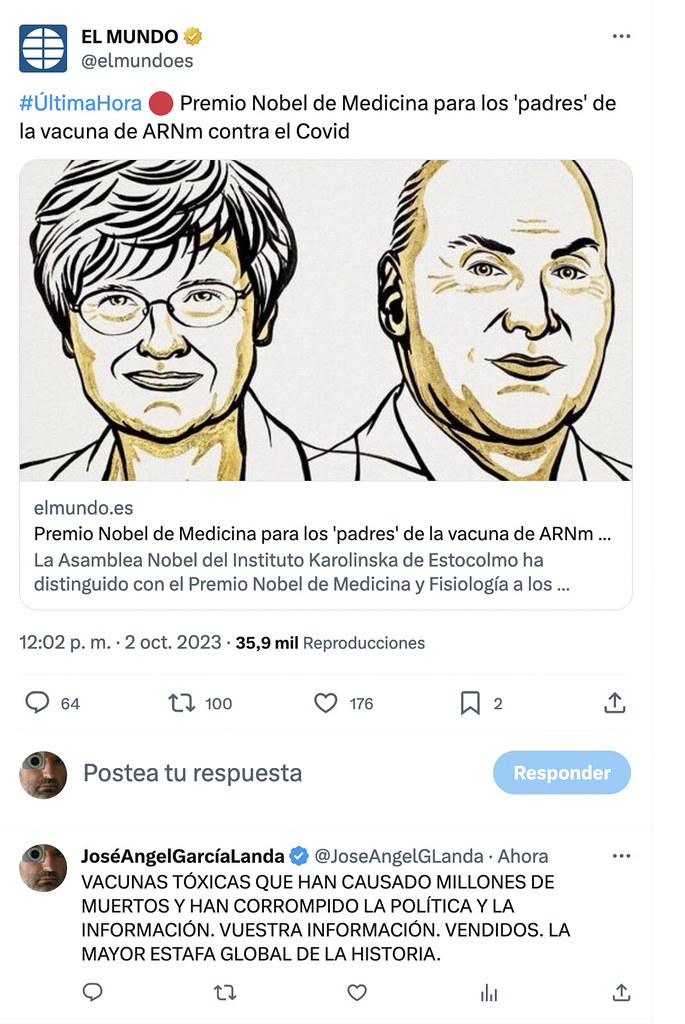
LEAN LOS COMENTARIOS A ESTA NOTICIA DE EL MUNDO, O, TANTO DA, LOS COMENTARIOS AL ANUNCIO ORIGINAL EN EL TWITTER DE LA FUNDACIÓN NOBEL, AQUÍ:
https://twitter.com/NobelPrize/status/1708780262883017166
The Conversation, cómo no, acude a dar palmas, que la Universidad es así, desdichadamente:
Corell Almuzara, Alfredo. (Chair of Inmunology, U of Seville). "Premio Nobel para la molécula de la vida que ha puesto contra las cuerdas a la Covid." The Conversation 2 Oct. 2023.*
2023
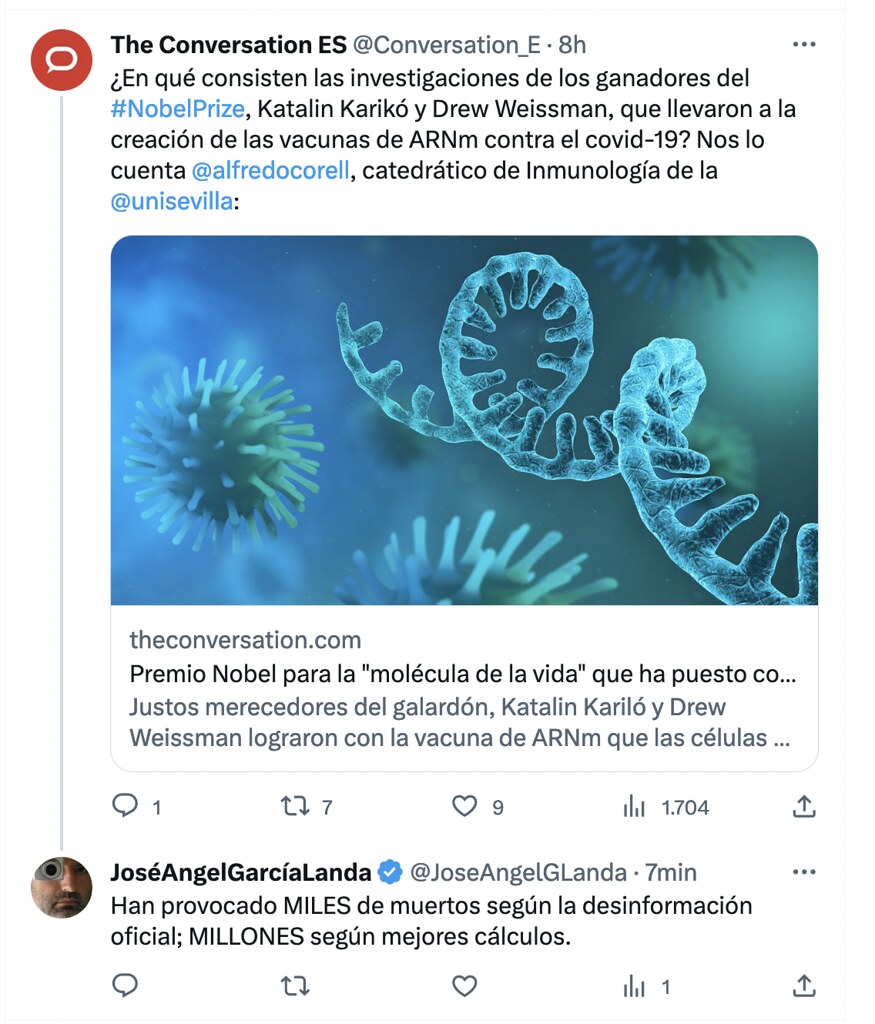
Estas inyecciones han provocado MILES de muertos según la desinformación oficial; MILLONES según mejores cálculos. En este artículo no aparecan las palabras "efectos adversos" ni "víctimas". Y no digo más. Las conclusiones, ustedes mismos. Es lamentable el nivel al que se están poniendo los científicos, las autoridades sanitarias, los informadores, y los premiadores.
Estas inyecciones han provocado MILES de muertos según la desinformación oficial; MILLONES según mejores cálculos. En este artículo no aparecan las palabras "efectos adversos" ni "víctimas". Y no digo más. Las conclusiones, ustedes mismos. Es lamentable el nivel al que se están… https://t.co/aC2IPx1xtY
— JoséAngelGarcíaLanda (@JoseAngelGLanda) October 3, 2023
Veremos lo que tardan en desaparecer los comentarios en The Conversation, medio globalista-covidista:
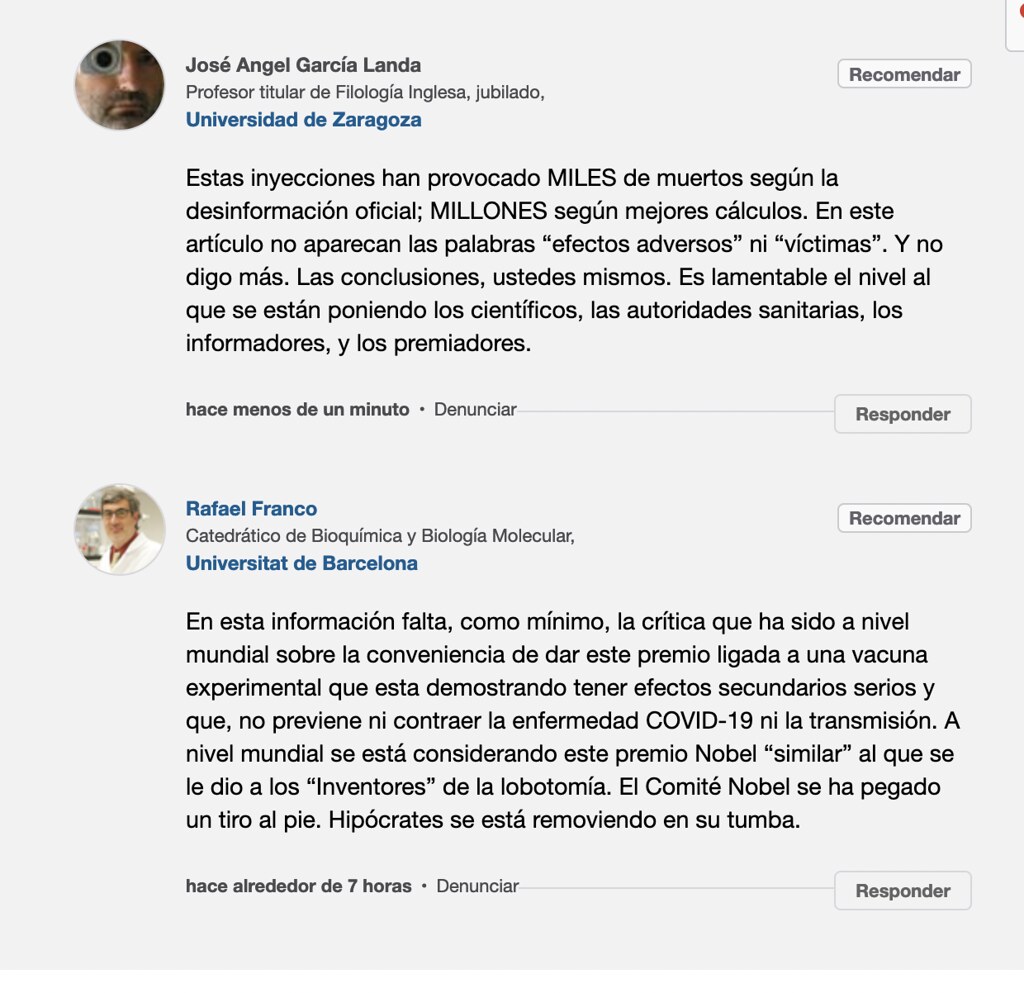
Desaparece mi comentario... según viene ser costumbre en este medio oficialista Covidiano que es The Conversation. Sobre algunos temas está claro que no quieren conversación, ni argumentos ni leches. Se eliminan las voces o ideas que nos disgustan y ya está. Muy académico todo:

Pero insisto:
Han eliminado Vds., por razones no especificadas, un comentario mío a este artículo. Pero es que estas cosas no pueden quedar sin respuesta. Ya que optan ustedes, en The Conversation, por la censura en lugar de por la argumentación o la conversación, no me queda sino irme a otro sitio o diluir el comentario a ver si pasa la censura de ustedes. Que siempre suele ir en unas direcciones muy determinadas. Sólo diré, por tanto, a ver si se dignan Vds. no borrar el comentario, que es extraño que se den por buenas unas vacunas que han causado muchas víctimas, y que el artículo en cuestión celebre el premio Nobel concedido sin hacer siquiera mención de esta circunstancia.
.@NobelPrize dark history repeats with award to Egaz Moniz 1949 for disastrous frontal lobotomy; now @WeissmanLab Kariko 2023 for modification of damaging mRNA making it long-lasting and lethal when coding for the Wuhan Spike Protein. @NobelPrize should help not hurt mankind. pic.twitter.com/U97zjorfLF
— Peter A. McCullough, MD, MPH™ (@P_McCulloughMD) October 3, 2023
Dr Robert Malone, inventor of mRNA vaccines:
— Robin Monotti (@robinmonotti) October 5, 2023
"Clearly the Nobel Assembly has not kept up with the latest data, and still believes the propaganda of safe, effective, and rapid degradation of the pseudo-mRNA. Which means that they really do not know what they have endorsed with… pic.twitter.com/netKd4XewB
More scary data showing how toxic (and lethal) the Covid mRNA vaccine platform is. How this study with this title managed to get published in a major journal is beyond me. Is it that some of the editorial mafia running the high-impact journals are starting to find a conscience?… pic.twitter.com/BRUFYTdtpX
— Pierre Kory, MD MPA (@PierreKory) October 12, 2023
__________________
En otro artículo de The conversation loando el premio Nobel a la de Biontech, pongo lo siguiente:
Por curiosidad, ¿han oído hablar los autores de los millares de víctimas y efectos adversos causados por estas vacunas? Son informaciones que corren por las redes, si bien no por los telediarios y por los medios oficialistas. ¿Las consideran hablillas, invenciones, 'fake news'? ¿Tienen esos miles de víctimas mortales algún asidero en la realidad, o los podemos dar por amortizados, y además ya por inexistentes? Son cuestiones que deberían hacer reflexionar a la hora de promover un determinado medicamento, como por desgracia ya se ha visto en otras ocasiones.
Verán lo que tardan en borrarlo. De aquí:
Navarrete, Kevin (Czech Academy of Sciences) and Yersain Elly Keller de la Rosa (UNAM). "Katalin Karikó y cómo la perseverancia rinde frutos en ciencia." The Conversation 2 Oct. 2023.*
https://theconversation.com/katalin-kariko-y-como-la-perseverancia-rinde-frutos-en-ciencia-168977
Borran, como era de prever, el comentario. Les añado este otro:
Veo que, en contra de los supuestos fines que sugeriría el título de "The Conversation", hay aquí más interés en la censura que en la conversación. Desde luego se toleran muy mal, es decir, se borran, los comentarios que presentan ideas contrarias a las favorecidas por el autor y por el medio. Con supuestas excusas justificativas, eso sí. Como este comentario mío seguirá los pasos de los anteriores, me limitaré a hacer constar, antes de que lo borren, de que aquí no se admiten las evidencias y datos contrarios a la política oficial (muy oficialista) sobre las vacunas Covid. Se ignora o se oculta que las vacunas Covid son muy perniciosas, que han causado numerosísimas víctimas mortales e incontables efectos adversos graves, leves o letales a medio plazo. Como han denunciado cientos, miles, de médicos y científicos valientes y acreditadísimos. Es un auténtico escándalo silencioso el que las autoridades sanitarias las sigan promoviendo, y que los medios como éste sigan encubriendo esta gigantesca estafa criminal. Premiada con el Nobel, para más inri y mejor encubrimiento. Una aportación nada más—tengo una bibliografía si les interesa:
McCullough, Peter. "One mRNA, One Spike Protein, 1291 Diseases, Unlimited Ways to Die." America Out Loud News 18 March 2022.*
https://www.americaoutloud.news/one-mrna-one-spike-protein-1291-diseases-unlimited-ways-to-die/
_______
Rancourt, Denis G., and Joseph Hickey. "Quantitative Evaluation of Whether the Nobel-Prize-Winning Covid-19 Vaccine Actually Saved Millions of Lives." Correlation 8 Oct. 2023.*
https://correlation-canada.org/nobel-vaccine-and-all-cause-mortality/
2023
Press Release: @NobelPrize Protest – Call for Global Candlelight Vigils on Dec 10 for All Those Harmed or Deceased from mRNA Vaccination--outrage happening in real time. Kariko/Weissman @WeissmanLab Nobel Prize for mRNA a nightmare for humanity. https://t.co/bfZkugzO3u pic.twitter.com/l67Wep9AX0
— Peter A. McCullough, MD, MPH® (@P_McCulloughMD) December 8, 2023
jueves, 6 de octubre de 2022
Annie Ernaux, premio Nobel
¿Quién es Annie Ernaux? Las claves vitales de la Nobel de Literatura 2022 https://t.co/URSI9I7I42
— ABC.es (@abc_es) October 6, 2022
viernes, 18 de diciembre de 2020
Morrison, Toni
By Adam Begley. From the Salon.com Reader's Guide to Contemporary Authors (2000).
MORRISON, Toni (1931-[2019])
FICTION: The Bluest Eye (1970), *Sula (1973), Song of Solomon (1977), Tar Baby (1981), Beloved (1987), Jazz (1992), Paradise (1998) [Love (2003), A Mercy (2008), Home (2012), God Help the Child (2015)]
NONFICTION: Playing in the Dark: Whiteness and the Literary Imagination (1992)
Sula—I'm talking about the character here, not the novel—would have winced at the sentimental streak running through Beloved, Toni Morrison's best-known book. Sula is bad news, a skeptical fatalist, an idle, amoral artist, an accident so sure to happen it doesn't bother waiting. But she's my favorite; and she lights up Morrison's second novel like a torch. She's a good part of the reason why I insist that Sula, the skinny, 174-page novel, is Morrison's masterpiece.
Beloved—I'm talking about the novel here, not the character, who's really just a ringer from The Exorcist—is something of an icon, a bit like Morrison herself, the unassailable Nobel laureate, supremely confident in herself as a woman, a black woman, and a black woman writer. Beloved is a "contemporary classic," a big book with a colossal subject: slavery. Who wants to knock it? Not m, because in fact it's beautiful, rich, fierce, harrowing. A damn fine book. But also sentimental. Why should uplift and overripe prose poems clog a novel about a runaway slave willing to slaughter her own children, including her newborn baby, rather than be dragged back to captivity, children in tow?
In Beloved, Morrison strains to remind us of goodness and love, as though she feels she has to counter the world's gross tonnage of evil. So we have a white girl busy saving Sethe's life (Sethe the runaway slave, half-dead, hugely pregnant); the white girl chatters all the while about how "Sleeping with the sun in your face is the best old feeling." And we have two of Morrison's specialties, food and sex, served up luscious enough to make us forget all that looming horror. Here, for example, the erotic version of corn-on-the-cob: "How loose the silk. How quick the jailed-up flavor ran free . . . [N]o accounting for how that simple joy could shake you."
I can already hear a grad-school clever argument about how Morrison binds food and sex and the monstrosity of slavery in one tangled life-like whole, but that doesn't change a thing. The music swells, Sula winces.
Morrison began with a bone-dry book, The Bluest Eye, about a little black girl raped by her father and driven mad by her yearning for blue eyes, epitome of the white world's ideal of beauty. A sad and bitter story, choked by too many voices, it contains passages as lovely as anything Morrison has written—but it's a minor work in a minor key.
Then comes Sula, the story of two little girls, best friends, who grow up very different in "the Bottom," the black neighbourhood of a small Ohio city. Sula and Nell are bouncing with life, vividly real but also emblematic. Sula becomes the radical individualist, Nell the pillar of the community, steady, maternal, dutiful. Morrison weaves her tale with just three strands, a place and two families, but she seems magnificently omniscient, as though she had access to the pooled insight of every sociologist, every psychologist, every anthropologist; as though she had solved the riddle of what holds society together, what holds the solitary self together—and what blows it all apart. Though packed with comic scenes and and brilliantly inventive, Sula ends on a note of rich, full-throated sadness. There's plenty of laughter in the Bottom, but only visiting white folk manage to "hear the laughter and not notice the adult pain that rested somewhere under the eyelids, somewhere under [the] head rags and soft felt hats . . . . [T]he laughter was part of the pain."
Song of Solomon—another marvel, a rambling tale, almost picaresque, freer and more daring than Sula, though less precise, less perfect—follow a callo young man's slow steps to redemption. If Sula is about self and community, Song of Solomon is about self and family. Hints of the fantastic in the first two novels—folklore, and the maybe-magic of myth—blossom here. The ordinary takes wing: Our hero flies.
The weakest of Morrison's novels is Tar Baby, a dubious jumble set in the Caribbean, featuring a white candy magnate, his black servants, their beautiful niece, and an ugly cruelty inflicted years ago. Morrison's first extended excursion into the heads of white folk. Only for the loyal fan.
Beloved wiped the slate clean and beckoned, with the same gesture, the august attentions of the Swedish Academy. After which, of course, a disappointment: Jazz, a curiously dispassionate, plotless love story set in Harlem in the 1920s. A teenage girl, an older man, and his jealous wife generate some bizarre domestic violence. In the background, the threat of race riots.
Another kind of violence powers Paradise: the defensive violence of black people intent on protecting their community. Ruby, Oklahoma, is an all-black settlement founded in 1950, a patriarchy, fortress of rightenousness, a prosperous, peaceable community. Persecuted by whites, shunned by lighter-skinned blacks, the people of Ruby have shut out the white world. A few miles from Ruby is the Convent, nun-less since 1970, a shelter of sorts for women, most of them battered and abused, some black, some white. There is no structure to life at the Convent, no rules, no authority. It is an anti-community, a kind of anarchist's paradise. In 1976, the misguided men of Ruby, who think of the Convent as a witches' coven, stage a deadly raid.
The narrative is choppy and needlessly confused, but Morrison's messabge comes through loud and clear. No haven can be heavenly, no home can smack of paradise, if it begins with exclusion or thrives by triage—some in, some out, some damned, some saved. Morrison is agitating for the abolition of us versus them.
As a storyteller Morrison combines a poet's grace, a radical's fervor, and a great preacher's moral majesty. She writes for and about the African-American community ("If I tried to write a universal novel," she once claimed, "it would be water"). And yet she reaches us all.
See Also: Nobody who "writes like" Morrison is anywhere as good as she is. If you're after other African-American writers, try James Baldwin or John Edgar Wideman (avoid Alice Walker). If you're after nuanced treatment of racial isues, try Nadine Gordimer. If you just want a novel as good as Sula, try The Great Gatsby or Billy Budd.
—Adam Begley
jueves, 29 de octubre de 2020
sábado, 17 de octubre de 2020
sábado, 4 de enero de 2020
Contra la podemita polaca
El discurso pronunciado por la escritora polaca Olga Tokarczuk @tokarczuk_olga durante la entrega del Premio Nobel de Literatura, incorporó algunas notas negrolegendarias. Era obligado salir al paso de las mismas: https://t.co/KrfBWbH7HL. #LeyendaNegra— Iván Vélez (@IvanVelez72) January 4, 2020
Quizá, como dice la autora, "la ficción sea siempre un tipo de verdad"—pero probablemente sólo en relación a la literatura de creación. Porque donde al autor quiere referirse a "ciertos momentos de la historia" habría más bien de tener en cuenta las obras escritas sobre ellos y los documentos. De otro modo, como dice ella misma, "una mentira se convierte en un arma de destrucción masiva." Por desgracia.
—oOo—
domingo, 8 de diciembre de 2019
viernes, 11 de octubre de 2019
Peter Handke, a controversial Nobel prize
Peter Handke, a troubling choice for the Nobel Prize for literature: https://www.theguardian.com/books/2019/oct/10/troubling-choice-authors-criticise-peter-handke-controversial-nobel-win
(Aren't they all controversial?) Well, no, the other laureate fits the bill perfectly, being a woman, a relative "youngster" for a Nobel, a feminist, and a vegetarian. That's more in keeping with the Spirit of the Age.
Armitstead,
Claire. "Olga Tokarczuc, the Dreadlocked Feminist Winner the Nobel
Needed." The Guardian (Books) 10
Oct. 2019.*
2019
—oOo—
sábado, 13 de abril de 2019
Nivelazo Premio Nobel
El nivelazo de la Premio Nobel. pic.twitter.com/jRoBuLkAcg— goslum (La insoportable levedad de Van den Eynde) (@goslum) 13 de abril de 2019
viernes, 5 de octubre de 2018
Nobel de la Paz contra el Califato Islámico
Nadia Murad Premio Nobel de la Paz 2018. Tuve la inmensa fortuna de entrevistarla hace unos meses en @okdiario. Reconocimiento merecidísimo a una luchadora. Tan frágil de aspecto como contundente en su determinación contra el Estado Islámico. Brava! https://t.co/tBM68gjgDy— María Jamardo (@MariaJamardoC) 5 de octubre de 2018
domingo, 6 de mayo de 2018
sábado, 14 de abril de 2018
lunes, 6 de noviembre de 2017
Retropost #1852 (6 de noviembre de 2007): Poetry, Nobel, Criticism
Me llega esta circular:
El Director del Departamento de Filología Inglesa y Alemana de la Universidad de Zaragoza le saluda y le comunica que el Comité para el Nobel de la Academia Sueca invita a todos los profesores de literatura e idiomas modernos a proponer candidatos para el Premio Nobel de Literatura del 2007. Las propuestas pueden dirigirse a la siguiente dirección antes del 25 de enero de 2008:
The Nobel Committee of the Swedish Academy
Box 2118
SE-103 13 Stockholm
Sweden
Carlos Inchaurralde Besga
Aprovecha la ocasión para reiterarle su consideración más distinguida
Pues aunque no les enviaré mi sugerencia, yo sugiero que por un año se deje vacante el premio, y que se saque una declaración pidiendo a los escritores que suban el nivel y nos dejen realmente impresionados.
O que se lo den a algún novelista novel, no por lo que ha hecho sino por lo que podría hacer—antes de que no lo haga. Mi candidato: Jonathan Littell—se acaba de publicar Las Benévolas, la traducción española de Les Bienveillantes.
Aún mejor: que vaya el premio a un poeta popular—y aún mejor que a Bob Dylan, que se lo den a Luis Eduardo Aute, o a Leonard Cohen:
Pero todavía mejor: sugiero que le den el premio, de una vez, a un crítico literario. Pues es sólo en la crítica donde la literatura logra ciertos efectos de elaboración, y donde la literatura alcanza su perfección, o llega a decir lo que parece que quería decir pero no conseguía.
En ese caso propongo que le den el premio Nobel a J. Hillis Miller.
—oOo—
El Director del Departamento de Filología Inglesa y Alemana de la Universidad de Zaragoza le saluda y le comunica que el Comité para el Nobel de la Academia Sueca invita a todos los profesores de literatura e idiomas modernos a proponer candidatos para el Premio Nobel de Literatura del 2007. Las propuestas pueden dirigirse a la siguiente dirección antes del 25 de enero de 2008:
The Nobel Committee of the Swedish Academy
Box 2118
SE-103 13 Stockholm
Sweden
Carlos Inchaurralde Besga
Aprovecha la ocasión para reiterarle su consideración más distinguida
Pues aunque no les enviaré mi sugerencia, yo sugiero que por un año se deje vacante el premio, y que se saque una declaración pidiendo a los escritores que suban el nivel y nos dejen realmente impresionados.
O que se lo den a algún novelista novel, no por lo que ha hecho sino por lo que podría hacer—antes de que no lo haga. Mi candidato: Jonathan Littell—se acaba de publicar Las Benévolas, la traducción española de Les Bienveillantes.
Aún mejor: que vaya el premio a un poeta popular—y aún mejor que a Bob Dylan, que se lo den a Luis Eduardo Aute, o a Leonard Cohen:
Pero todavía mejor: sugiero que le den el premio, de una vez, a un crítico literario. Pues es sólo en la crítica donde la literatura logra ciertos efectos de elaboración, y donde la literatura alcanza su perfección, o llega a decir lo que parece que quería decir pero no conseguía.
En ese caso propongo que le den el premio Nobel a J. Hillis Miller.
—oOo—
domingo, 15 de octubre de 2017
Retropost #1825 (15 de octubre de 2007): Much ado about Lessing
Much ado about Lessing
Publicado en Literatura y crítica. com. José Ángel García Landa
Enhorabuena a Doris Lessing por el Premio Nobel de Literatura. Dirá la gente que vamos más que servidos de anglófonos, pero no me voy a quejar yo... Africanas persas no hay tantas en la lista. Lessing me ha gustado lo suficiente como para leer varias novelas suyas, y aún pienso repetir.
Como cajón de sastre mental, narración parabloguística y para amantes de las crisis y desastres personales, recomiendo The Golden Notebook. Para etarras, The Good Terrorist—aunque serán incapaces de apreciarlo, ya están en ello. Para ancianas que no se resignan a serlo, Love, again. Como fantasía que se abre como un paisaje infinito en un mundo de rutina, Briefing for a Descent into Hell. Y a mí me recomiendo el próximo que me leeré, The Fifth Child (no apto para parejas jóvenes). Para adoradoras míticas del coño, la última de este año: The Cleft. A quienes aprecien una pizca de humor en su literatura, no les recomiendo ninguno.
Me parece en conjunto bastante ajustada, y entretenida, esta discusión sobre algunos aspectos de su obra en The Valve. Puede que no sea Lessing la elección más obvia para Premio Nobel, pero nadie lo es si lo miras bien. El Premio Nobel magnifica la atención, pero al nivel fundamental ni añade ni quita cualidades a un escritor. Con lo cual el Nobel resulta ser una decepción en la mayoría de los casos, pues el atractivo de un escritor para un público determinado ni a tiros se convierte en el atractivo universal que parece requerir un premio universal. Así que las reclamaciones, a la Academia.
Publicado en Literatura y crítica. com. José Ángel García Landa
Enhorabuena a Doris Lessing por el Premio Nobel de Literatura. Dirá la gente que vamos más que servidos de anglófonos, pero no me voy a quejar yo... Africanas persas no hay tantas en la lista. Lessing me ha gustado lo suficiente como para leer varias novelas suyas, y aún pienso repetir.
Como cajón de sastre mental, narración parabloguística y para amantes de las crisis y desastres personales, recomiendo The Golden Notebook. Para etarras, The Good Terrorist—aunque serán incapaces de apreciarlo, ya están en ello. Para ancianas que no se resignan a serlo, Love, again. Como fantasía que se abre como un paisaje infinito en un mundo de rutina, Briefing for a Descent into Hell. Y a mí me recomiendo el próximo que me leeré, The Fifth Child (no apto para parejas jóvenes). Para adoradoras míticas del coño, la última de este año: The Cleft. A quienes aprecien una pizca de humor en su literatura, no les recomiendo ninguno.
Me parece en conjunto bastante ajustada, y entretenida, esta discusión sobre algunos aspectos de su obra en The Valve. Puede que no sea Lessing la elección más obvia para Premio Nobel, pero nadie lo es si lo miras bien. El Premio Nobel magnifica la atención, pero al nivel fundamental ni añade ni quita cualidades a un escritor. Con lo cual el Nobel resulta ser una decepción en la mayoría de los casos, pues el atractivo de un escritor para un público determinado ni a tiros se convierte en el atractivo universal que parece requerir un premio universal. Así que las reclamaciones, a la Academia.
domingo, 8 de octubre de 2017
Retropost #1813 (8 de octubre de 2007): Abandoned Love
Seguimos canturreando. Aquí una casi desconocida canción de Bob Dylan, que es una de las que más me gustan, especialmente en la versión de los Everly Brothers. Dylan está propuesto para el Nobel de literatura: creo que se lo darán cuando a mí me den el Grammy.
PS: Pues mucho me equivocaba yo hace diez años, y ya hace un año que Dylan recibió el Nobel de Literatura. Yo aún sigo, snif, esperando mi Grammy.
—oOo—
viernes, 6 de octubre de 2017
Kazuo Ishiguro Premio Nobel de Literatura 2017
Ellis-Petersen,
Hannah, and Alison Flood. "Kazuo Ishiguro Wins the Nobel Peace Prize in
Literature 2017." The Guardian 5
Oct. 2017.*
2017
—oOo—
jueves, 5 de octubre de 2017
Kazuo Ishiguro on The Buried Giant
Hoy se anuncia que recibe el Premio Nobel Kazuo Ishiguro. Van dos Nobel de literatura seguidos a la lengua inglesa, después de Bob Dylan. Esta entrevista es sobre su última novela, The Buried Giant.
—oOo—
martes, 6 de junio de 2017
Bob Dylan' 2016 Nobel Lecture in Literature
Texted version: https://youtu.be/3Zf04vnVPfM
Bob Dylan Delivers His Nobel Prize Lecture, Just in Time https://nyti.ms/2sJF1Eo
Bob Dylan's speech at the Nobel prize Banquet, read by the American ambassador:
—oOo—
lunes, 26 de diciembre de 2016
Suscribirse a:
Entradas (Atom)
Mi fotoblog

se puede ver haciendo clic en la foto ésta de Termineitor. Y hay más enlaces a cosas mías al pie de esta página.