
Mostrando entradas con la etiqueta Smolin. Mostrar todas las entradas
Mostrando entradas con la etiqueta Smolin. Mostrar todas las entradas
viernes, 18 de abril de 2025


jueves, 19 de diciembre de 2024
sábado, 27 de mayo de 2023
Retropost, 2013: Lee Smolin, TIME REBORN / EL RENACER DEL TIEMPO
The Perimeter Institute founder, physicist and cosmologist Lee Smolin, rethinks the nature of the universe in his new book, Time Reborn. With Robert J. Sawyer.
Lee Smolin expounds in Time Reborn a radical evolutionary theory, which includes the possibily of the evolution, with time, of the laws of physics. This might lead to an explanation of the so-called 'fine tuning' of the laws of physics which in principle would seem to make the existence of our universe highly improbable. This novel explanation would not involve an anthropic teleology or a theory of the multiverse.
Lee Smolin propone en su nuevo libro una teoría evolucionista radical,
que incluye la posible evolución con el tiempo de las leyes de la
física. Así podría explicarse el llamado "ajuste fino" de las leyes
físicas que en principio parecería hacer improbable la existencia de
nuestro universo: y ello sin acudir ni a una teleología antrópica, ni a
una teoría del multiverso.
Transcripción en español de la entrevista con Lee Smolin:
—oOo—
miércoles, 27 de enero de 2021
viernes, 3 de mayo de 2019
lunes, 22 de abril de 2019
miércoles, 20 de diciembre de 2017
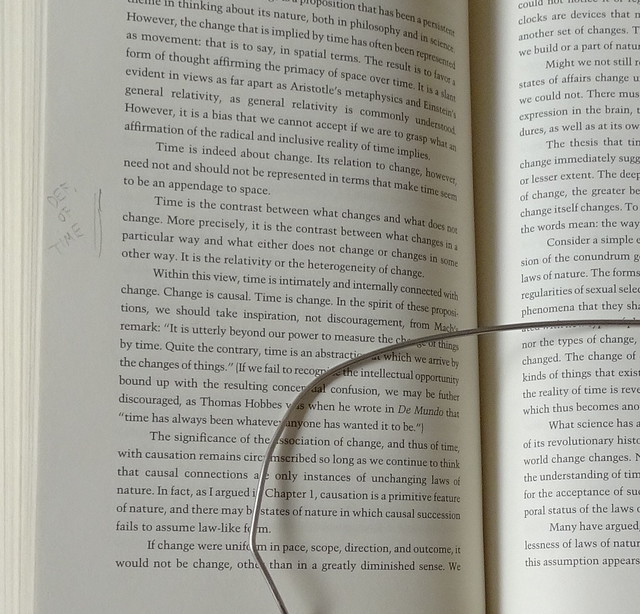
jueves, 14 de diciembre de 2017
El descubrimiento del espacio inmenso y del tiempo infinito
El descubrimiento de la inmensidad del espacio cósmico se fue abriendo paso gradualmente en la astronomía moderna. El concepto de la inmensidad del tiempo quedaba sin embargo limitada por la dificultad de establecer una teoría científica sobre el pasado o el futuro remotos, a la vez que la tradición religiosa lo acotaba a los límites de un acto creativo de Dios. La primera concepción científíca de un universo no estático llevó a una teoría — el Big Bang — que también participa en cierto modo de una concepción finita del tiempo. Pero en la física de hoy, enfrentada al problema del multiverso, también el tiempo tiende, más allá de la inmensidad de las proporciones cósmicas, hacia un pasado y un futuro infinitos, sin límite concebible ni en la imaginación ni en la ciencia.
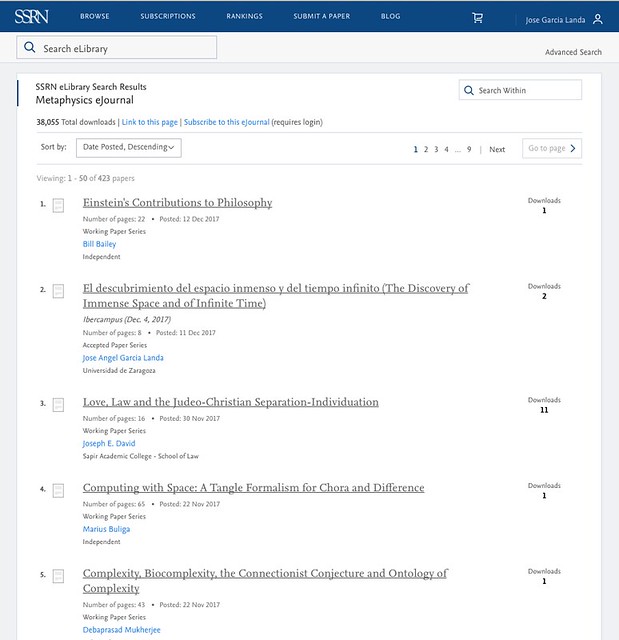
El descubrimiento del espacio inmenso y del tiempo infinito https://papers.ssrn.com/abstract=3083462
English abstract:
The Discovery of Immense Space and of Infinite Time
The discovery of the immensity of cosmic space was a gradual discovery of modern astronomy. A conception of the immensity of time was nonetheless limited by the difficulty of establishing a scientific approach to the remote past or future, while the religious tradition set a limit to time in the creative action of God. The first scientific conception of a non-static universe led to a theory — the Big Bang theory — which in a sense also partakes of a finite conception of time. But in contemporary physics, facing the problem of the multiverse, time also tends, beyond the immensity of cosmic proportions, towards an infinite past and future, without any conceivable limit either for science or for imagination.
Reference Info: Ibercampus (Dec. 4, 2017)
Date posted: December 11, 2017
Notes: Downloadable document is in Spanish.
Keywords: Time, Physics, Big Bang, Cosmology, Multiverse, Evolution, Lee Smolin, Infinite, Eternity, Universe
Garcia Landa, Jose Angel, El descubrimiento del espacio inmenso y del tiempo infinito (The Discovery of Immense Space and of Infinite Time) (December 4, 2017). Ibercampus (Dec. 4, 2017). Available at SSRN: https://ssrn.com/abstract=3083462
| eJournal Classifications | Message |
AARN Subject Matter eJournals | Added to eLibrary  |
| PRN Subject Matter eJournals | Added to eLibrary |
| PRN Subject Matter eJournals | Added to eLibrary |
—oOo—
lunes, 4 de diciembre de 2017
El descubrimiento del espacio inmenso y del tiempo infinito
El descubrimiento de la inmensidad del espacio se fue abriendo paso gradualmente en la astronomía moderna. La inmensidad del tiempo quedaba sin embargo acotada por una concepción finita, que lo acotaba a los límites de un acto creativo de Dios—o del Big Bang. Pero hoy también el tiempo tiende, más allá de la inmensidad de las proporciones cósmicas, hacia un pasado y un futuro infinitos, sin límite concebible ni en la imaginación ni en la ciencia.
Hace poco en Intereconomía un presentador creacionista, y un físico creacionista, comentaban el problema del Ajuste Fino, y ante el absurdo del Multiverso necesario al parecer para explicarlo, optan por una solución clásica (la que les pedía el cuerpo) que es remitir el origen del Ajuste Fino de las fuerzas de la naturaleza, de la inflación del Universo, de la masa relativa de las partículas, etc., a la voluntad de un creador y al "diseño inteligente". (Un creador que queda inexplicado y que en ese sentido no explica nada, claro).
Min. 53,
--> https://youtu.be/HuESdXv6l2g
Allí se remontan estos contemporáneos nuestros al ejemplo de los primeros científicos modernos, también creacionistas ellos, que daban con la misma solución en cuanto se hacían la misma pregunta. Leemos así en el prólogo a A Treatise on the System of the World de Isaac Newton—donde el prologuista expone los límites de la comprensión que tenemos de la gravitación:
Y ciertamente hemos argumentado también nosotros contra las soluciones matemáticas de Hawking invocando el infinito multiverso, y conllevando la insustancialidad del nuestro, en El Gran Diseño. Aquí más:
Hay una teoría del multiverso más atractiva, que (sin escapar de la multiplicidad de universos) los conecta todos en una historia única, y limita en cierto modo su arbitrariedad matemática. Ello a la vez que explica el ajuste fino de manera científicamente consistente. Es la teoría evolucionista de la cosmología propuesta por Lee Smolin y Roberto Mangabeira Unger, en la que se cuestiona la noción newtoniana (por así llamarla) de las leyes físicas dictadas para siempre e invariables por siempre jamás. Teoría de la cual hablo más aquí:

También satisface en cierto modo en esta teoría la articulación de un principio de generación de universos mediante la selección natural, reformulada a nivel cósmico ahora, pero enlazando de modo consiliente y elegante con la teoría darwinista de la formación autogenerada de la complejidad ("de las especies"). El problema de las "leyes firmes por siempre jamás" desaparece del primer plano, al introducirse la noción de la variabilidad de las leyes de la naturaleza en los momentos de crisis formativa o "big bang" del Universo—momentos en los que se generan universos de diferente viabilidad o complejidad, y entre ellos el nuestro (desde el que observamos y reconstruimos, por retrospección antrópica, el proceso que ha conducido hasta aquí).
Reaparece en un segundo plano, sin embargo, la cuestión de las leyes eternas rectoras del universo, en la forma del problema de las meta-leyes, también discutido elegante e inteligentemente por Smolin y Unger.
Pero en última instancia no podemos esquivar la cuestión del multiverso. El proceso de selección natural requiere un número enorme de generaciones de universos, y una máquina del mundo inabarcable, vale decir infinita —y siendo el infinito una de las bestias negras de Smolin y Unger, hay que señalar la paradoja o ironía de que el infinito no acaba de irse, y no hay manera de echarlo de la teoría, como sí parecía que lo echaba del mundo en un momento dado Stephen Hawking con su noción de un tiempo esférico cerrado en sí mismo. El consuelo de la teoría de Smolin/Unger es que los demás universos son aquí sub-universos del único universo y pertenecen a una única serie temporal.
Infinitos abismos de tiempo, si el tiempo es (una piedra angular de la teoría de Smolin y Unger) una dimensión fundamental e irreducible del Universo. Seguimos descubriendo, al asomarnos a esos abismos infinitos, abismos todavía mayores abriéndose a una escala vertiginosa, que nos sigue desbordando y pasmando, como les sucedía a los primeros científicos modernos al descubrir las vastas extensiones del universo abiertas por la astronomía matemática. Antaño el mundo, el Universo entero, había parecido finito y abarcable visualmente....
Pero esta infinidad del espacio no iba acompañada para ellos por una infinidad del tiempo. El Universo no podía considerarse eterno sino en virtud de la ignorancia de los procesos de la física y química de las estrellas; la eternidad que pedían las matemáticas para las leyes newtonianas en realidad venían a toparse con los límites de esa insuficiente explicación física por una parte, y con la tradición de narraciones creacionistas por otra. El Dios de Newton, deus ex machina si jamás hubo uno, le servía no sólo para decretar las leyes y reajustarlas en cuanto apareciesen inconsistencias en la teoría: también le servía para lidiar con la más importante inconsistencia de la misma: la existencia de leyes eternas que sin embargo han de surgir de alguna parte. La historia del mundo y el origen de las leyes se solucionan de un plumazo creativo, creacionista y científicamente inconsistente al postular un principio súbito para las leyes, que también supone un límite temporal para el mundo.
El terror de los espacios infinitos atenazaba a Pascal, pero sin embargo parece que la teoría cosmológica de la modernidad temprana (en la medida en que era una teoría) estaba a salvo de una serie infinita de tiempo. El tiempo del más allá es otra cosa, claro: no podemos sino figurarlo como tiempo, pero está claro que ese más allá de la creación imaginado sería una imagen móvil de la eternidad.
El mismo Einstein dejaba fuera de su teoría muchas cuestiones relativas a la dinámica del universo, y se contentaba con suponer (harto inconsistentemente) un universo estático. El consenso científico generalizado en torno al Big Bang propuesto por el físico cristiano Lemaître dejaría obsoletas posturas como la de Einstein. Es más, el consenso en torno a los orígenes físicos del universo sumaba a la Iglesia, que aceptó gustosa la teoría del Big Bang como muy consecuente con el Acto Creativo original de Dios. Con ello también se cerraba el tiempo del Universo al menos en uno de sus extremos: si bien había dudas sobre el destino final del Universo, parecía fuera de toda duda que el tiempo, a la vez que el espacio, se inició en el Big Bang, y que el tiempo "de antes" era (para el consenso físico de finales del siglo XX) un pseudo-problema, algo así como el tiempo de Dios que es sólo una manera de figurar la Eternidad.

Incluso la reciente teoría del multiverso de Vilenkin, Greene, Kaku, Hawking y otros, vendría a redundar en el consenso de poner de algún modo límites al tiempo—eso si el multiverso se entiende como una forma en último término geométrica o espacializada, con el Big Bang como origen de cada universo aislado y de cada serie temporal, cada una de ellas desconectada de las otras. Hasta ahora hemos sido griegos viviendo en un espacio-tiempo limitado, que es el espaciotiempo del Universo que nos rodea.
La infinidad del tiempo acaba de abrirse para la consideración de la Física, por primera vez. De algún modo resulta intuitivamente cercana, pero podemos sentir al contemplarla los mismos vértigos de infinidad espacial que sentían los primeros astrónomos caldeos al deternerse a examinar las estrellas, casi cayendo en ellas al mirar el cielo nocturno, o los vértigos espaciales resultantes de los cálculos de Kepler o de Newton. Ahora también el tiempo es un abismo inabarcable. Un abismo que se abre más allá de otro, y no parece que pueda concebirse un principio ni un final para la serie inabarcable y apenas discernible de los infinitos mundos pasados y futuros—concebibles quizá tan sólo desde éste.
Hace poco en Intereconomía un presentador creacionista, y un físico creacionista, comentaban el problema del Ajuste Fino, y ante el absurdo del Multiverso necesario al parecer para explicarlo, optan por una solución clásica (la que les pedía el cuerpo) que es remitir el origen del Ajuste Fino de las fuerzas de la naturaleza, de la inflación del Universo, de la masa relativa de las partículas, etc., a la voluntad de un creador y al "diseño inteligente". (Un creador que queda inexplicado y que en ese sentido no explica nada, claro).
Min. 53,
--> https://youtu.be/HuESdXv6l2g
Allí se remontan estos contemporáneos nuestros al ejemplo de los primeros científicos modernos, también creacionistas ellos, que daban con la misma solución en cuanto se hacían la misma pregunta. Leemos así en el prólogo a A Treatise on the System of the World de Isaac Newton—donde el prologuista expone los límites de la comprensión que tenemos de la gravitación:
Some persons will probably be ready to enquire what is the cause of this hidden virtue of gravity which is here attributed to the heavenly bodies. To this the only answer is, that this cause is as yet one of Nature's secrets: and perhaps it will ever remain so. 'Tis only plain from mathematical reasoning and undoubted observation, that such a virtue exists and operates in the System of the Planets, and that according to the laws above mentioned. Till a better explication be found, we may very well resolve it into the Will of the All-Wise and Almighty Creator, who when he formed and disposed these bodies, by this invisible bond made them fast for ever and ever: and gave them a law which shall not be broken. (xxiii-xxiv)
—In
Isaac Newton, A Treatise of
the System of the World: Translated into English. London: Printed
for F.
Fayram, 1728. Google Books:
Y ciertamente hemos argumentado también nosotros contra las soluciones matemáticas de Hawking invocando el infinito multiverso, y conllevando la insustancialidad del nuestro, en El Gran Diseño. Aquí más:
"El
Gran Diseño y Hacedor de
Estrellas: Especulaciones
sobre el multiverso y la única realidad." ResearchGate
1 Jan. 2015.*
Hay una teoría del multiverso más atractiva, que (sin escapar de la multiplicidad de universos) los conecta todos en una historia única, y limita en cierto modo su arbitrariedad matemática. Ello a la vez que explica el ajuste fino de manera científicamente consistente. Es la teoría evolucionista de la cosmología propuesta por Lee Smolin y Roberto Mangabeira Unger, en la que se cuestiona la noción newtoniana (por así llamarla) de las leyes físicas dictadas para siempre e invariables por siempre jamás. Teoría de la cual hablo más aquí:
_____.
"El paradigma evolucionista en Física y
Cosmología." ResearchGate 14
June 2016.*
También satisface en cierto modo en esta teoría la articulación de un principio de generación de universos mediante la selección natural, reformulada a nivel cósmico ahora, pero enlazando de modo consiliente y elegante con la teoría darwinista de la formación autogenerada de la complejidad ("de las especies"). El problema de las "leyes firmes por siempre jamás" desaparece del primer plano, al introducirse la noción de la variabilidad de las leyes de la naturaleza en los momentos de crisis formativa o "big bang" del Universo—momentos en los que se generan universos de diferente viabilidad o complejidad, y entre ellos el nuestro (desde el que observamos y reconstruimos, por retrospección antrópica, el proceso que ha conducido hasta aquí).
Reaparece en un segundo plano, sin embargo, la cuestión de las leyes eternas rectoras del universo, en la forma del problema de las meta-leyes, también discutido elegante e inteligentemente por Smolin y Unger.
Pero en última instancia no podemos esquivar la cuestión del multiverso. El proceso de selección natural requiere un número enorme de generaciones de universos, y una máquina del mundo inabarcable, vale decir infinita —y siendo el infinito una de las bestias negras de Smolin y Unger, hay que señalar la paradoja o ironía de que el infinito no acaba de irse, y no hay manera de echarlo de la teoría, como sí parecía que lo echaba del mundo en un momento dado Stephen Hawking con su noción de un tiempo esférico cerrado en sí mismo. El consuelo de la teoría de Smolin/Unger es que los demás universos son aquí sub-universos del único universo y pertenecen a una única serie temporal.
Infinitos abismos de tiempo, si el tiempo es (una piedra angular de la teoría de Smolin y Unger) una dimensión fundamental e irreducible del Universo. Seguimos descubriendo, al asomarnos a esos abismos infinitos, abismos todavía mayores abriéndose a una escala vertiginosa, que nos sigue desbordando y pasmando, como les sucedía a los primeros científicos modernos al descubrir las vastas extensiones del universo abiertas por la astronomía matemática. Antaño el mundo, el Universo entero, había parecido finito y abarcable visualmente....
But our reason assisted by geometry, opens to us a very different scene. It shews us an immense ocean of celestial space spreading it self on all hands from our Earth without possibility that any limits should be set to it. That the several heavenly bodies that seem to our eye so small, and equally distant from us, are in reality of prodigious magnitudes, and placed at vast and very different intervals from the Earth and each other, in that boundless abyss. (System of the World, v-vi)
Pero esta infinidad del espacio no iba acompañada para ellos por una infinidad del tiempo. El Universo no podía considerarse eterno sino en virtud de la ignorancia de los procesos de la física y química de las estrellas; la eternidad que pedían las matemáticas para las leyes newtonianas en realidad venían a toparse con los límites de esa insuficiente explicación física por una parte, y con la tradición de narraciones creacionistas por otra. El Dios de Newton, deus ex machina si jamás hubo uno, le servía no sólo para decretar las leyes y reajustarlas en cuanto apareciesen inconsistencias en la teoría: también le servía para lidiar con la más importante inconsistencia de la misma: la existencia de leyes eternas que sin embargo han de surgir de alguna parte. La historia del mundo y el origen de las leyes se solucionan de un plumazo creativo, creacionista y científicamente inconsistente al postular un principio súbito para las leyes, que también supone un límite temporal para el mundo.
El terror de los espacios infinitos atenazaba a Pascal, pero sin embargo parece que la teoría cosmológica de la modernidad temprana (en la medida en que era una teoría) estaba a salvo de una serie infinita de tiempo. El tiempo del más allá es otra cosa, claro: no podemos sino figurarlo como tiempo, pero está claro que ese más allá de la creación imaginado sería una imagen móvil de la eternidad.
El mismo Einstein dejaba fuera de su teoría muchas cuestiones relativas a la dinámica del universo, y se contentaba con suponer (harto inconsistentemente) un universo estático. El consenso científico generalizado en torno al Big Bang propuesto por el físico cristiano Lemaître dejaría obsoletas posturas como la de Einstein. Es más, el consenso en torno a los orígenes físicos del universo sumaba a la Iglesia, que aceptó gustosa la teoría del Big Bang como muy consecuente con el Acto Creativo original de Dios. Con ello también se cerraba el tiempo del Universo al menos en uno de sus extremos: si bien había dudas sobre el destino final del Universo, parecía fuera de toda duda que el tiempo, a la vez que el espacio, se inició en el Big Bang, y que el tiempo "de antes" era (para el consenso físico de finales del siglo XX) un pseudo-problema, algo así como el tiempo de Dios que es sólo una manera de figurar la Eternidad.
Incluso la reciente teoría del multiverso de Vilenkin, Greene, Kaku, Hawking y otros, vendría a redundar en el consenso de poner de algún modo límites al tiempo—eso si el multiverso se entiende como una forma en último término geométrica o espacializada, con el Big Bang como origen de cada universo aislado y de cada serie temporal, cada una de ellas desconectada de las otras. Hasta ahora hemos sido griegos viviendo en un espacio-tiempo limitado, que es el espaciotiempo del Universo que nos rodea.
La infinidad del tiempo acaba de abrirse para la consideración de la Física, por primera vez. De algún modo resulta intuitivamente cercana, pero podemos sentir al contemplarla los mismos vértigos de infinidad espacial que sentían los primeros astrónomos caldeos al deternerse a examinar las estrellas, casi cayendo en ellas al mirar el cielo nocturno, o los vértigos espaciales resultantes de los cálculos de Kepler o de Newton. Ahora también el tiempo es un abismo inabarcable. Un abismo que se abre más allá de otro, y no parece que pueda concebirse un principio ni un final para la serie inabarcable y apenas discernible de los infinitos mundos pasados y futuros—concebibles quizá tan sólo desde éste.
—ooo—
viernes, 1 de septiembre de 2017
Chaos and the Emergence of Order in Evolutionary Cosmology: Two Classical Accounts
This paper compares two very different cosmological accounts (a
classical creationist one, from the Enlightenment poet Abraham Cowley)
and a contemporary theory coming from the field of physics, Lee Smolin's
evolutionary theory of cosmology which upholds the changing nature of
physical laws. This is done in order to point out some striking
coincidences. Evolutionary accounts of phenomena may display such
seemingly enigmatic points in common due to two reasons: the nature of
the physical processes described, and the cognitive instruments
available to the human mind in dealing with the formation of stable
objects of cognition, such as physical laws, order, regularity, and
objects.
Chaos and the Emergence of Order in Evolutionary Cosmology: Two Classical Accounts
https://papers.ssrn.com/abstract=3013015
Suggested Citation:
Garcia Landa, Jose Angel, Chaos and the
Emergence of Order in Evolutionary Cosmology: Two Classical Accounts
(August 29, 2015). Ibercampus (August 29, 2015). Available at SSRN: https://ssrn.com/abstract=3013015
| eJournal Classifications |
| AARN Subject Matter eJournals |
| AARN Subject Matter eJournals |
| CSN Subject Matter eJournals |
| LIT Subject Matter eJournals |
| PRN Subject Matter eJournals |

Also here:
_____. "Chaos and the Emergence of Order in Evolutionary Cosmology: Two Classical Accounts." In García Landa, Vanity Fea 21 August 2015.*
http://vanityfea.blogspot.com.es/2015/08/chaos-and-emergence-of-order-in.html
2015
_____. "Chaos and the Emergence of Order in Evolutionary Cosmology: Two Classical Accounts." Ibercampus (Vanity Fea) 29 Aug. 2015.*
2015 DISCONTINUED 2022 – Online at the Internet Archive.*
2026
_____. "Chaos and the Emergence of Order in Evolutionary Cosmology: Two Classical Accounts." SSRN 15 Aug. 2017.*
https://ssrn.com/abstract=3013015
2017
Psychological Anthropology eJournal 15 Aug. 2017.*
https://www.ssrn.com/link/Psychological-Anthropology.html
2017
Cultural Anthropology eJournal 15 Aug. 2017.*
https://www.ssrn.com/link/Cultural-Anthropology.html
2017
Human Cognition in Evolution and Development eJournal 15 Aug. 2017.*
https://www.ssrn.com/link/Human-Cognition-Evolution-Development.html
2017
English & Commonwealth Literature eJournal 15 Aug. 2017.*
https://www.ssrn.com/link/English-Commonwealth-Lit.html
2017
Philosophy of Science eJournal 15 Aug. 2017.*
https://www.ssrn.com/link/Philosophy-Science.html
2017
_____. "Chaos and the Emergence of Order in Evolutionary Narratology: Two Classical Accounts." In García Landa, Vanity Fea 1 Sept. 2017.*
http://vanityfea.blogspot.com.es/2017/09/chaos-and-emergence-of-order-in.html
2017
_____. "Chaos and the Emergence of Order in Evolutionary Cosmology: Two Classical Accounts." Academia 14 Nov. 2017.*
https://www.academia.edu/35133928/
2017
_____. "Chaos and the Emergence of Order in Evolutionary Cosmology: Two Classical Accounts." ResearchGate 15 Nov. 2017.*
https://www.researchgate.net/publication/321085936
2017
_____. "Chaos and the Emergence of Order in Evolutionary Cosmology: Two Classical Accounts." Net Sight de José Angel García Landa 5 Jan. 2023.*
https://personal.unizar.es/garciala/publicaciones/Chaos&theEmergence.pdf
2023
_____. "Chaos and the Emergence of Order in Evolutionary Cosmology: Two Classical Accounts." Knowledge Commons Works 13 June 2026.*
https://doi.org/10.17613/psea7-e1d11
https://works.hcommons.org/records/psea7-e1d11
2026
—oOo—
viernes, 11 de agosto de 2017
On the Universe as a Process of Unique Events
On the Universe as a Process of Unique Events
Notes from (and on) the article by Marina Cortês and Lee Smolin, "The Universe as a Process of Unique Events" (Physical Review, 2014). With a few corrections and observations.
In this important article, Cortês and Smolin (herafter C&S) describe a new class of models of quantum space-time based on energetic causal sets and show that under natural conditions space-time emerges from them. These are causal sets whose causal links are labeled by energy and momentum and conservation laws are applied at events. The models are motivated by principles they propose govern microscopic physics which posit a fundamental irreversibility of time. One consequence is that each event in the history of the universe has a distinct causal relationship to the rest. This requires a novel form of dynamics which can be applied to uniquely distinctive events. They hence introduce a new kind of deterministic dynamics for a causal set in which new events are generated from pairs of progenitor events by a rule which is based on extremizing the distinctions between causal past sets of events. This dynamics is asymmetric in time, but they find evidence from numerical simulations of a 1 + 1 dimensional model, that an effective dynamics emerges which restores approximate time reversal symmetry. Finally they also present a natural twistorial representation of energetic causal sets.
Thus far the abstract. Only mathematicians and first-class theoretical physicists are advised to read the original paper in Physics Review, linked below. This is a mere attempt at popularization (a modest one, as the paper has already won an award in cosmology). Although I have detected several typos, the mathematics of the paper is beyond my ken, so I will "skip the equations" in one fell swoop and focus on C&S's account of the import and significance of the operations. One must point out, though, that:
- the theory in this paper is complemented by two companion papers by C&S in which the mathematical model for fundamental irreversibility in cosmology is further specified and developed, and some of its implications for quantum foundations are drawn out.
- the mathematical treatment of this issue should be placed in the context of Lee Smolin's evolutionary cosmology, as exposed in Time Reborn and (with Roberto Mangabeira Unger) in The Singular Universe and the Reality of Time. A lively and accessible summary is available (in English and Spanish) in Smolin's interview with Robert Sawyer linked in the works cited. This theory includes not just a new conception of time and cosmology, but also a "downgrading" of the status of mathematics, which is demoted from its transcendental position dictating the underlying structure of reality, beyond time, to a more modest instrumental role in a human world. Mathematical models are tools which, though they do not uncover any fundamental realm transcending the universe (such as the mind of God, etc.), are useful in modelling for their manipulation a selection of aspects of physical reality, or allowing operations within the much more localized realm of human communication and research in scientific disciplines. That is, in spite of the phrasing used sometimes in the paper, the mathematical model presented here is not the formula which generates reality, the way E=mc2 is sometimes conceived as being inscribed in some constellation. It is a mathematical set of formulas which are meant to account what other theories leave out, i. e. the singularity of events in the universe whose description is necessitated by the cosmological scope of the theory.
The paper helps to provide a crucial theoretical foundation which allows the (consilient) embedding of classical physics, and its mathematical formulation of time-reversible dynamics, within the novel paradigm of evolutionary cosmology based on the irreversibility and the inclusive reality of time. A fuller exposition of this paradigm, which amounts to a substantial revision of the current paradigm of physical science and mathematics, is available in the volume The Singular Universe and the Reality of Time, by Roberto Mangabeira Unger and Lee Smolin.

The current scientific consensus about time, the one they reject, is formulated thus by C&S:
"Time is an illusion. It emerges as we coarse grain, zooming out from timeless fundamental physics. It's not a fundamental quantity of nature. In searches for quantum gravity we are to seek an underlying Plack length description, expressed in the form of timeless equations, where time is not to play any role. When time emerges it is to parametrize equations that are symmetric under time reversal. The evident time-asymmetry of nature is then held to be an accident, due to an improbable choice of initial conditions."
C&S complain that this view "twice diminishes our basic experience of the world as an unfolding series of moments, to the realm of accident and illusion (i) because the asymmetry of time is held to be an accident, and (ii) because time itself is held to be emergent".
[Note, by the way, that the appeal to "our basic experience of the world" may be misleading here, because the whole issue of the experience of time in its perceptual-animal sense, not to mention the peculiar dimensions of human time, is outside the scope of this paper, which focuses altogether on the basic processes giving rise to events in nature, quite apart from the issue of how these events are construed by sentient beings.]
"In this paper we will propose the diametrically opposite view. We develop the hypothesis that time is both fundamental and irreversible, as opposed to reversible and emergent. We will argue that the irreversible passage of time must be incorporated in fundamental physics to enable progress in our current understanding. The true laws of physics may evolve in time and depend on a distinction between the past, present and future, a distinction which is absent in the standard block universe perspective.
The present instant is a primitive and part of fundamental processes, and the laws of physics may refer to it preferentially. There is a process continually acting in the present bringing into existence the next moment. The present may code aspects of past states but the past is no longer accessible, as could be argued to be the case in the block universe picture. Along the same lines the future has yet to happen, and aspects of it may even be open, i.e. not computable from a complete knowledge of the present.
We'll argue that, in contrast to the time reversal symmetry which is standard practice, time is fundamentally asymmetric and irreversible. The future is different from the past: the process by which the present becomes the past and gives rise to the future cannot be inverted to allow the perfect reconstruction of the past.
Based on this view we propose four principles. The first will concern the nature of time.
(i) Principle A Time is a fundamental quantity; the agency of time is the most elementary process in physics, by which new events are created out of present events. Causality results directly from the irreversible agency of time.
(ii) Principle B Time has a fundamental directionality. The future develops out of the present constantly; there are no causal loops and no regions or phenomena where time "evolves backwards." This implies that the fundamental laws that evolve the future from the past are irreversible in the sense that they have no inverse by which the past state can be reconstructed from the present state.
A second pair frame the way that the dynamics of the world may be expressed.
(i) Principle C We choose a relational point of view, according to which the space-time properties of an object or event arise from its relationship with other objects or events. All space-time properties have a dynamical origin.
(ii) Principle D Energy is fundamental. Energy and momentum are not emergent from space-tim, rather the opposite is the case, space-time is emergent from a more fundamental causal and dynamical regime in which energy and momentum are primitives.
We chose to model these assumptions within a discrete framework. This means that we envision the history of the universe as a set of events, endowed with both a causal structure and intrincis energy-momentum variables.
Before presenting this model, we not that the assumption that events are described relationally has a strong consequence, which is the
(i) Uniqueness of events The relational properties of each event in cosmological evolution make it unique and distinguishable from all others.
This is a consequence of the demand that each event be distinguishable by its relational properties. Within a discrete causal structure an event can only be distinguished by its causal past. Furthermore the events that make up the causal past of a given event cannot have any absolute labels, for those are only labeled by their causal pasts. But those are part of the causal past of the given event. This implies that any two events must have nonisomorphic causal pasts in that there is no map that takes one to the other preserving their causal pasts. This can be considered to be a consequence of Leibniz's principle of the identity of the indiscernible.
Uniqueness need not contradict our standard scientific method which we base on statistical inference from repeated experiments. Repeated systems do occur—to a sufficient degree of approximation—if we are considering subsets of the whole universe. Whenever we apply a boundary to define the system under study in the laboratory, we are severing the relations it has with the remainder of the system. Truncating these connections makes it possible for the subsystem to appear approximately similar to other subsets as well as to itself when subject to repetitions in time of the initial conditions. Similarity is local, and a result of truncation, and repetition is never exact when the whole system is considered.
Uniqueness of events is a strong requirement as it demands each event has a causal past that is complex enough to be district from the causal pasts of all the other events. As a result, fundamental laws acting on unique events need to take their complexity into consideration. This would seem to imply large informational inputs and outputs, which appears to contradict the idea that elementary events should be simple. We will show below that this query has a simple answer, which is that a space-time must emerge within which the network of complex historical relations embeds. When an embedding of the history of events in a space-time exists one can use coordinates on the space-time to uniquely identify each event. this is a highly nontrivial requirement, but in the next section we describe a model in which it is satisfied.
Having set out the physical picture which follows from our assertions, we present in Sec.II a simple model which is useful to study them. In this model a causal set [1] is generated by an event generator which acts according to a rule satisfying the principles we laid out. The events are endowed with energy and momenta which are propagated from old to new events subject to conservation and energy-momentum relations. We propose to call causal sets so endowed energetic causal sets. We find some remarkable results:
(1) Space-time is not part of the fundamental description but emerges as an arena for a statistical description of the fundamental process.
(2) The emergent equations of motion, which describe the embedding of the causal processes in space-time, cannot always be solved consistently but when they can there is a classical limit which is a theory of interacting relativistic particles.
(3) Numerical studies of the model in 1+1 dimensions show that a reversible effective dynamics can emerge from irreversible evolution rules.
(4) In 3 + 1 dimensions the model can be reformulated in the language of twistor theory."
(...)
[In this model,] "the history of the universe is described as a set of N events, EI, I = 1, ..., N.
Principle A is incorporated here, in that each event is created as the result of a process acting on the prior set of events. The process is the activity of time. In the model we call it the events generator.
The event generator must make two decisions each time it creates an event: First, which of the prior set of events are to be progenitors of the new event. Second, how are the properties of the new event determined from the properties of its progenitors.
Each event is endowed with energy and momenta, which are held to be primitive properties. These are conveyed to an event from its progenitors. This realizes Principle D."
(...)
"We can gain more insight into the physics of this model by introducing a statistical formulation. Since the dynnamics which generates the causal set is deterministic, but non-local, we have to define carefully what ensemble the statistical averaging corresponds to. We also have to respect the assumption that each fundamental event is unique when all the information about its causal past is known. There is also a single, unique causal history for the whole universe, Cuniverse. A statistical ensemble can then only arise from the consideration of subsystemss of intermediate scale, neither cosmological nor universal. We propose then to introduce statistics by studyin ensembles composed of subsystems which are characterized by incomplete information about their causal pasts."
(...)
"The emergence of the zaI's as coordinates of the embeddings of the events in a space-time neatly solves the puzzle of how to give dynamics to unique events. As we posed the question in the Introduction, the question was how to conceive of a law or a rule for generating unique events when that rula had to be simple, but what distinguishes the events in a big universe are the intricacies of their histories. The answer is to invent space-time so that each event has a unique embedding in that space-time."
(...)
Twistor formulation
"We can solve the energy-momentum constraints for massless particles (3) in terms of two component spinors. (...) So we elegantly reconstruct the embeddings of the causal processes in Minkowski space-time."
Description of the model
"We will consider events that have two incoming photons and two outgoing photons, in which one pair is left-movin, the other is right moving" (...) "The spatial compactness is also helpful to get an interesting model; without it the worldliness disappears as nothing happens after a finite number of interactions" [Garbled text; my hypothetical reconstruction].
(...)
"Each event is distinguished by its past, as well as its position and time labels, and is stored in the past of the parent event that contributed the left incoming ray. Hence all events belong to one and only one past, and the intersection of all pasts is null."
However[,] even a moderately complex measure of each [past] quickly becomes computationally unfeasible because the number of differences of pasts to compute in the generation of each new [event] increases exponentially with the number of intervening events. Since our sole requirement for each past is that it be unique, the need for complexity can be alleviated by taking a simple measure of each as the average of the space-intervals of events in that past. This we know to be unique since we have continuum space-time available. So the emergence of space-time from the interaction momenta is at the same time ensuring [the] uniqueness of each past. (...) Each event is distinguished by its past, as well as its position and time labels, and is stored in the past of the parent event that contributed the left incoming ray. Hence all events belong to one and only one past, and the intersection of all pasts is null.
This model is very simple[:] the momenta play a small role, which is just to propagate themselves acoording to the conservation rules. But it can be used to study the question of how time reversible approximate laws might emerge out of time irreversible fundamental laws, and hence address our central assumption, principle A."
(...)
Description of results
"We saw evidence for a simple characterization of the time evolution in which the systems pass in time thorugh two distinct phases. The systems begin in a disordered phase, followed by an ordered phase we call the locked in phase. In the disordered phase, the time asymmetry of the event generation rule manifests itself in a visible time asymmetry of the pattern of space-time positions of the events. In this initial phase, the events form a roughly random pattern in space-time, characterized by a large variety of spatial positions, within an envelope that is asymmetric under time reversal. In the [locked-in] phase an approximate time symmetry emerges. This second phase is dominated by persistent repeating patterns we can call quasiparticles."
[Note the similarity to the account of the origin of repetition, equilibration and partially stable systems out of an original undifferentiated force in Herbert Spencer's theory of evolutionary cosmology, as expounded in his First Principles.]
"Each run began with a period of seemingly chaotic behavior, manifested by a disordered ensemble of events in which the time asymmetry of the algorithm is evident. In this disordered phase all the past-sets intervene with similar weights in the generation of new events. Variety is maximal. Any two past-sets interact only very briefly—two times—just enough for both paris of photons of the parent to be used and discarded, and interaction moves on to another pair." (...) "In Fig. 1 we see a very different behavior emerging after a sufficient number of events has been generated. As time progresses, we gradually begin to see two past-sets interlocking, ever so briefly for a short succession of events, and we start to see momentarily glimpses of stable trajectories in the plotted evolution. The interlocking between pairs of past-sets lasts longer each time it occurs. These give rise to recognizable trajectories of quasiparticles." (...) "Quasiparticles move in straight lines in space-time ,and as such have a dynamics which appears to be unchanged under reversal of the time coordinate. We call this the lock-in phase." (... ) "given enough time models eventually evolve towards the lock-in and regular phase".
"The general behavior is thus an evolution from initial disordered behavior, from which a few quasiparticles eventually set off and interact only amongst themselves. The other pasts are left behind and stop interacting. These results support the hypothesis that approximately time reversal symmetric behavior can emerge from time asymmetric evolution rules."
"The emergence of regularity always seems to be related to the loss of novelty in the system. In our case the novelty element is the random number of cycles added at each event generation. In the beginning all pasts intervene in similar amounts, any pair interacts only twice and interaction moves on to the next pair. The information in each past is minimal and novelty, in the form of the random number of cycles added, plays a more determining role in the generation of new events than the interaction rule. However, with each event generation the information in each past-set builds up, and begins to weigh increasingly more in the selection of pairs. Correspondingly novelty plays progressively a minor role, until there are no new positions created and the number of possible space positions is constant. This is represented by the emergence of quasiparticles, with regular trajectories, which we observe in all four figures. This is the lock-in phase which is identifiable by the regularity of structures in the network. We observed that, quite surprisingly, this lock-in regular phase exists [for each] of the interaction rules and initial conditions we considered."
[Note that the 'novelty' C&S refer to here is exactly the reverse of 'the novelty of emergent phenomena', as the novelty of emergent phenomena, such as quasiparticles, is enabled precisely by the build-up of information from the past, from the increasing complexity of locked-in phenomena, and from the loss of the short-term randomness of the initial phase as described here. This process has also been put in verse by Abraham Cowley. See 'Chaos and the Emergence of Order in Evolutionary Cosmology. Two evolutionary accounts'.]
"So there is an interplay between the random input and the regularity of the rule we apply. The observed tendency is for the regularity to eventually overcome the amount of diversity. Irreversible dynamics seems to have the tendency to evolve toward predictable, reversible evolution."
"The general system is irreversible because each state may not have a unique predecessor, even if determinism requires each state to have a unique successor. But once a limit cycle is entered, each state has both a unique predecessor and a unique successor. Hence, restricted to the limit cycles, the system may be said to be governed by an effective reversible dynamics. This will be discussed in more detail in [Fundamental Irreversibility in Cosmology]."
Summary and conclusions
"We began this work as we began the paper, by a search for principles that could guide the search for a physics that could be applied to the whole universe. This must be a novel form of dynamics that can be applied to a unique system—the universe as a whole, that is neither quantum mechanics nor general relativity, from which quantum physics and space-time emerge as approximate descriptions of systems that may be regarded to a sufficient degree of approximation as isolated subsystems."
A. Summary of ideas
"We formulated four principles, which we presented as Principles A to D in Sec. I. The first two have to do with the nature of time and assert that time, taken as the agency that produces new events from present events, is truly fundamental and irreversible. This focuses attention on an agent which creates novel events—what we call the event generator[.] The third principle asserts the philosophy of relationalism—that space-time emerges from the action of that agent as a reflection of the network of causal relatins that agent creates. The fourth principle limits the reach of relationalism to assert that in addition to their relational, spatial-temporal properties, events are endowed by intrinsic properties, and these include energy and momenta.
From these principles we draw several conclusions.
(1) We work within an ontology of events, and the causal processes that create new events out of old events.
(2) Each event should be uniquely distinct from the rest. This is a consequence of Leibniz's principle of the identity of the indiscernible applied to an ontology of events and causal processes.
(3) The fundamental dynamics resides in the choices made by the events generator: which pairs (or small sets of) present events will give rise to a new event and how are the properties o those progenitor events—both relational and intrinsic—transferred to the newly created event. We should emphasize that no existing paradigm addresses the question of why particular events are created. The existing causal set of dynamics are either stochastic or based on a sum of stories approach to a quantum physics. Another paradigm based on an events ontology—the Feynman diagram approach to QFT—is also based on a sum over stories.
(4) The event generator must make use of and create tha data that uniquely identifies each event.
This emphasis on the uniqueness of events, and its role in the fundamental dynamics, stands in strong contrast to the existing paradigms for dynamics, which assume that microscopic systems are simple and come in vast ensembles of identical copies. This puts the emphasis on symmetry principles applied to identical elementary particles. In contrast to this we assert that at the level of the elementary events and the dynamics that generates them every event is unique so there are no ensembles of identical events and no fundamental symmetries.
Consequently we assert that the kind of physics we have developed to this point, based on identical properties classified by symmetries, must emerge at an intermediate scale. We can say more specifically that this emergence has to do with truncating the description within which each event is unique, so as to give an effective description of subsystems of the universe with minimal information.
It is also natural to conjecture that this truncation is responsible for the statistical nature of quantum physics. The stochastic description arises by neglecting data that renders each event unique which results in a description of emergent quasiparticles that fall into large classes of nearly identical copies. It is at this emergent level that symmetry and identity arise as aspects of a statistical and approximate description. We can express this by saying that there are hidden variables which reside in the data that makes each event unique and determines which events take place.
Time reversal invariance is amongst the symmetries that must emerge from the coarse graining that neglects the unique identity of each event. From our perspective fundamental physics is time asymmetric and the apparent time symmetry of the laws of nature is approximate and emergent.
We explored the implications of this new approach to fundamental physics by inventing a new kind of model of space-time physics: an energetic causal set, which differs from the usual causal sets by having events endowed with intrinsic energy and momenta, which are transmitted by causal processes. We discovered that under natural assumptions—a small enough number of progenitors—space-time naturally emerges as an approximate description based on stationary phase approximation that appears in a statistical description of these systems. This addresses a long standing difficulty of causal set models to generate emergent [low-dimensional] space-times.
We can offer a suggestion of why space-time emerges, which is that it resolves a problem faced by the event generator, which is how to uniquely label each event in a manner that requires a small amount of information and so is computationally efficient. At first, each event is distinguished by its causal past, but to specify these in a large universe to the point they render each event unique would take a vast amount of information. The emergent [spacetime] summarizes this information in a small set of numbers."
[Note that the phrasing and presuppositions here are curiously formalistic, and ascribe to the universe processes which are actually relative to the mathematical theory used to model it. This is particularly striking in view of Smolin's instrumental view of mathematics; this may be attributed to the mathematical views of Cortês, or perhaps it is a case of resolutely adopting for the sake of the reasoning the mathematicians' view of mathematics as literally generating the structure of reality. I propose that this be considered a rhetorical licence.]
(...)
B. Future prospects
"A key goal of future work will be to identify the limit where the science of the subsystems breaks down and uniqueness of cosmological events must be taken into account. Locally the structures in the universal network appear identical, and we achieve the limit of repeatable experiments by truncating the description to subsystems. There is however a scale where this frequentist science breaks down, subsystems are no longer similar, and we need to extend a subsystem to include its unique history in order to obtain a consistent cosmological dynamics."
[This might be the way to address such phenomena as quantum entanglement]
"In the model of unique events, the present is defined as the set of open events, instants that are in the process of completing. In the model we described here, these are those events or instants that still have unused photons. So the present is not a single instant, but a set of instants. This has a parallel in the discussion of whether the present moment is thin or thick: in this view the present is thick, made of those events that are in the process of realizing themselves."
[Note once again how the formal needs of the model lead C&S to use a language that seems to contradict their assumption of time as an irreducible primitive; mathematics necessarily maps time and events into a simultaneous atemporal graph in which some of the operations represent 'the present'.]
"One important question to study is the nature of the set of present events. In the model we studied in the last section, the present is continually generated from interaction of open events. Even in the case of stationary quasiparticles, that have static space-time trajectories, they [are in fact interacting:] their trajectories are created mutually by interacting with each other. There is no absolute stillness, the agency of time is continual. Both in the emergence of quasiparticles and in the irreversible phase, at each moment, one event or two events are transpoted into the past, stop being part of the present, and a new event is created, taking their place, and is brought into the present.
The amount of information in the current live events set characterizes the potential for novelty and diversity of the future network. There are multiple possibilities for how to [quantify] the amount of latent novelty in a system. In our model, novelty arises with the random number of cycles introduced at each event generation. As argued above, when this novelty is exhausted lock-in occurs and the regular phase is reached. In the regular phase the diversity in the system is constant and limited. It will be an interesting [experiment] to make the injection of novelty vary in time and observe how the [system] reacts with regards to its reversible or irreversible dynamics."
[This sounds like a promising avenue to further theorize the "locked-in" nature of such phenomena as strong atomic force, the binding of quarks, etc.—as subsystems which partially escape the action of time, or dimensional scales of nature where "time has stopped" at a local level]
"Our results suggest that the irreversibility persists so long as diversity in the system is abundant. If there is a fixed quantity of novelty, the tendency is for it to be used up in the generation of irreversibility. When novelty is exhausted, the amount of diversity (however we choose to quantify it) becomes limited, and the dynamics regularizes, becoming patterned and reversible."
[One might argue that, at a convenient emergent distance, this is the matter with my blog of late; the influx of novelty is null, time has stopped or a locked-in phase has been reached, and the dynamics has become patterned and reversible]
"It is notable to observe that the lock-in and consequent emergence of reversible dynamics is robust and occurs whether the interaction rule is local or nonlocal i.e. whether the progenitors of now events are chosen to have past-sets which are maximally similar or maximally diverse.
A goal for future work will be to understand in more detail how fundamental irreversibility gives rise to standard reversible laws; what is the quantity that represents novelty; and how does the transition to the reversible regime occur."
Works cited
Cortês, Marina, and Lee Smolin, "The Universe as a Process of Unique Events." Physical Review D: Particles, Fields, Gravitation and Cosmology 90.8 (6 Oct. 2014).
http://www.research.ed.ac.uk/portal/en/publications/the-universe-as-a-process-of-unique-events(3c29b15e-2aa7-4660-a81d-e4a31ffaff19).html
http://dx.doi.org/10.1103/PhysRevD.90.084007
2017
_____. "The Universe as a Process of Unique Events." ArXiv (25 Nov. 2015).*
https://arxiv.org/abs/1307.6167
2017
_____. "Quantum Energy Causal Sets." Physical Review D: Particles, Fields, Gravitation and Cosmology 90, 044035 (14 August 2014)
https://journals.aps.org/prd/abstract/10.1103/PhysRevD.90.044035
https://doi.org/10.1103/PhysRevD.90.044035
2017
_____. "Fundamental Irreversibility in Cosmology." Forthcoming (2014).
García Landa, José Angel. "Chaos and the Emergence of Order in Evolutionary Cosmology: Two Classical Accounts." Ibercampus (Vanity Fea) 29 Aug. 2015.
http://www.ibercampus.eu/chaos-and-the-emergence-of-order-in-evolutionary-cosmology-two-classical-3358.htm
2015
_____. "Primeros Principios, Resumen y Conclusión." ResearchGate 5 May 2016.
https://www.researchgate.net/publication/301891379
2016
_____. "El paradigma evolucionista en Físíca y en Cosmología (The Evolutionary Paradigm in Physics and in Cosmology)." Social Science Research Network 16 Jan. 2015.
http://papers.ssrn.com/abstract=2550659
2015
_____."La realidad inclusiva del tiempo." Social Science Research Network 19 July 2017.
https://ssrn.com/abstract=3002081
2017
Sawyer, Robert. "Lee Smolin / April 23, 2013 / Appel Salon." Video interview. YouTube (Toronto Public library) 17 May 2013.
http://youtu.be/3y5IQ3kqMt8
2013
_______. "Lee Smolin habla sobre El renacer del tiempo." Academia 27 Dec. 2014.
https://www.academia.edu/9914789/
2014
Smolin, Lee. Time Reborn: From the Crisis in Physics to the Future of the Universe. Boston and New York: Houghton Mifflin, 2013.
_____. "Lee Smolin public lecture: Time Reborn." YouTube (Perimeter Institute for Theoretical Physics) 12 Dec. 2014.
https://youtu.be/ATxi0_-7HqQ
2016
Spencer, Herbert. First Principles. 6th ed. (The Thinker's Library). London: Watts, 1937.
"Time Comes First: Cortês and Smolin Win Cosmology Prize." Perimeter Institute 6 Jan. 2015.*
https://www.perimeterinstitute.ca/news/time-comes-first-cort-s-and-smolin-win-cosmology-prize
2017
Unger, Roberto Mangabeira, and Lee Smolin. The Singular Universe and the Reality of Time. Cambridge: Cambridge UP, 2015.
—oOo—
Suscribirse a:
Entradas (Atom)
Mi fotoblog

se puede ver haciendo clic en la foto ésta de Termineitor. Y hay más enlaces a cosas mías al pie de esta página.