
lunes, 12 de octubre de 2020


lunes, 4 de enero de 2016
Traducción - Interacción - Retroacción
Exponemos en este trabajo las ideas teóricas sobre la traducción desarrolladas por Walter Benjamin en 'La tarea del traductor', un ensayo que articula no sólo una teoría de la traducción, sino también una filosofía del lenguaje y de la interpretación. Destacaremos los elementos relativos a la perspectiva historica sobre la tradición, y los efectos de la retrospección, a los cuales Benjamin era especialmente sensible, como puede verse en sus 'Tesis sobre la filosofía de la historia'. Criticaremos un cierto idealismo que aparece en su concepción, resultado de unas maneras de concebir el tiempo, la retrospección, de la intertextualidad y de la tradición que son insuficientemente interaccionales. Un análisis de la interpretación desconstructiva según la entienden diversos miembros de la escuela de Yale sacará a la luz idealismo comparable, y puntos ciegos similares, unidos a la perspicacia crítica de estas perspectivas.
Texto completo:
Traducción – Interacción – Retroacción:
Una relectura de Benjamin y de Man
desde la teoría materialista del discurso
English
abstract:
Translation – Interaction – Retroaction: A Rereading of Benjamin and de Man from a Materialist Theory of Discourse
Keywords: Translation, Theory of translation, Interpretation, Hermeneutics, Deconstruction, Walter Benjamin, Critical theory, Idealism, Materialism, Dialogism, Discourse analysis, Interpretation
| SSRN eJournal Classifications (Date posted: December 26, 2015) |
Cognitive Science Network Subject Matter eJournals 
Cognition & Culture:
Culture, Communication, Design, Ethics, Morality, Religion, Rhetoric,
& Semiotics eJournal
- CMBO
|
Literature Network Subject Matter eJournals
|
Philosophy Research Network Subject Matter eJournals
|
|
|
|
|
También aquí:
_____. "Traducción – Interacción – Retroacción: Una relectura de Benjamin y de Man desde la teoría materialista del discurso." En La traducción: Nuevos planteamientos teórico-metodológicos. Ed. Azucena Penas Ibáñez. Madrid: Síntesis, 2015. 105-15.*
http://dialnet.unirioja.es/servlet/articulo?codigo=5226761
2015
_____. "Traducción – Interacción – Retroacción: Una relectura de Benjamin y de Man desde la teoría materialista del discurso." Academia 24 Dec. 2015.*
https://www.academia.edu/19818047/
2015
https://www.academia.edu/44955882/
2021
_____. "Traducción – Interacción – Retroacción: Una relectura de Benjamin y de Man desde la teoría materialista del discurso." ResearchGate 24 Dec. 2015.*
DOI: 10.13140/RG.2.1.2893.0645
https://www.researchgate.net/publication/287997481
2015
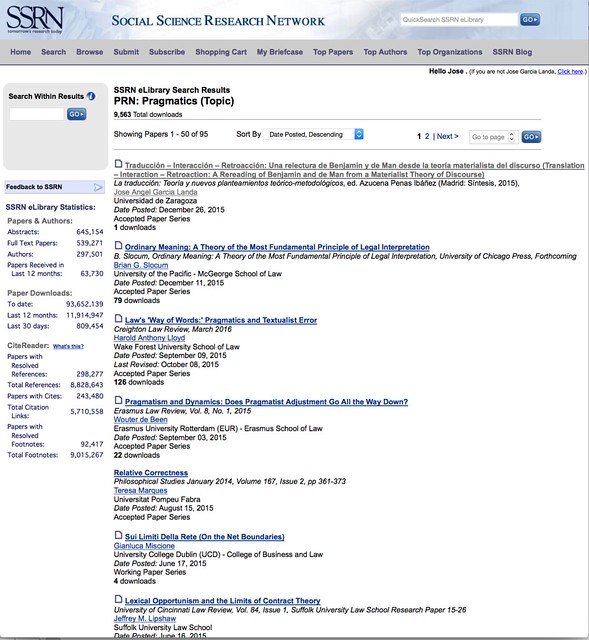
_____. "Traducción - Interacción - Retroacción: Una relectura de Benjamin y de Man desde la teoría materialista del discurso (Translation - Interaction - Retroaction: A Rereading of Benjamin and de Man from a Materialist Theory of Discourse)." SSRN 26 Dec. 2015.*
http://ssrn.com/abstract=2708048
2015
Cognition & Culture: Culture, Communication ... Rhetoric & Semiotics eJournal 26 Dec. 2015.*
http://www.ssrn.com/link/Cognition-Culture.html
2015
Literary Theory & Criticism eJournal 26 Dec. 2015.*
http://www.ssrn.com/link/English-Lit-Theory-Criticism.html
2015
History of Western Philosophy eJournal 26 Dec. 2015.*
http://www.ssrn.com/link/History-of-Western-Philosophy.html
2015
Continental Philosophy eJournal 26 Dec. 2015.*
http://www.ssrn.com/link/Continental-Philosophy.html
2015
Philosophy of Language eJournal 26 Dec. 2015.*
http://www.ssrn.com/link/Philosophy-Language.html
2015
_____. "Traducción - Interacción - Retroacción." In García Landa, Vanity Fea 4 Jan. 2016.*
http://vanityfea.blogspot.com.es/2016/01/traduccion-interaccion-retroaccion.html
2016
_____. "Traducción – Interacción – Retroacción: Una relectura de Benjamin y de Man desde la teoría materialista del discurso." Net Sight de José Angel García Landa 5 Jan. 2023.*
https://personal.unizar.es/garciala/publicaciones/RelecturaBenjamin.pdf
2023
miércoles, 23 de junio de 2010
de Man, Benzon, Meaning, Intention
On the poststructuralist theory of meaning; a comment to this passage on "Language Games" in Bill Benzon's New Savannah:
Consider this passage (de Man, p. 25):
“Intent” is seen, by analogy with a physical model, as a transfer of a psychic or mental content that exists in the mind of the poet to the mind of a reader, somewhat as one would pour wine from a jar into a glass. A certain content has to be transferred elsewhere, and the energy necessary to effect the transfer has to come from an outside source called intention.
De Man’s point was that, when we read a text, the intention (de Man uses the term in its somewhat rarified philosophical sense) that gives life to those signs on the page is our intention, not the author’s. And he is right.
(My commentary:)
On your comment on the text by de Man: it is all right "our" intention that animates the text and constructs meaning, but "our" intention cannot mean the intention of an isolated reader: it is a shared intention, shared by that reader with other readers of the same text with whom one would want to communicate, and also with the author. There is a community of meaning ranging across space and time; not a solid community of clear-cut meaning (there are fuzzy edges, negotiations as you say, etc.) but an interactive community nonetheless, and the author is part of that. Therefore, authorial intention cannot be dismissed any more than our own intentions as readers, and the communicative intent that we share with our own addressees when we try to make sense of a text.
Mi fotoblog

se puede ver haciendo clic en la foto ésta de Termineitor. Y hay más enlaces a cosas mías al pie de esta página.