
miércoles, 8 de enero de 2020


domingo, 24 de julio de 2016
John R. Searle - The Unity of Reality: Why We Live in One World at Most
Lecture at the University of Bonn, 26 March 2012. ("Prospects for a New Realism").
John Searle (Dpt. of Philosophy, U of California at Berkeley). Online at Uni-Bonn.tv
I transcribe here the following lecture by J. R. Searle:
Thanks a lot for that excellent introduction. I listened carefully. I think people giving an introduction to a conference don't expect anybody to listen. But I actually listened carefully, and it was a rare philosophical talk becausde as far as I can tell I agree with almost everything he said about philosophy, and it almost never happens to me, so I am very impressed. Also, now I want to thank the organisers for all the work that goes into organising this conference and especially for inviting me, and above all I want to thank everybody for being willing to listen to a lecture in a language that for many of you is not your own first language. I could never do it myself, but I am very glad that other people are willing to listen to a lecture in English, 'cause that's what you're going to get from me, being in effect resolutely monolingual. I have lectured in other languages, but generally to the pain of everybody involved.
OK; normally, at a conference like this, the speakers don't take their theme very seriously, "Prospects for a New Realism"; they talk about whatever they happen to be interested in at the moment, and if it's got anything to do with the prospects for a new realism, then so much the better, but so much the worse if it doesn't. I in fact intend to address the actual subject implicit in the title, and I take it from Marcus's introduction that the sense of realism that we're talking now is a descendant of the traditional medieval sense, but it's now... the notion of realism is opposed not so much to nominalism, but to various forms of anti-realism, and in particular the entire idealistic tradition, or pragmatism and instrumentalism.
The basic idea, the basic intuition behind realism, is that there exists a reality that is totally independent of our representations of it. And that has enormous consequences, because, among other consequences, it lends support to the idea of some sort of correspondence conception of truth. If there is a reality out there, then our representations of it are, at least in some respects, answerable to that reality and they will be true or false depending on whether or not they succeed in meeting that requirement.
Now I need to situate the discussion I'm going to give you in present intellectual context, and the central intellectual fact about the present era is that knowledge grows. The increase of knowledge that we've had over the past few centuries, but in particular over the past century, is absolutely stunning. I wonder what would be like to take Descartes or Leibniz into a university bookstore and just show them textbooks on molecular biology, or, for that matter, civil engineering. There is a stunning increase in knowledge and that places our philosophical investigation in a somewhat different situation from the tradition. For three hundred years the dominant question in philosophy was epistemic, as Locke put it: the nature and extent of human knowledge, and as Descartes put it more pressingly, how can we answer the skeptic. Now, I think that in a way that in the seventeenth century it was possible to take skepticism seriously as a real threat, I think that we can no longer, we no longer take it seriously as a real threat. There are interesting philosophical puzzles, about how we know we're not brains in vats or deceived by evil demons, but I think, to put it very bluntly, you can't send men to the Moon and back and then wonder "does reality really exist out there, is there anything independent"—you can't send men to the Moon and back and wonder if it's really possible to make secure predictions about the future based on inductive reasoning.
So, it isn't that we have resolved the questions of traditional epistemology, but they are no longer gripping to us in the way that they were. Well, what has replaced the epistemic skeptical problem, then, as the central problem in philosophy? Well, when I was an undergraduate, that would have had an easy answer. We were all obsessed with language. And for rather complex reasons that I won't have time to go into, we've evolved beyond that; we no longer have quite the obsession with language, but we have a kind of sensitivity to the philosophical nuances and the threats posed by language that not all of our forebears had.
What has replaced the obsession with language as a central question? Well, a number of questions have replaced it, but the one I want to face is this: given that we have now a remarkable extension of human knowledge, particularly in the form of atomic physics, chemistry, both organic and inorganic, and the natural sciences generally; given this remarkable extension of knowledge, there is a quite pressing philosophical problem, and I want to say it's the central problem of philosophy today. Well, where is the central problem of intellectual life today? It's a problem that's so vast we in effect unconsciously try to prevent our students from understanding that we really don't know how to answer the problem or even how to pose it, but here is a crude way to pose it. The knowledge that I described tells us that reality is ultimately a matter of entities that we call physical particles. They are not really particles, but that's a useful shorthand. That the world is made of the entities described by atomic physics and in some sense all of reality has to be a matter of aspects of the basic facts, the basic facts of physics and chemistry.
But now we've got a problem, because there is a tension; there is a tension between the basic facts of physics and chemistry and our self-conception. The facts of physics and chemistry tell us that these particles—that the universe is made entirely of mindless tiny physical particles, and yet we think of ourselves as conscious, as having rationality, intentionality, we think of ourselves as moral, as performing speech acts, as having free will, as capable of aesthetic creation and artistic judgement. Now we can pose the central question in a more pressing vein, and that is, how do we reconcile our self-conception as mindful, conscious, free, rational, social, langauge-speaking agents, how do we reconcile that picture with a picture of reality as consisting entirely of mindless, meaningless physical particles? Now, that I think is the problem posed for the new realism; and I want to say, a constraint in addressing that problem, is not just realism, but naturalism: the idea that we are discussing natural phenomena, phenomena that are a part of the real world. On the conception that I am putting forward, if there were such a thing as the supernatural, it would be part of nature like anything else. If God really existed, that would be a fact of physics like anything else; there couln't be a supernatural, because if there were, it would be part of nature like anything else.
OK, but if that is our question, how to give an account of reality that shows not just how our self-conception is consistent with not only what we know about the world from physics and chemistry, but in some sense is a natural development from; it isn't just that we've got to show that our social reality is possible given a world of basic facts but rather that it is a natural extension of the world of basic facts. We've got to show how you can get from electrons to elections and from protons to presidents, and we know that you have to do that because it happens; that is, for example, if you're going to have an election, you'd better have enough electrons; nobody brings the electrons, you can't have an election—to put it very crudely.
OK, now again, you might say, well, let's just get busy, and solve the problem that I have posed. And that's what I'm going to start doing, in a very cursory fashion. But I have to say there are certain enormous intellectual obstacles that we face and for the most part these obstacles derive from our remarkable philosophical tradition, and I have to mention a few of those before I make my positive suggestions.
Well, the first obstacle we face is that somehow or other there's something especially problematic about the mental. The mind cannot be part of the physical world. You all know the name of that view; traditionally, it's dualism, but I want to say, the traditional opposition to dualism—monism, materialism, behaviorism—they inherit the worst mistaken dualism, the idea that somehow or other there's something problematic about the mental, naively construed. One of the worst expressions of this confusion is in something called artificial intelligence, or what I call strong artificial intelligence. I think you can't understand the project of strong AI unless you see that they don't think of the mind as part of the natural world like digestion; as one of them, Dan Dennett, said, "the mind is something formal and abstract"—well, you can't get more Cartesian than that. There's nothing formal or abstract about digestion, or photosynthesis, or the secretion of bile, and that's how we are to think of the mental. So that's one of our curses: it's the curse, to put it crudely, of God, the soul, and immortality. If you start off with your conception of mind as deriving from a conception of God, the soul, and immortality, then you will never get a naturalistic account of the mental, of the sort that I am advocating.
Now, I used to think that was our main obstacle—the refusal to see the mind as a natural part of the world. But there are a couple of other sources of mistakes. And just as we live under the shadow of God, the soul, and immortality, so we live in the shadow of a certain conception of science. And people mistakenly suppose that science is the name of a set of propositions, of a set of tentative...—what are in fact the actual tentative results of scientific investigation at any stage of human history. And on that conception that they have of science it is as they sometimes like to say, thoroughly materialistic and reductionist. So, on this conception of science, there would be no place for the mental, naively construed, for consciousness and intentionality as I construe them. And indeed if you look at most contemporary philosophers, when they engage in something they like to call "naturalizing consciousness", or "naturalizing intentionality", it almost always means denying the existence of consciousness and intentionality and showing that they are really something else. As Jerry Fodor once put it, "if intentionality really exists, it must be something else". And the answer to that is "it does really exist, and it's not something else", for reasons that I'm going to try to tell you in a few moments.
So we've got these twin curses of God, the soul and immortality on the one hand, and a misconception of science as, so to speak, alternative dogma on the other hand, and we've got to crawl out—I'm going to mix this metaphor here slightly—we've got to crawl out from under these two heavy burdens that we've been carrying. And in the account that I'm going to give you we have to resist any form of postulating that there are alternative realities. The dualism was one horrendous mistake that we've still not fully escaped, but it came out in even worse form in the views of, well, for example, Popper and Habermas, that know there are really three worlds out there, there's the world of the physical, the world of the mental, and then there's the world, as one author put it, of the social, of the cultural, in all of its manifestations. And I want to say, echoing my title here, no, as my colleague Donald Davidson liked to put it, we live in one world at most, and that's the world that we need to describe. Well, OK, then, let's just get busy and do it.
Well, I said we had this... —we live under the course of God, the soul and immortality, but also we live under the influence of a certain conception of perception. Perception, along with action, is a basic way of relating to the world, so you can't get going in philosophy if you have a false theory of perception. And it's not much of an exaggeration to say that philosophy over the past three centuries has suffered from a mistaken theory of perception. And the people who make the mistake, well, the names are rather familiar: Descartes, Leibniz, Locke, Berkeley, Hume, Kant... I could keep going and certainly mail on Hegel, right up to positivism. What's the mistake? This is a philosophers' jam, because it's a simple fallacy and it's repeated over and over in the history of the subject; I wish I had a blackboard, but anyway, imagine I did, here's what I would write down. There's a famous argument, and here's how it goes. Whatever it is I am now seeing, let's suppose I now say I now see my watch, well, I could be having a hallucination that was indiscriminable from this case. And fill in your favourite hallucinatory story, we could be deceived by an evil demon, or we're brains in vats—whatever. The point is I could have exactly this experience and it 'd still be hallucination. But now, in the hallucinatory case, I'm aware of something. I mean, there's something in my awareness: I'm surely aware of something, it isn't just impy, my experience. But since the two experiences are indiscriminable, they are qualitatively identical —that's by hypothesis— then, whatever I'm aware of in the veridical case, it must be exactly the same as what I'm aware of in the hallucination case, because the two cases are indiscriminable. But in the hallucination case I'm not aware of anything in the real world, I'm aware of an idea, an impression or sense data, or whatever term you want to use to describe it. Therefore, it turns out, we're never directly aware of the real world in perception, we're always aware only of our own experiences. And we're then often running with traditional epistemology and I have now... —I've been going through a lot of these old arguments, and they all make the following fallacy: In the example I gave you, we're aware of something in the veridical case, and aware of something in the hallucinatory case; but it must be the same thing in the two cases. There's a fallacy of ambiguity over the expression "aware of". The sense in which I am aware of my watch when I see it is an intentionalistic sense; the watch is the object of my awareness. The sense in which I am aware of something in the hallucinatory case is not an intentionalistic sense, because the awareness and the object of the awareness are identical; the awareness in the case of the hallucination just is an awareness of the experience. "Awareness of" then just picks an internal accusative, where in awareness the thing you are aware of is the awareness itself. You can see this with a very simple example: push your hand against the table; you are aware of the table, you are also aware of a painful sensation in your hand, if you push hard enough, so it looks like what? That you are really... —that you are aware only of the painful sensation in your hand, or you're aware really of two things? There's a fallacy and ambiguity in "aware of". "Aware of" has two senses. In the intentionalistic sense, the thing you are aware of is not identical with the awareness. In the constitutive or identity sense, the thing that you are aware of is the awareness itself, it's the sensation itself when you push your hand against the table. Now it might seem odd that so much philosophy should be based on such a simple fallacy, but I've been through a lot of these guys and I find the fallacy over and over and over and in fact it's repeated in modern science: "aware", the temptation is to think "well, all we are really aware of when we see anything is what actually happens in the cortex, when the neuron firings finally produce a visual experience" So, roughly speaking, from Descartes to Francis Crick, we find the same fallacy repeated over and over. And it is a beauty for philosophers, because it is a clear and identifiable fallacy, that rare thing, it's a fallacy of ambiguity in the occurrence of the expression "aware of"; the fallacy is repeated in all —at least all that I've been able to find—all of the traditional arguments. Hume thought a realistic theory of perception was so stupid that he only bothered to refute it in one sentence. He said, if you are tempted to realism, to naive or direct realism, push your eyeball. The world would double if naive realism were true, so it's not true. That's the fallacy I've been talking about. The world doesn't "double" when I push my eyeball. What actually happens is that I then have two visual experiences where I used to have one visual experience before.
Anyhow, I'm tempted to give you the whole lecture about this fallacy, because it's everywhere you turn around. There's a mistaken theory of perception called "disjunctivism"—I hope it hasn't spread to Bonn, because it's all over the streets of Berkeley; but it commits the same fallacy. The idea is that if you think that you can actually... that there's something in common between the hallucination and the veridical case, then what is in common has to be the object perceived. So it turns the traditional argument on its head; the traditional argument says, well, all you do perceive are the contents of your mind. And the disjunctivist says, well, if you don't accept disjunctivism, you would have to accept that all that you perceive are the contents of your mind. Both make the same mistake.
OK, I want to assume we've overcome those mistakes, that we have naive realism —some kind of direct realism as our theory of perception, and we are out from under the burden of God, the Soul and Immortality, and a certain conception of science... —where do we go? Well, actually I think many —not all, but many— of the philosophical problems have relatively easy and fairly natural, if not solutions, at least approaches to the problem, that would give us a correct conception of the relations. So le'ts just go through several of these problems.
Well, I'd start with the famous mind/body problem. How can it be the case, —I said the world consisted entirely of physical particles... —by the way, I'm embarrassed to say they're not really particles, and there is a more acute embarrassment I should mention at least in passing. The latest version of physics that I get in Berkeley is that our old friends the atoms and the molecules, and I loved physics when there were electrons, protons, and neutrons, but now God knows, with all the quarks and muons and so on, it's less fun. But that's just, you know, that's what we pay all those guys to do. But it turns out that that cheerful friendly world, that's only about four per cent of reality. And what's the rest? Well, the other 96% is dark energy and dark matter. Oh, yeah? And what's dark about them? What's dark about them is we don't know what the hell is going on in there. The darkness is a matter of our cognitive state, not a feature of the physics we are describing. But anyway, I'm going to assume that whatever is going on there is the same as goes on in physics as traditionally conceived. OK, well, if that's right, then how do we situate consciousness and intentionality within this picture? And I think once you accept a completely naturalistic view, and you accept the realistic conception of the mental, of consciousness and intentionality, then it's not all that hard.
Try to imagine what it would be like if we had no philosophical tradition. If we had the kind of knowledge of how the world works that we have anyway, but we had no great tradition on the one hand of God, the Soul and Immortality, and no great tradition on the other hand of supposing that science has to be reductionist and materialistic. Then it seems to me that there's a fairly obvious solution to the philosophical parts of the so-called mind/body problem, and that is, mental states, there are the two great features of mental states, consciousness and intentionality—they are real: they are real, natural phenomena. They are as real as any other biological phenomena, and they are entirely caused by neurobiological processes. We don't know the details, but we're making a lot of progress. We now know a whole lot more about the brain than we did when I first got interested in these, just the sheer volume of knowledge that we have. When I first got interested in the brain, there were about five known neurotransmitters. Now there are over fifty, and still counting. So we know now a lot more about the brain, but whatever we know, we know that all our conscious states and all of our intentional processes are caused by neurobiological processes.
But that doesn't solve our ontological problem. Where are they? What's going on? And there I want to say the answer to that is equally simple. They are realized in the brain as higher-level features. Just as the liquidity of this glass of water is not something squirted out by the H2O molecules, but rather is a state that the molecules are in, it's causally explained by the behavior of the molecules, so the consciousness present in my brain right now is not an extra juice squirted out by the neurons, but is a state that the brain is in, and it's causally explained by the behavior of the neurons.
Philosophers like labels. I was once asked, "What's the name of your view?" Oh my God, I didn't have a name, so I thought of one on the spot; I said, "It's Biological Naturalism". Well, OK. I'm sort of stuck with that. But anyway, that's the view that I'm putting forward.
Now grant me, then, that we do have a reality of the mental, and that it's part of nature, it's part of biology, there's nothing in it that's reminiscent of the dualistic tradition that postulates somehow or other that Geist cannot be part of the ordinary physical world. Grant me that: then, it's not all that hard to see how if you've got creatures that have intentionality, that have this capacity for beliefs and desires and hopes and fears and intentions and perceptions, they have all these capacities —then it seems to me it's not hard to see how they can get collective intentionality; how you can have shared intentions, and even shared beliefs, and shared desires; where you are engaged in an activity, not just "I am doing this", but "I am doing this as part of our doing this", you have collective intentionality". Now, once you have intentionality and collective intentionality, you are often running with the possibility of a much richer ontology than you would have without that.
However, lots of animals have both of those features; they have intentionality and consciousness on the one hand, and they have a capacity to share that on the other. What's special about human beings?
Well, one of the things that's special is that human beings have language. So the next great task that we have to account for in philosophy is how do you get from this raw, pre-linguistic mental life, to the richness of natural human languages. And here I'm going to be rather brief, but I would want to tell you the broad outlines. The key to understand intentionality is that intentional states have conditions under which they are satisfied or not satisfied—what I call conditions of satisfaction. What stands to the beliefs being true is what stands to the desires being satisfied is what it stands to the intentions being carried out. Think of intentionality as the representation of the conditions of satisfaction. I think that perceptual intentionality is a special kind of case where you've got a direct presentation of the conditions of satisfaction, it's not a matter of shuffling representations.
Well, if that's right, then if you ask yourself, well, how do you get linguistic meaning in a world that has a rich neurobiology along with the structures of intentionality including collective intentionality? Then I think the answer is fairly simple, at least in its broad outline, and it's this. If you ask yourself, what's the difference between saying something and meaning it, and saying it without meaning it, I think there's a simple answer to that. Wittgenstein, by the way, used to ask questions like that because he wanted us to get out of the idea that meaning was the name of an introspective process. But there is a difference between saying something and meaning it, and saying it without meaning it.
Suppose I say es regnet as the matter of practising German pronunciation. I say it, but I don't mean it: I'm practising it in the shower, we'll say. But now if I actually go outdoors and say es regnet, and I really mean it, then there's a difference. What's the difference? The utterance with a meaning has conditions of satisfaction which just practising the pronunciation does not have. The condition of satisfaction of saying es regnet without meaning it is just that I correctly pronounce the German words. But if I say it and mean it, then the correct... the utterance with a correct pronunciation of the words now has additional conditions of satisfaction—namely, it should be raining. I know... —I think this is, in its simple form, as a key to understanding meaning, speaker meaning, a fundamental form of meaning, is the intentional imposition of conditions of satisfaction on conditions of satisfaction. You make the sounds through your mouth, and that's intentional, so the production of the sounds is itself the condition of satisfaction of your intention to produce them. But the production of the sounds now has conditions of satisfaction on... —built on to those conditions of satisfaction, namely that they should correspond to something in the world, in one or the other... —one of various possible directions of fit. So that gives us the first step in the analysis of language. Now you've got to be able to communicate those meanings to other people. And the next crucial element we need is the notion of convention. The notion of convention is the notion of a procedure that you can follow: you make the noises that other people in your tribe have a right to expect will only be uttered under certain conditions, that is, only under conditions... —when the conditions of satisfaction are in fact satisfied; they have a right to expect that you will be speaking truly.
So you get meaning and convention. And that enables you to communicate meanings, because the conventions are shared.
Now the next thing you need in your account of language —and this is a stunning development, it changes everything— and that is internal structure. The marvelous thing about human language is, you see, there are all sorts of other signaling systems among animals; the bees are probably the best understood—they have nothing like the internal structure of... —the syntax of natural languages. You have a structure when you can make the distinction between the reference of the noun phrase and the condition specified by the verb phrase.
My dog, Tarski, is a very intelligent dog. He's a Burmese mountain dog; I mean, he looks like a sincere dog and he is very intelligent. And he can believe that someone is at the door. But he can't believe "Well, maybe there are seventeen people at the door", or "Wouldn't it be nice if people came to the door next week?" or "By the way, have you done your income tax on time this year?" He can't think any of those thoughts, and not because he's too stupid—he's actually pretty intelligent. But he doesn't have the internal syntactical resources for those sorts of thoughts. So syntax, literally, gives us the capacity for an infinite number of thoughts, for an infinite number of thoughts in a way that animals lacking inner syntax do not have that capacity. The dog can think "There's somebody at the door" but he cannot think "I wish there were some more people at the door" or "I hope we get more people coming to the door next week". To have those thoughts, you've got to have a richer syntax than he has.
OK, so now we've got... –and I apologize for the brevity, but I have only a very short space of time— we've got these biological beasts, namely ourselves, we're running around—and presumably when we're getting this stuff in its primitive form we're running around in northern Europe, perhaps not far from here—and we've got consciousness and intentionality which we share with lower animals, but also we've got meaning, convention and syntax, and that gives us an enormous power. Now, the power is not just the power to communicate, to communicate complex thoughts, but it gives us the power to create a kind of reality that other animals do not have, and I want now to say something about that.
Typically, speech acts represent reality in oner or the other of the most famous directions of fit: the aim of statements, like perception, is to represent how things are, what I call the mind-to-world direction of fit; the contents of the mind are supposed to fit reality, and to the extent that they do we say they are true or false. The test for the mind-to-world direction of fit, the simplest test, is can you say literally that it's true or false? The upward direction of fit, which you get with commissives and directives, with promises, vows, threats and pledges on the one hand, and orders, commands and requests on the other, the aim there is not to represent how things are, but to change reality by getting reality to match the content of the speech act, to match the content of the representation. They have the world-to-word direction of fit.
But no here's an amazing fact, and I don't know any communication system other than the human that has this, and that is that we have a capacity to create a reality by representing that reality as existing. The most famous examples of this were in Austin's discussion of performatives, where you can make something the case by saying that it's the case. The chairman can adjourn the meeting by saying "The meeting is adjourned"; war can be declared by the appropriate authorities saying "War is declared". And you can even perform other speech acts by declaring yourself to be performing them: you can make a promise by saying "I promise". These speech acts have both directions of fit. They make something the case by representing it as being the case. They make it the case, and thus achieve the upward or world-to-mind direction of fit, but they change reality, they bring about that change, by representing reality as having been so changed. They make it the case that war is on, that you are husband and wife, that you have received a piece of property, that Barack Obama is the President of the United States, that I'm a professor of the University of California, Berkeley... All those facts are created by speech acts that have this form. And I have a name for those: I call them declarations.

Human institutional civilization is created entirely by a certain class of declarations, where you make something the case by representing it as being the case.
But now, how can you do so much with such a feeble apparatus? What sort of fact do we create? And here we get an interesting hybrid between realism and constructivism. It's really the case that I'm a professor, and that these bits of paper in my wallet are euros I use as currency in the European... in the signers of the European Community; those really are epistemically objective facts, but they are only facts by human agreement. It's a fifty-euro note not because of some feature of physics, but because we have accepted that it is, and that acceptation, that fact is created by a declaration, and it's maintained in its continued existence by representations that have the form of a declaration. How can such a thing be? Well, here I have to introduce a crucial notion: the notion of a status-function.
Humans have a capacity to impose functions on objects. So, this object, my watch, has a function, and this glass carrying water has another, and this, my wallet, has a function... Lots of animals also have that capacity to impose functions on objects. But humans have a remarkable capacity and as far as I know it's not shared by any other species. And that is there are class of functions where the function is performed not in virtue of the physical structure of the entity in question (you see, these entities perform their function in virtue of their physical structure)—the function is performed not in virtue of the physical structure but in virtue of the fact that through collective intentionality we have assigned a status to the person or the object: the status of being money, or the status of being President of the United States, or the status of being the University of Bonn. And with that status goes a function or set of functions which can only be performed in virtue of the collective acceptance of the object or person's having that status and with that acceptance the acceptance of the functions that go along with that.
So the remarkable thing about human civilization, and I want to keep reminding this is intended as completely realistic in the sense that I described and it's completely objective epistemically, it isn't my opinion—this is money, really is money—but it's a natural consequence of our biological structure, given language: we create a reality, and this is the reality of human civilization. We create a property of money, government, property, marriage, universities, cocktail parties, income tax, and philosophical conferences. All of those are created by repeated applications of representations that have the logical form that I described, and I call them status-function declarations.
Now, not all declarations are status-function declarations. When God, if he had existed, said "Let there be light", that was a declaration: he's not saying, "Someone over there, turn on the lights", it's not a directive, it's not a promise, he's not saying "I'll make light for you guys when I get around to it", he's making it the case that there's light, by representing it as being the case. Now we can't do that, we can't create light just by declaring light to exist, but we can create governments, money, property, marriages, universities, and all the rest of that, phenomena that are peculiar to human civilization. We do those by representations that have this logical structure, where you make something the case by representing it as being the case.
Now, what's the point of doing that? I mean, ist't all a kind of massive fantasy? And the answer is, it creates power. Throughout your life, you are immersed in a sea of status-functions. You are a professor or a student; you are a husband or a wife; you are a citizen of Germany, and the owner of a car, and the possessor of a driver's license. All of those are status-functions: we create these power relations. But what kind of power is that, where status functions can create power? And the power has various names, in English. In English, they are obligations, rights, duties, responsibilities, authorizations, etc.; that is, there is a list of the kind of powers that you can create using this apparatus that I have described. Now, the interesting thing is this, if you say, well, all right, you've created these power relations, but how does it work? I mean, how does it give any grip on rationality, how does it motivate behavior?
And the answer is, then, going the next step, human civilization has a remarkable feature, that other forms of animal life do not have. And that is, we create a set of power relations that give people reasons for acting that are independent of their immediate inclinations, they are what I call desire-independent reasons for acting—and that is what status-functions do. If you accept that you have an obligation, or that somebody else has a right, then you accept that you have a reason for doing something that's independent of your immediate inclination. And this is what gives human institutional reality its enormous power. A nice person invites me to give a talk in Bonn, and it seems like a good idea so I say yes. But then that day arrives, and I've got to get up at four in the morning and make my way to San Francisco airport, and do all the sort of things that one has to do nowadays—in the United States you have even got to take you damn shoes off, I won't go through the sordidnes... well, you're all familiar with the sordidness of air travel. And I don't think, "oh boy, how much fun, to sit in an airplane for endless hours and eat airplane food, and trying to put my elbow where some other guy is trying to put his elbow and all the other things... but I do it! I do it, why? Well, I made a promise. I made a promise to do it and that gave me a reason for doing it, and now I'm glad i did it!
However, and let me just conclude. What I urge is this: If we can just get out from under our horrendously bad tradition; if we can get out from under the mistake that I've described as the foundational mistake of modern epistemology, and if we can get out from under the mistakes which go with that, the twin mistakes of religion and science—both, I think, misconceived; —and those mistakes are not trivial mistakes, I mean, there are names to repeat: Descartes, Spinoza, Leibniz, Kant, Locke, Berkeley, Hume, not to mention Mill and Hegel and others I've know better, I mean, you would have to throw in Schopenhauer, I'm sure; and if we can get out from under those mistakes, then there's a possibility of doing a type of philosophy which I think is much more productive than ocurred in the past. I've only mentioned three features of this type of philosophy: they are mind, language, and society. They are rather important features but I think the approach that I'm advocating would also be the right approach to take to ethics, aye, and aesthetics, aye, and political philosophy and lots of other branches of philosophy.
So the general message that I want to leave you with is, as I said, we say we live in one world, and one of the most... the most single, most fascinating question of philosophy today is how we can give an account of ourselves as rational agents in that one physical-so-called world.
Thank you very much.
miércoles, 20 de julio de 2016
Criticism after Romanticism: 6) Realism and Naturalism
An overview of some central ideas and
movements in nineteenth-century criticism and aesthetics, after the
heyday of Romanticism. This lecture centers on the development of the
theory of realistic prose fiction, with Bulwer-Lytton, Henry James and
William Dean Howells among others, and the fin-de-siècle Naturalist
aesthetic exemplified in the theories of Zola.
Number of Pages in PDF File: 13
Keywords: Aesthetics, Realism, History of Criticism, Prose fiction, Narratology, Zola, Henry James, Bulwer-Lytton, William Dean Howells,
Criticism after Romanticism:
6. Realism and Naturalism
| eJournal Classifications (Date posted: June 30, 2016) | |
AARN Subject Matter eJournals
|
|
| LIT Subject Matter eJournals
|
|
| PRN Subject Matter eJournals
|
lunes, 4 de mayo de 2015
El realismo como idolatría: Conocemos en parte
Este artículo compara la
tradición intelectual de la teología negativa y de la semiótica sacra
con algunos desarrollos contemporáneos de la ciencia cognitiva y la
teoría de la mente. En ambos casos un realismo ingenuo se desconstruye
mediante la consciencia de la naturaleza semiótica del objeto, y las
representaciones de la naturaleza última de la realidad se someten a una
desmitologización, estableciéndose una oposición entre el literalismo espontáneo y la posición crítica del propio analista.
Texto completo:
El realismo como idolatría: Conocemos en parte
http://papers.ssrn.com/abstract=2585893
Ibercampus (March 18, 2011)
Realism as Idolatry: We Know in Part
This paper compares the intellectual tradition of negative theology and sacred semiotics to some contemporary developments in cognitive science and the theory of mind. In both cases naive realism is deconstructed through an awareness of the semiotic nature of the object, and representations of the ultimate nature of reality are demythologized, establishing an opposition between spontaneous literalism and the analyst's own critical stance.Keywords: Philosophy, Theology, Semiotics, Scholasticism, Negative theology, Theory of Mind, Cognition, Constructivism, Psychology
| eJournal Classifications (Date posted: 28 March 2015) |
| AARN Subject Matter eJournals |
| CSN Subject Matter eJournals
Cognition & Culture: Culture, Communication, Design, Ethics, Morality, Religion, Rhetoric, & Semiotics eJournal - CMBO
|
| PRN Subject Matter eJournals |
| PRN Subject Matter eJournals |

_____. "El realismo como idolatría." In García Landa, Vanity Fea 16 March 2010.*
http://vanityfea.blogspot.com/2010/03/el-realismo-como-idolatria.html
2010
_____. "El realismo como idolatría: Conocemos en parte." Ibercampus (Vanity Fea) 18 March 2011
http://www.ibercampus.info/articulo.asp?idarticulo=14526
2013
_____. "El realismo como idolatría: Conocemos en parte (Realism as Idolatry: We Know in Part). Social Science Research Network 28 March 2015.*
http://ssrn.com/abstract=2585893
2016
Anthropology of Religion eJournal 28 March 2015.*
http://www.ssrn.com/link/Anthropology-Religion.html
2016
Cognition & Culture… eJournal 28 March 2015.*
http://www.ssrn.com/link/Cognition-Culture.html
2015
Philosophy of Mind eJournal 28 March 2015.*
http://www.ssrn.com/link/Philosophy-Mind.html
2016
History of Western Philosophy eJournal 28 March 2015.*
http://www.ssrn.com/link/History-of-Western-Philosophy.html
2016
_____. "El realismo como idolatría: Conocemos en parte." In García Landa, Vanity Fea 4 May 2015.*
http://vanityfea.blogspot.com.es/2015/05/el-realismo-como-idolatria-conocemos-en.html
2015
_____. "El realismo como idolatría: Conocemos en parte." Academia 20 Sept. 2016.*
https://www.academia.edu/28608299/
2016
_____. "El realismo como idolatría: Conocemos en parte." ResearchGate 23 Sept. 2016.*
https://www.researchgate.net/publication/308520322
2016
_____. "El realismo como idolatría: Conocemos en parte." Net Sight de José Angel García Landa 4 Jan. 2023.*
https://personal.unizar.es/garciala/publicaciones/realismoIdolatria.pdf
2023
—oOo—
lunes, 30 de marzo de 2015
Salgo en el Anthropology of Religion eJournal
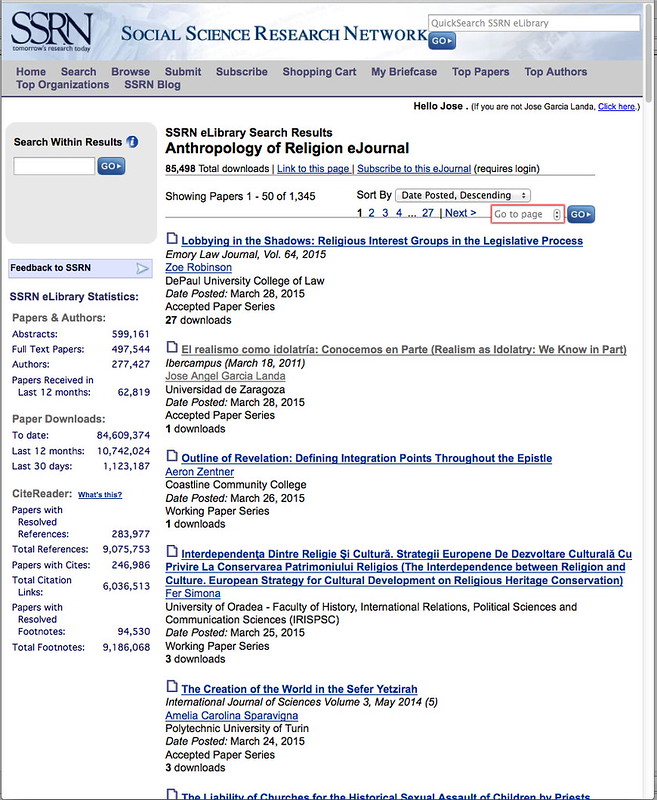
_____. "El realismo como idolatría: Conocemos en parte (Realism as Idolatry: We Know in Part). SSRN 28 March 2015.*
http://ssrn.com/abstract=2585893
—oOo—
sábado, 18 de octubre de 2014
Bibliografía sobre el realismo
viernes, 7 de diciembre de 2012
Capturing the Real Thing
[William Dean] Howells never gravitated from realism to naturalism, with its emphasis on the determining influence of heredity and environment and its harrowing depiction of landscapes, social and natural, that are at best indifferent and at worst hostile to humankind. There is a fundamental benevolence, a belief in human worth and social betterment, that is caught in one of his most famous remarks in Criticism and Fiction: "our novelists concern themselves with the more smiling aspects of life, which are the more American." That remark would have elicited sardonic laughter from Ambrose Bierce (1842-1914?), who was known as "bitter Bierce" and "the wickedest man in San Francisco" among his contemporaries, and seemed to revel in both titles. Born in Ohio, Bierce participated in the Civil War. The war disgusted him, prompting him to see soldiers as little more than paid assassins and, when it ended, he moved to California, where he established a reputation as a brilliant and caustic journalist. Living in England for four years from 1872, he returned to California. He then published Tales of Soldiers and Civilians in 1891, retitled In the Midst of Life in England and in the 1898 American edition. Another collection of stories, Can Such Things Be?, followed in 1893. More than half the stories in the first collection, and many in the second, deal with the Civil War; they reflect their author's feelings of revulsion for military life, and his bleak, bitterly comic view of existence in general. Some of these stories capture the vicious confusion of battle, just as, say Miss Ravenel's Conversion from Secession to Loyalty (1867) by John William De Forest (1826-1906) does. In "A Horseman in the Sky," a young Union soldier is forced by circumstances to kill a Confederate officer who happens to be his father. Others use stream-of-consciousness and suspense endings to explore the subjectivity of time. "An Occurrence at Owl Creek Bridge," for example, presents the fantasy experienced by a man who is being hanged, in the final seconds of his life. And still others deploy a fluid, almost surrealistic prose style and black humor to dramatize physical and emotional violence. So, in "Chickamanga," we see a battleground strewn with corpses through the eyes of a child. The child sees but does not understand—although, thanks to an ironic narrator, the reader does—until the end, when he comes across the ruin of his home and the dead body of his mother, "the greater part of the forehead ... torn away." A deaf mute, he then utters "a series of inarticulate and indescribable cries—something between the chattering of an ape and the gobbling of a turkey—a starting, soulless, unholy sound." It is the wreckage of a language, used in response to the "wreck" he sees around him; he has awoken, hopelessly and helplessly, to the horror of life. The same dark light that simultaneously illuminates and shadows these stories also informs Bierce's poems, and the ironic series of definitions—such as the definition of realism quoted earlier—collected in The Devil's Dictionary. [Realism was described by Ambrose Bierce as "The art of depicting nature as it is seen by toads" and having "the charm suffusing a landscape painted by a mole, or a story written by a measuring worm"]. In 1913 Bierce traveled into war-torn Mexico to escape American civilization and to seek, he said, "the good, kind darkness." He must have found it, for he disappeared. To this day, it is not know when, how, or exactly where he died.
At first sight, there are few connections between William Dean Howells and Henry James (1843-1916). Both saw writing as a serious vocation, and the writing of fiction as a form of artistic endeavor equal to any other. Both were influential, Howells exerting a powerful influence on his contemporaries and James mostly on his successors. Both addressed their work to what they saw as "the real thing," to use James's phrase: to the strenuous realities of material, mental, and moral existence. But the differences between them are clear. Howells, in his very emphasis on the "commonplace," tended to concentrate on human likeness, typicality, and give priority, if not a monopoly, to the social context. James, on the other hand, was intensely interested in what he called "the special case"; that is, he chose to focus on how common moral conflicts and shared social concerns were realized in the complexities of individual experience and encountered by the individual consciousness. Howells used a variety of fictional techniques, but all of them were characterized by the directness of the journalist or historian. James, on the contrary, was what Joseph Conrad famously called him, "the historian of fine consciences." And to write this history, thoroughly and accurately, he devoted a lifetime to finding and developing the right fictional tools. "There is, I think, no more nutritive or suggestive truth," James wrote in his preface to The Portrait of a Lady (1881), "... than that of the perfect dependence of the 'moral' sense of a work of art on the amount of felt life concerned in producing it." To create that "felt life," an imaginative experience for the reader, James experimented with narrative structure and texture, developing patterns of character or imagery and moments of epiphany—and, above all, with point of view. "The house of fiction," James insisted, "has ... not one window, but a million—a number of possible windows ... every one of which has been pierced, or is still pierceable ... by the need of the individual vision and by the pressure of the individual will." It mattered hugely, James knew, which window or windows the novelist chose to tell his tale because, in a variation of the theory of relativity or the indeterminacy or uncertainty principle of Werner Heisenberg (both of which were becoming current at the time James was still writing), what you saw depended on where you stood. James was not a moral relativist, by any means, but he became increasingly a psychological one. His constant experiments with narrative viewpoint, which were perhaps to be his major contribution to the developing aesthetics of the novel, sprang ultimately from the sense he shared with many of his contemporaries in science as well as art that our knowledge of reality is contingent on perspective.
Howells might have been more interested in social justice and the simplicities of realism than James; James might have been more concerned with a kind of secular mysticism of consciousness and the indeterminate, contingent character of the real. But it is to Howells's credit that, as critic and editor, he was among the first to recognize James's talent. "You showed me the way and opened me the door," James wrote to Howells in gratitude in 1912; "you wrote to me, and confessed yourself struck with me—I have never forgotten the beautiful thrill of that." Credit is due to Howells all the more, perhaps, because as they knew, the two men came from very different backgrounds. James was born in New York City to a wealthy, patrician family, the grandson of an Irish immigrant who had amassed a large fortune. His father, Henry James, Sr. (1811-1882), acquired a reputation as a moral and social philosopher, developing his own form of liberal Christianity and ideas for social reform in books like Christianity the Logic of Creation (1857) and Substance and Shadow; or Morality and Religion in Their Relation to Life (1863). Henry James, Sr. encouraged intellectual experiment in his sons and gave them the freedom to develop their own systems of morality and discipline. The results were positive. While Henry was to grow up and into a dedication to literature, the eldest son William James (1842-1910) was to become the foremost American philosopher of his day, developing his ideas about psychology and religion and his view that an idea has meaning only in relation to its consequences in feeling and in action in, respectively, The Principles of Psychology (1890), The Varieties of Religious Experience (1902), and Pragmatism (1907). These enlightened principles did not extend to women, however. On the contrary, Henry James, Sr. argued that "Woman" was not truly a person but "a form of personal affection," whose mission it was to redeem man from his natural egotism and brutality. Such views, not untypical for the time, meant that Alice James (1848-1892), the youngest child and only daughter, was denied the formal education given to her brothers. Her family, while respecting her abilities—she was, among other things, an astute critic of both her famous brothers—coddled and, arguably, stifled her. She had several breakdowns during her relatively short life; and her daily journal, which she seems to have intended for publication, only appeared in 1964 as The Diary of Alice James.
After being educated by private tutors until the age of 12, Henry James went to schools in Europe and the United States. Entering Harvard Law School in 1862, he withdrew after a year. Then, with the encouragement of Howells and Charles Eliot Norton (1827-1908), a Harvard professor and translator of Dante, he began to concentrate on writing. Reviews and essays appeared in the Atlantic Monthly and the North American Review. In 1869 he returned to Europe, his first visit as an adult, first to England and then to Italy, which made a deep impression on him. It was while he was in Europe that his beloved cousin Mary Temple died. How exactly this affected his later fiction is open to debate, although the situation of an attractive, lively but doomed or even fatally sick young girl certainly recurs in such novels as The Portrait of a Lady and The Wings of the Dove (1902) and in the novella Daisy Miller (1878). In any event, James's first novel, Watch and Ward, apperared serially in the Atlantic Monthly in 1871 (and in volume form in 1878). This was followed by his first collection, A Passionate Pilgrim and Other Tales (1875) and Transatlantic Sketches (1875), and his first novels of real consequence, Roderick Hudson (1876), The American (1877), and The Europeans (1878). The story "A Passionate Pilgrim" deals with the reactions of an eager American "pilgrim" when confronted with the fascinations of the complex European world of art and affairs. And James himself during this period was something of a pilgrim in Europe, which he came to regard as his spiritual fatherland, moving there permanently in 1875. During a year in Paris, he associated with such masters of the art of fiction as Flaubert and Turgenev, who encouraged his interest in what Flaubert called "le mot juste": the right word, the careful planning of the language and structure of the novel so as to make it an accurate register of reality. After 1876, however, he made his home mainly in London, although he maintained an American home in Massachusetts and, much later, moved to the small town of Rye in Sussex.
James was developing his ideas about his craft, and expressing them in, for instance, his well-known essay on "The Art of Fiction" (1884). He was also exploring what were to be the dominant themes of this the first stage of his career as a novelist, which lasted from roughly 1870 until 1890. There is James's interest in the mired complexities of fate and freedom, the possibly determining influences of environment and the possible power, the capacities of the human will: "don't talk about the will being 'destined'," declares a character in Roderick Hudson as a contribution to the debate, "The will is destiny itself. That's the way to look at it." There is his concern for the individual consciousness and the terms it must negotiate with society, how it maneuvers its way through moral and mental complexities. Above all, there is "the international theme," the series of contrasts James draws between Europe and America. In his book on Nathaniel Hawthorne (1879) James urged that "the good American" of his own time would be a more complicated, "more critical person" than the one of the time of his subject. He was thinking, among other things, of his own difference from the author of The Scarlet Letter, which was due, he thought, not only to the eruptions of civil conflict but to his exemplary encounter with European culture. There is a residue of "American" romanticism, as James would see it, in these novels of the first period: stories of young American pilgrims, dark family secrets, oppressive villains. But this is overlaid by habits of realism, empirical rigor, and attention to mannerly detail that James, at least, felt he owed to his European masters: to Flaubert or Turgenev, say, rather than to Hawthorne. More seriously and centrally, James was of the passionate belief that, as he puts it in his account of Hawthorne, "it takes a great deal of history to produce a little literature"—and that, despite the Civil War, history "had left in the United States but so thin and impalpable a deposit that we very soon touch the hard substratum of nature." What America lacked was what, precisely, Europe had: "an accumulation of history and custom," "a complexity of manners and types," all that could form a fund of suggestion for a novelist." James even went so far as to enumerate "the absent things in American life," the "items of high civilisation" which, he felt, were nowhere to be found in his place of birth. He was less specific about what was present, apart form insisting that "a good deal remains." What was clear, however, and could be succintly stated is that he felt compelled, as a novelist, to live in Europe and, as an American novelist, to dwell on this contrast. As a result, he offered a series of increasingly sophisticated fictional negotiations between European culture and American nature, European society and the American individual, European experience and American innocence. To an extent, he was transplanting a contrast embedded in American thought, and especially that of the nineteenth century, to the international arena: a contrast articulated in the fundamental divisions of the clearing and the wilderness. But what distinguished this fiction was not merely the transplantation of content but also the transformation of form. "A novel is a living thing," James insisted in "The Art of Fiction", "all one and continuous, like any other organism and in proportion as it lives will it be found ... that in each of its parts there is something of each of the other parts." That belief vividly informed his own practice as a novelist. It stimulated fictions in which, at best, the medium is the message, the "moral" of the narrative springs from a "doing" that is subtly intricate and mutually restrained, balanced and brilliantly nuanced.
In The American, James explores the contrast between Europe and America through the story of a protagonist whose name betrays his origins and missions. Christopher Newman is an American who reverses the voyage of his namesake Christopher Columbus and travels from his own, New World to the Old World of France during the Bourbon period. There, he finds his love for a Frenchwoman of the nobility frustrated by her family. James draws a series of sly contrasts between Newman's innocence, candor, and ignorance (especially about matters of art and social convention) and the sophistication and cunning of his European hosts. The Europeans reverses this voyage, in turn, by bringing Europeans to New England. The transatlantic contrasts multiply and are more complex here, but the fundamental distinctions remain the same. In response to the news, for instance, that one of the European visitors is "the wife of a Prince," an older American character simply responds, "We are all princes here." Daisy Miller focuses the international contrast via the story of a charming but ingenous American girl who is destroyed, first socially and then literally, by her lack of understanding of her new European surroundings. Part of the exemplary subtlety of the story comes from a symbolic pattern it shares with The American and The Europeans: contrasting American "brightness," starkness, and simplicity with European shadows, secrets, and complexities. Part of it comes from the adept use of a narrator, an observer whose developing interest in Daisy, mingled sympathy and criticism, affection and astonishment, and developing feelings and opinions enable the narrative to maintain a delicate balance. Typically, the story offers not so much a judgment of Daisy and all she comes to represent, as a series of essays toward a critical understanding of both, a knowledge felt along the pulses. It nicely illustrates the remark of T. S. Eliot, meant as a compliment although it hardly sounds like it, that James had a mind so fine no idea could penetrate it.
That is even more finally illustrated by the major work of the first period, and arguably James's greatest novel, The Portrait of a Lady. It is, as James put it, the story of "a certain young woman affronting her destiny." Isabel Archer, a penniless orphan living in Albany, New York, is taken up by her Aunt, Lydia Touchett. She goes to England to stay with her aunt and uncle and their tubercular son, Ralph. There, she declines the proposals of both Caspar Goodwood, a rich American, and Lord Warburton, an English aristocrat. Wealthy now, thanks to an inheritance from Mr. Touchett arranged for her by Ralph, she then accepts the proposal of an American expatriate, a widower and dilettante living in Florence, Gilbert Osmond. She is introduced to Osmond by another expatriate, Madame Merle, and is impressed by his taste and refinement. Soon after the marriage, however, she discovers him to be selfish, sterile and oppressive. She also finds that Osmond's young daughter, Pansy, is actually the daughter of Madame Merle and that this was the reason for the woman's introducing her to Osmond and promoting the marriage. Despite Osmond forbidding her, Isabel leaves for England when she hears Ralph is dying, and is at his side when he dies. Despite a last attempt from Caspar Goodwood to persuade Isabel to go away with him, though, Isabel determines to return to Osmond. And the novel closes with her accepting her destiny, or perhaps more accurately the consequences of her choices, and preparing to go back to a home that is more like a prison. Stated baldly, the story has strong elements of romance of fairytale, just like The Scarlet Letter: the awakening of a sleeping beauty, the three suitors, a villain whose "egotism lay hidden like a serpent in a bank of flowers," a heroine held captive in "the house of darkness, the house of dumbness, the house of suffocation." the sick young cousin who observes and admires her from afar before dying, the voyage of an American Adam—or, rather, Eve—and their exile from Paradise. But what distinguishes it, in the reading, is its adherence to the substantial realities of the social life and the subtle realities of the life of the consciousness. Isabel Archer is as much like the heroines of, say, Middlemarch or Daniel Deronda by George Eliot as she is like Hester Prynne: the imaginative maneuvers of the book represent as much an encounter between the American and the European as its story does. It is both of and about a collision of cultures.
One reason for the subtle but substantial reality of Isabel herself is that James focuses on her. "Place the center of the subject in the young woman's own consciousness," James tells us, in the preface, he told himself when he was writing the book. "Stick to that—for the center." As for the other characters, he explains, his aim was to "press least hard" on "the consciousness" of his "heroine's satellites, especially the male," so as to "make it an interest contributive only to the greater one." James wanted to reveal the full implications of the developing consciousness of his protagonist. So the reader experiences a lot through her, and shares the lively animations of her mind on the move but, in addition, sees her from the outside, through the comments and often critical commentary of the narrator—and through the observations of characters like Ralph Touchett. We understand her sense of herself, her moods and changes, but we also take the measure of "the whole envelope of circumstances" in which she is implicated. Characteristically of James, the strategy is part of the debate. That phrase "the whole envelope of circumstances" is used by Madame Merle, who has adapted to a European vision sufficiently to believe that self and circumstance, the human being and his shell, are indivisible. "One's self—for other people—is one's expression of one's self," she insists. Isabel disagrees. Subscribing to the American romance of the self, she believes in freedom as an absolute and the individual as somehow separable from conditions and circumstances. "Nothing that belongs to me is any measure of me," she insists; "everything's on the contrary a limit, a barrier, and a perfectly arbitrary one." James wryly complicates this debate by intimating that his heroine's profound belief in herself, her "fixed determination to regard the world as a place of brightness, of free expansion," may itself spring from circumstance. She has grown up in a world, the new world of America, where there have been few forms of authorities, no rigorous or rigidly enforced social practices, to challenge that belief. But that complication is further complicated by the clear admiration that Isabel's "flame-like spirit" inspires in the narrator, observers such as Ralph Touchett, and the reader. There is candor and honesty here, a fundamental integrity and capacity for wonder as well as innocence, an openness that leaves her vulnerable—and, by some measures ast least, humanly incomplete.
With the characters surrounding Isabel, some are quietly developed, the reader comes to know them gradually—sometimes for good, as with Ralph Touchett, and sometimes as with Osmond and Madame Merle, for ill. Others, like Lydia Touchett, are flatter and deftly summarized when they are introduced. All, however, contribute to our understanding of the heroine and the representative character of her transatlantic encounter. A minor character such as Henrietta Stackpole, for instance, another young American woman abroad, helps the character place Isabel further; so do the sisters of Lord Warburton, "the Misses Molyneaux." Henrietta is self-confidence and independence to the point of bluster: "Henrietta ... does smell of the future," Ralph observes, "—it almost knocks one down!" The Misses Molyneaux are compliant and decorous to the point of vanishing into their surroundings. The character of Isabel is mapped out using such minor characters as coordinates, in a manner James had learned from another novelist he admired, Jane Austen. And it is mapped out, too, in Isabel's perilous voyage between the possibilities represented by her first two suitors and the alternatives they vigorously embody: America, with its devotion to individual initiative, enterprise, and possibility, and Europe, with its adherence to mannerliness, custom, and tradition, the rich fabric woven out of the past. Isabel's voyage is a literal one, to begin with, when she leaves New York for England: landscapes that here, as throughout James's fiction, have a symbolic as well as a literal application, with the starkness and simplicity of the one contrasting with the opulence and grandeur of the other. But it becomes an intensely symbolic one when Ralph Touchett tries, as he puts it, to put some "wind in her sails" by arranging for her to receive a bequest from his father.
Isabel, too, tires to put wind in the sails of someone else. She is drawn to Gilbert Osmond precisely because she believes she can help him fulfill the requirements of his imagination. With Goodword or Warburton, she would, in a sense, be embarking on a ship that has already set sail; comitting her destiny to one that had achieved full definition beforeshe appeared; she would, perhaps, be resigning herself to the authority or at least ambience of another. But with Osmond, she believes, it would be she herself who would enable the voyage, create the destiny. "He was like a skeptical voyager strolling on the beach while he waited for the tide, looking seaward yet not putting to sea," Isabel observes of the man she eventually marries. "She would launch his boat for him; she would be his providence; it would be a good thing to love him." In fact, it is not "a good thing" at all. Osmond, as it turns out, had just as firm a notion that he would be her providence, when he married Isabel. "Her mind was to be his," Isabel bitterly reflects after she has come to know her husband. "—attached to his own like a small garden-plot to a deer park." What all this adumbrates is a theme interwoven with the contrast between Europe and America, and dear to the heart of Hawthorne as much as James: the human use of human beings. The complex interplay of character focused in the figures of voyaging reminds us that to declare one self may be to deny another. To enable is also to authorize, to will the fate of someone else; there is only a thin membrane separating freedom from power and power from what Hawthorne called the unpardonable sin.
James's response to the problem he opens up, as he examines his characters' attempts to negotiate their freedom, is a dual one, and is typical in the sense that it involves what happens in The Portrait of a Lady and how it is written. What happens is that Isabel decides to go back to Gilbert Osmond. To run away with Goodwood would suggest that Madame Merle had been right after all, an admission from Isabel that the "envelope" of her unfortunate circumstances was influential enought to make her evade the consequences of her own actions with a man she never loved. To return involves an acceptance of those consequences, and a fulfillment of a promise made earlier to Pansy, Osmond's daughter, that she would come back. It marks her victory over circumstance and over the naive ideal of freedom she had brought with her from America. That ideal had identified freedom with limitless power, the boundless pursuit of her own needs. Pursuing it, she married a man who has sought to extinguish her. Abandoning, or rather refining, it, she now sets freedom as conditional on knowledge: being clearsighted enough to choose the right course with reference to all responsibilities and probable consequences. In choosing to go back, Isabel transcends her circumstances by accepting them, keeps her word and keeps faith with herself—accepting her responsibility for her past and future. The choice on which the novel ends depends on a subtle balance between self and circumstance, in that it involves the recognition that expression of the one properly depends on awarness of the other: that freedom is a matter of responsible, realistic self-determination. And that same balance is at work with its narrative texture. James, as he meant to, does not yield to the determining nature of circumstance here, although he admits its irreducible reality. Nor, while emphasizing the power of consciousness, does he present that power as separate and inviolable, somehow superior to the circumstance it encounters. What he does, in his fictional practice, is what he preached in his criticism. He enters into a complex series of negotiations betwen the "moral" and the "felt life," the meaningful structures organizing experience and the contingencies, the fluid processes in which tose structures are embedded. He assets the authority of authorship, the strength of his own individual will as writer, but he also accepts tha authority, the reality of the "living thing," the imaginative experience that constitutes the story. Not only that, he shows that assertion of the one depends precisely on acceptance of the other: that, like any other living organism, the meaning of the novel is its being.
James returned to America in 1882, shortly before the death of his mother. His father died in the same year, and then in 1883 his younger brother, Wilky. his sense of attachment to his place of birth was drastically reduced by these deaths. And the second period of his writing career, broadly from the middle of the 1880s to 1900, was marked by an attachment to English settings in much of his fiction. The Princess Cassamassima (1886), for instance, is set in London and deals with all social classes, exploring the tension between private sensibility and political belief. Other works of the period include The Bostonians (1886), a satirical study of the movement for female emancipation in New England ("the situation of women," James explained, "the decline of the sentiment of sex, and the agitation on their behalf" was the most striking aspect of American life of the time); The Aspern Papers (1888), a collection of stories, and The Spoils of Poynton (1897). James made a venture into writing plays at this time, which proved disastrous. It came to a humiliating end when his play Guy Domville was given a riotous reception on its first night in 1895. The venture did, however, encourage him to develop dramatic techniques for his fiction. If the first period of James's career could be described in terms of moral realism, and the third in terms of psychological realism—although these are, necessarily, labels that do less than full justice to the sophistication of his art—then the second could be called a period of dramatic realism. James used careful manipulation of point of view, elaborate patterning of contrasting episodes and characters, and a focus on dialogue and dramatic scene to achieve here what he always sought: "the maximum of intensity," to use his own words, "with the minimum of strain." The results are powerfully evident in a novel like What Maisie Knew (1897) that explores adultery, infidelity, and betrayal. The entire story, although written in the third person, is told from the point of view of the perceptive but naive young girl Maisie, who is just 6 years old when her parents are divorced. The strategy enables James to achieve economy, intensity, and irony as he combines and implicitly compares what Maisie sees with what the narrative voice intimates.
Toward the end of his second period, James confirmed his reputation as a writer of short stories with tales many of which were about writers and writing. Like "The Lesson of the Master" (1888), "The Middle Years" (1893), and "The Figure in the Carpet" (1896). Again, many of these tales are fitted into life by James's ingenious, inspired use of narrative viewpoint. In "The Turn of the Screw" (1898), for example, the entire narrative depends for its intensity of terror on the fact that everything occurs in the mind of a governess, who desperately needs corroboration that she is not mad in attributing supernatural experiences to her young charges and seeing dead people. The reader is left in doubt, thanks to the possible unreliability of the narrator, as to whether or not she sees ghosts or hallucinations—and as to whether this is a Gothic story of evil or a psychological tale about repression and projection. In its own modest fashion, "The Turn of the Screw" prepares the way for the emotional and pychological subtleties, the sense the reader has of wandering through the labyrinth of the human mind, that characterize the three major novels of the third and final period of James's career: The Ambassadors, written in 1901 and published in 1903, The Wings of the Dove (1902) and The Golden Bowl (1904). In all three, James returns to the international theme. In The Ambassadors, for instance, Lambert Strether is sent by a wealthy widow, Mrs. Newsome, to persuade her son Chad to return to Massachusetts. Gradually, however, he grows less enthusiastic about his mission, as he becomes more and more receptive to the charms of England and France. Abandoning his aims, and with them the prospect of an advantageous marriage to Mrs. Newsome—which is his promised reward, if he fulfills them—he even encourages the liaison between Chad and a charming Frenchwoman, Madame de Vionnet. It would be "the last infamy," he tells Chad, if he forsook her. "Live all you can," Strether declares to another character, when he is provoked by a sense of his own tentative life, "it's a mistake not to. It doesn't so much matter what you do in particular, so long as you have your life. If you haven't had that what have you had?" Nevertheles, Strether remains detached, content to observe rather than participate, eventually returning to his inconsequential life as a widower in Massachusetts. As he searches for the reality of Chad's motives, and the truth of his own relationship to life, living, and the conflicting cultures of America and England, there is speculation, mediatation, but fundamental irresolution. Europe has its own secrecies—the liaison of Chad and Madame de Vionnet, he eventually discovers, has been an intimate one—just as America has its absurdites. Life is for living, it may be, but not for him. This story of transatlantic encounters acquires some clarity by an elaborate balancing of scene and character: there are four major scenes set in a plainly allegorical garden, for instance, in which knowledge is slowly acquired and, in the course of the action, Chad and Strether change moral places. But it also acquires a certain mystery, even opacity from James's determination to follow the smallest refinement of emotional detail, the slightest nuance of social gesture—and from a style that, in the service of this pursuit, often becomes formidably, impenetrably intricate.
In the last few decades of his life, James devoted much of his time to preparing the New York edition of his novels. He made revisions that often reflected his later dedication to a more allusive style. A reference, in the original version of The Portrait of a Lady, to the fact that Ralph Touchett had "simply accepted the situation" of invalid was altered, for instance, to this: "His serenity was but the array of wild flowers niched in his ruin." He also wrote eighteen new prefaces for his novels. He traveled widely, and wrote about his travels in The American Scene (1907) and Italian Hours (1909). He published two volumes of autobiography, A Small Boy and Others (1913) and Notes of a Son and Brother (1914); and a third volume, The Middle Years, appeared posthumously in 1917. Angered by American reluctance to become involved in World War I, he became a British citizen in 1915. But, in a sense, as T. S. Eliot was later to put it, it was not the condition of being English to which he—or, at least, part of him—aspired but the condition of being European, "something which no born European, no person of any European nationality, can become." James anticipated the direction in which many American writers were to move in the twentieth century: in his concern with the complex fate of being an American in an international culture, his concern with the possibly limited terms of American culture and the fragments that could perhaps be rescued from the ruins of European tradition, in his growing concern with the romance and mystery of the consciousness. He assimilated the romantic tendencies that were part of the pressure of the age into which he was born, the moral rigor that was a continuing characteristic of his part of the nation; he also moved, especially in his later work, toward the modernist conviction that the truth of art and the truth of life are one and the same. A summative and seminal writer, James stands at the juncture between two centuries, and different moments in American writing. He was also, complexly, his own man. There is no more satisfactory way of summing up that complexity than the one James himself was probably alluding to when he called his last fragment of autobiography "The Middle Years." The title is also that of an earlier story, published in 1895, in which a dying writer makes a statement of faith that his creator might well have made for himself. "We work in the dark—we do what we can—we give what we have," the writer declares. "Our doubt is our passion and our passion is our task. The rest is the madness of art."
Mi fotoblog

se puede ver haciendo clic en la foto ésta de Termineitor. Y hay más enlaces a cosas mías al pie de esta página.