Mostrando entradas con la etiqueta Aristóteles. Mostrar todas las entradas

miércoles, 25 de diciembre de 2024

jueves, 12 de mayo de 2022

Aristotle's Poetics and Aesthetic Design

 Un artículo en el que se me cita:


Francis, Heather. "Aristotle's Poetics and Aesthetic Design." TechTrends 65 (2021): 686-88.*

         https://link.springer.com/article/10.1007/s11528-021-00643-3

         2022


—oOo—

lunes, 14 de febrero de 2022

Staying Power

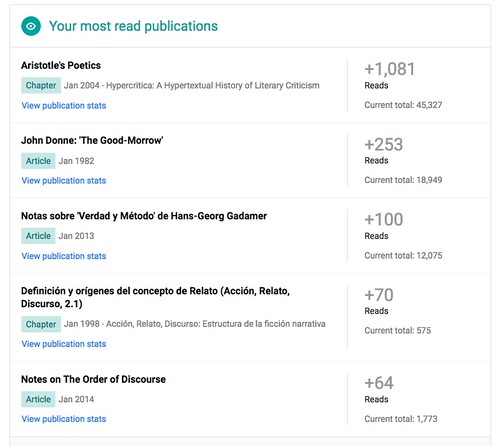
Veo que mi artículo o capítulo sobre la poética Aristóteles vuelve al primer puesto de la publicación más leída de esta universidad—donde suele estar desde hace años.  Tiene cierto staying power —que se debe, cómo no, a Aristóteles más que a mí:


Captura de pantalla 2022-02-14 a las 9.57.37


—oOo—

martes, 30 de noviembre de 2021

140.000 lecturas

Un éxito, mi capítulo sobre Aristóteles. Todas las semanas está entre las publicaciones más leídas de la Universidad de Zaragoza, y hoy llega a las 140.000 visitas en ResearchGate:

140,000 reads - here.

lunes, 5 de julio de 2021

Aristotle's Poetics - Top Ten


Dear José Angel García Landa:

Your paper, "ARISTOTLE'S POETICS", was recently listed on SSRN's Top Ten download list for: Ancient Greek & Roman Literature eJournal.

As of 05 July 2021, your paper has been downloaded 504 times. You may view the abstract and download statistics at: https://ssrn.com/abstract=2423697.

Top Ten Lists are updated on a daily basis. Click the following link(s) to view the Top Ten list for:

Ancient Greek & Roman Literature eJournal Top Ten.

Click the following link(s) to view all the papers in:

Ancient Greek & Roman Literature eJournal All Papers.


Captura de pantalla 2021-07-05 a las 12.28.59

—oOo—

martes, 9 de marzo de 2021

Top Ten Helenístico

 
Sigo pegando fuerte con Aristóteles, parece:


Dear Jose Angel Garcia Landa:

Your paper, "THE STRUCTURE OF THE FABULA (I): ARISTOTLE'S 'POETICS' (NARRATIVE THEORY, 1)", was recently listed on SSRN's Top Ten download list for: PRN: Hellenistic & Roman (Sub-Topic).

As of 09 March 2021, your paper has been downloaded 146 times. You may view the abstract and download statistics at: https://ssrn.com/abstract=2689058.

Top Ten Lists are updated on a daily basis. Click the following link(s) to view the Top Ten list for:

PRN: Hellenistic & Roman (Sub-Topic) Top Ten.

Click the following link(s) to view all the papers in:

PRN: Hellenistic & Roman (Sub-Topic) All Papers.


Hellenistic Top Ten

lunes, 28 de septiembre de 2020

Cien Mil Lecturas


Cien mil lecturas lleva (nada más en ResearchGate) mi capítulo sobre la Poética de Aristóteles. Muchas más todavía si sumamos las de otros repositorios donde está. No deja de sorprenderme mi éxito (sin cobrar) en ResearchGate. Semana tras semana recibo comunicados de que soy el más leído en mi universidad y en los principales campos temáticos en los que he trabajado, no sólo crítica y lingüística sino también Literatura, Filosofía, Análisis del Discurso a veces... El más leído del mundo, hay que suponer.  Cosa que, como digo, si bien es halagadora, no deja de extrañarme.  En el caso de este artículo la cosa es un poco más comprensible puesto que el que tiene arrastre realmente en este asunto no soy yo sino más bien Aristóteles.


100,000


Ranking High


—oOo—

lunes, 13 de mayo de 2019

Mi publicación más leída

Mi publicación más leída quizá sea ésta, un capítulo sobre la Poética de Aristóteles más bien divulgativo y no especialmente original, que sólo en ResearchGate (hay otras varias "ediciones") ha alcanzado las 70.000 lecturas—o "lecturas".


Mi publicación más leída creo


Aristotle's Poetics (ResearchGate)

—oOo—


viernes, 15 de marzo de 2019

Aristotle on the Sea


From Aristotle's Meteorology (online at MIT).


Aristotle, Meteorology (I.i):

Since there is necessarily some change in the whole world, but not in the way of coming into existence or perishing (for the universe is permanent), it must be, as we say, that the same places are not for ever moist through the presence of sea and rivers, nor for ever dry. And the facts prove this. The whole land of the Egyptians, whom we take to be the most ancient of men, has evidently gradually come into existence and been produced by the river. This is clear from an observation of the country, and the facts about the Red Sea suffice to prove it too. One of their kings tried to make a canal to it (for it would have been of no little advantage to them for the whole region to have become navigable; Sesostris is said to have been the first of the ancient kings to try), but he found that the sea was higher than the land. So he first, and Darius afterwards, stopped making the canal, lest the sea should mix with the river water and spoil it. So it is clear that all this part was once unbroken sea. For the same reason Libya —the country of Ammon— is, strangely enough, lower and hollower than the land to the seaward of it. For it is clear that a barrier of silt was formed and after it lakes and dry land, but in course of time the water that was left behind in the lakes dried up and is now all gone. Again the silting up of the lake Maeotis by the rivers has advanced so much that the limit to the size of the ships which can now sail into it to trade is much lower than it was sixty years ago. Hence it is easy to infer that it, too, like most lakes, was originally produced by the rivers and that it must end by drying up entirely.

Again, this process of silting up causes a continuous current through the Bosporus; and in this case we can directly observe the nature of the process. Whenever the current from the Asiatic shore threw up a sandbank, there first formed a small lake behind it. Later it dried up and a second sandbank formed in front of the first and a second lake. This process went on uniformly and without interruption. Now when this has been repeated often enough, in the course of time the strait must become like a river, and in the end the river itself must dry up.

So it is clear, since there will be no end to time and the world is eternal, that neither the Tanais nor the Nile has always been flowing, but that the region whence they flow was once dry: for their effect may be fulfilled, but time cannot. And this will be equally true of all other rivers. But if rivers come into existence and perish and the same parts of the earth were not always moist, the sea must needs change correspondingly. And if the sea is always advancing in one place and receding in another it is clear that the same parts of the whole earth are not always either sea or land, but that all this changes in course of time.

2.i:

The whole of the Mediterranean does actually flow. The direction of this flow is determined by the depth of the basins and by the number of rivers. Maeotis flows into Pontus and Pontus into the Aegean. After that the flow of the remaining seas is not so easy to observe. The current of Maeotis and Pontus is due to the number of rivers (more rivers flow into the Euxine and Maeotis than into the whole Mediterranean with its much larger basin), and to their own shallowness. For we find the sea getting deeper and deeper. Pontus is deeper than Maeotis, the Aegean than Pontus, the Sicilian sea than the Aegean; the Sardinian and Tyrrhenic being the deepest of all. (Outside the pillars of Heracles the sea is shallow owing to the mud, but calm, for it lies in a hollow.) We see, then, that just as single rivers flow from mountains, so it is with the earth as a whole: the greatest volume of water flows from the higher regions in the north. Their alluvium makes the northern seas shallow, while the outer seas are deeper. Some further evidence of the height of the northern regions of the earth is afforded by the view of many of the ancient meteorologists. They believed that the sun did not pass below the earth, but round its northern part, and that it was the height of this which obscured the sun and caused night.

2.iii:

We must now explain why the sea is salt, and ask whether it eternally exists as identically the same body, or whether it did not exist at all once and some day will exist no longer, but will dry up as some people think.

Every one admits this, that if the whole world originated the sea did too; for they make them come into being at the same time. It follows that if the universe is eternal the same must be true of the sea. Any one who thinks like Democritus that the sea is diminishing and will disappear in the end reminds us of Aesop's tales. His story was that Charybdis had twice sucked in the sea: the first time she made the mountains visible; the second time the islands; and when she sucks it in for the last time she will dry it up entirely. Such a tale is appropriate enough to Aesop in a rage with the ferryman, but not to serious inquirers. Whatever made the sea remain at first, whether it was its weight, as some even of those who hold these views say (for it is easy to see the cause here), or some other reason —clearly the same thing must make it persist for ever. They must either deny that the water raised by the sun will return at all, or, if it does, they must admit that the sea persists for ever or as long as this process goes on, and again, that for the same period of time that sweet water must have been carried up beforehand. So the sea will never dry up: for before that can happen the water that has gone up beforehand will return to it: for if you say that this happens once you must admit its recurrence. If you stop the sun's course there is no drying agency. If you let it go on it will draw up the sweet water as we have said whenever it approaches, and let it descend again when it recedes. This notion about the sea is derived from the fact that many places are found to be drier now than they once were. Why this is so we have explained. The phenomenon is due to temporary excess of rain and not to any process of becoming in which the universe or its parts are involved. Some day the opposite will take place and after that the earth will grow dry once again. We must recognize that this process always goes on thus in a cycle, for that is more satisfactory than to suppose a change in the whole world in order to explain these facts. But we have dwelt longer on this point than it deserves.

To return to the saltness of the sea: those who create the sea once for all, or indeed generate it at all, cannot account for its saltness. It makes no difference whether the sea is the residue of all the moisture that is about the earth and has been drawn up by the sun, or whether all the flavour existing in the whole mass of sweet water is due to the admixture of a certain kind of earth. Since the total volume of the sea is the same once the water that evaporated has returned, it follows that it must either have been salt at first too, or, if not at first, then not now either. If it was salt from the very beginning, then we want to know why that was so; and why, if salt water was drawn up then, that is not the case now.

Again, if it is maintained that an admixture of earth makes the sea salt (for they say that earth has many flavours and is washed down by the rivers and so makes the sea salt by its admixture), it is strange that rivers should not be salt too. How can the admixture of this earth have such a striking effect in a great quantity of water and not in each river singly? For the sea, differing in nothing from rivers but in being salt, is evidently simply the totality of river water, and the rivers are the vehicle in which that earth is carried to their common destination.

It is equally absurd to suppose that anything has been explained by calling the sea 'the sweat of the earth', like Empedocles. Metaphors are poetical and so that expression of his may satisfy the requirements of a poem, but as a scientific theory it is unsatisfactory. Even in the case of the body it is a question how the sweet liquid drunk becomes salt sweat whether it is merely by the departure of some element in it which is sweetest, or by the admixture of something, as when water is strained through ashes. Actually the saltness seems to be due to the same cause as in the case of the residual liquid that gathers in the bladder. That, too, becomes bitter and salt though the liquid we drink and that contained in our food is sweet. If then the bitterness is due in these cases (as with the water strained through lye) to the presence of a certain sort of stuff that is carried along by the urine (as indeed we actually find a salt deposit settling in chamber-pots) and is secreted from the flesh in sweat (as if the departing moisture were washing the stuff out of the body), then no doubt the admixture of something earthy with the water is what makes the sea salt.

Now in the body stuff of this kind, viz. the sediment of food, is due to failure to digest: but how there came to be any such thing in the earth requires explanation. Besides, how can the drying and warming of the earth cause the secretion such a great quantity of water; especially as that must be a mere fragment of what is left in the earth? Again, waiving the question of quantity, why does not the earth sweat now when it happens to be in process of drying? If it did so then, it ought to do so now. But it does not: on the contrary, when it is dry it graws moist, but when it is moist it does not secrete anything at all. How then was it possible for the earth at the beginning when it was moist to sweat as it grew dry? Indeed, the theory that maintains that most of the moisture departed and was drawn up by the sun and that what was left over is the sea is more reasonable; but for the earth to sweat when it is moist is impossible.

Since all the attempts to account for the saltness of the sea seem unsuccessful let us explain it by the help of the principle we have used already.

Since we recognize two kinds of evaporation, one moist, the other dry, it is clear that the latter must be recognized as the source of phenomena like those we are concerned with.

But there is a question which we must discuss first. Does the sea always remain numerically one and consisting of the same parts, or is it, too, one in form and volume while its parts are in continual change, like air and sweet water and fire? All of these are in a constant state of change, but the form and the quantity of each of them are fixed, just as they are in the case of a flowing river or a burning flame. The answer is clear, and there is no doubt that the same account holds good of all these things alike. They differ in that some of them change more rapidly or more slowly than others; and they all are involved in a process of perishing and becoming which yet affects them all in a regular course.

This being so we must go on to try to explain why the sea is salt. There are many facts which make it clear that this taste is due to the admixture of something. First, in animal bodies what is least digested, the residue of liquid food, is salt and bitter, as we said before. All animal excreta are undigested, but especially that which gathers in the bladder (its extreme lightness proves this; for everything that is digested is condensed), and also sweat; in these then is excreted (along with other matter) an identical substance to which this flavour is due. The case of things burnt is analogous. What heat fails to assimilate becomes the excrementary residue in animal bodies, and, in things burnt, ashes. That is why some people say that it was burnt earth that made the sea salt. To say that it was burnt earth is absurd; but to say that it was something like burnt earth is true. We must suppose that just as in the cases we have described, so in the world as a whole, everything that grows and is naturally generated always leaves an undigested residue, like that of things burnt, consisting of this sort of earth. All the earthy stuff in the dry exhalation is of this nature, and it is the dry exhalation which accounts for its great quantity. Now since, as we have said, the moist and the dry evaporations are mixed, some quantity of this stuff must always be included in the clouds and the water that are formed by condensation, and must redescend to the earth in rain. This process must always go on with such regularity as the sublunary world admits of. and it is the answer to the question how the sea comes to be salt.

It also explains why rain that comes from the south, and the first rains of autumn, are brackish. The south is the warmest of winds and it blows from dry and hot regions. Hence it carries little moist vapour and that is why it is hot. (It makes no difference even if this is not its true character and it is originally a cold wind, for it becomes warm on its way by incorporating with itself a great quantity of dry evaporation from the places it passes over.) The north wind, on the other hand, coming from moist regions, is full of vapour and therefore cold. It is dry in our part of the world because it drives the clouds away before it, but in the south it is rainy; just as the south is a dry wind in Libya. So the south wind charges the rain that falls with a great quantity of this stuff. Autumn rain is brackish because the heaviest water must fall first; so that that which contains the greatest quantity of this kind of earth descends quickest.

This, too, is why the sea is warm. Everything that has been exposed to fire contains heat potentially, as we see in the case of lye and ashes and the dry and liquid excreta of animals. Indeed those animals which are hottest in the belly have the hottest excreta.

The action of this cause is continually making the sea more salt, but some part of its saltness is always being drawn up with the sweet water. This is less than the sweet water in the same ratio in which the salt and brackish element in rain is less than the sweet, and so the saltness of the sea remains constant on the whole. Salt water when it turns into vapour becomes sweet, and the vapour does not form salt water when it condenses again. This I know by experiment. The same thing is true in every case of the kind: wine and all fluids that evaporate and condense back into a liquid state become water. They all are water modified by a certain admixture, the nature of which determines their flavour. But this subject must be considered on another more suitable occasion.

For the present let us say this. The sea is there and some of it is continually being drawn up and becoming sweet; this returns from above with the rain. But it is now different from what it was when it was drawn up, and its weight makes it sink below the sweet water. This process prevents the sea, as it does rivers, from drying up except from local causes (this must happen to sea and rivers alike). On the other hand the parts neither of the earth nor of the sea remain constant but only their whole bulk. For the same thing is true of the earth as of the sea: some of it is carried up and some comes down with the rain, and both that which remains on the surface and that which comes down again change their situations.

There is more evidence to prove that saltness is due to the admixture of some substance, besides that which we have adduced. Make a vessel of wax and put it in the sea, fastening its mouth in such a way as to prevent any water getting in. Then the water that percolates through the wax sides of the vessel is sweet, the earthy stuff, the admixture of which makes the water salt, being separated off as it were by a filter. It is this stuff which make salt water heavy (it weighs more than fresh water) and thick. The difference in consistency is such that ships with the same cargo very nearly sink in a river when they are quite fit to navigate in the sea. This circumstance has before now caused loss to shippers freighting their ships in a river. That the thicker consistency is due to an admixture of something is proved by the fact that if you make strong brine by the admixture of salt, eggs, even when they are full, float in it. It almost becomes like mud; such a quantity of earthy matter is there in the sea. The same thing is done in salting fish.

Again if, as is fabled, there is a lake in Palestine, such that if you bind a man or beast and throw it in it floats and does not sink, this would bear out what we have said. They say that this lake is so bitter and salt that no fish live in it and that if you soak clothes in it and shake them it cleans them. The following facts all of them support our theory that it is some earthy stuff in the water which makes it salt. In Chaonia there is a spring of brackish water that flows into a neighbouring river which is sweet but contains no fish. The local story is that when Heracles came from Erytheia driving the oxen and gave the inhabitants the choice, they chose salt in preference to fish. They get the salt from the spring. They boil off some of the water and let the rest stand; when it has cooled and the heat and moisture have evaporated together it gives them salt, not in lumps but loose and light like snow. It is weaker than ordinary salt and added freely gives a sweet taste, and it is not as white as salt generally is. Another instance of this is found in Umbria. There is a place there where reeds and rushes grow. They burn some of these, put the ashes into water and boil it off. When a little water is left and has cooled it gives a quantity of salt.

Most salt rivers and springs must once have been hot. Then the original fire in them was extinguished but the earth through which they percolate preserves the character of lye or ashes. Springs and rivers with all kinds of flavours are found in many places. These flavours must in every case be due to the fire that is or was in them, for if you expose earth to different degrees of heat it assumes various kinds and shades of flavour. It becomes full of alum and lye and other things of the kind, and the fresh water percolates through these and changes its character. Sometimes it becomes acid as in Sicania, a part of Sicily. There they get a salt and acid water which they use as vinegar to season some of their dishes. In the neighbourhood of Lyncus, too, there is a spring of acid water, and in Scythia a bitter spring. The water from this makes the whole of the river into which it flows bitter. These differences are explained by a knowledge of the particular mixtures that determine different savours. But these have been explained in another treatise.

We have now given an account of waters and the sea, why they persist, how they change, what their nature is, and have explained most of their natural operations and affections.


—oOo—


-->

miércoles, 6 de febrero de 2019

Número 4 en Humanities Commons

El repositorio CORE, de Humanities Commons, reúne las contribuciones de las redes sociales de la MLA y de otras sociedades norteamericanas de humanidades. Me felicita anunciarles que una publicación mía ha sido de las más consultadas durante el año 2018:


No. 4 in Humanities Commons
Con esto, ya son cuatro los repositorios internacionales de primera línea en los que tengo un posicionamiento destacado por una u otra razón: Humanities Commons, la SSRN, Academia, y ResearchGate. Eso sin contar el Zaguán de la Universidad de Zaragoza—esa universidad que lejos de facilitarme las cosas (o felicitarme, por ejemplo, por estos resultados) se está dedicando últimamente a hacerme la cusqui y a ponerme trabas con normativas absurdas (prohibición de blogs, prohibición de enlaces externos, etc.) creadas al parecer ad hoc para tratar con mi caso. Si es que hay que entender que soy un caso.


—oOo—


lunes, 29 de octubre de 2018

Mi publicación más leída

Ésta es mi publicación más leída hasta la fecha, y en ResearchGate. No sé si es lógico, o deprimente, que sea la más leída siendo que la escribí hace más de 30 años.

Aristotle's Poetics: https://www.researchgate.net/publication/262224737


Mi publicación más leída


—oOo—


martes, 18 de septiembre de 2018

La Poética de Platón

Plato's Poetics:

https://www.freelance-filmmaker.com/blog/plato-s-poetics

Enlazan en este blog sobre vídeo y cine, Freelance Filmmaker, mi artículo sobre la poética de Platón


(artículo que tiene DOI 10.2139/ssrn.2414535)

—aunque por asociación con la Poética de Aristóteles se toman demasiado en serio lo de que Platón escribiese una Poética, propiamente dicha.

Sí escribí yo en cambio otro artículo o lección sobre la Poética de Aristóteles, y viene siendo ésta mi publicación más leída, tanto en Academia como en ResearchGate:


My most read publications


—oOo—


viernes, 1 de junio de 2018

Los más descargados de mayo

Después de ser el autor del artículo más descargado en el mes de abril en la red de la MLA, en mayo vuelvo a estar entre los más descargados:

Los más descargados de Mayo


—oOo—


miércoles, 2 de mayo de 2018

El más descargado en abril


Empiezo a tener algún pequeño éxito de posicionamiento en el nuevo repositorio que voy utilizando, el Humanities Commons asociado a la MLA (y a otras sociedades académicas norteamericanas).  En este caso, mi artículo sobre Aristóteles, un clásico de mis viejos éxitos, es el más descargado de la red en el mes de abril.


April's Most Downloaded


Bueno, eso es una foto que le he hecho, para que conste. Esto es el tweet:


—oOo—


sábado, 10 de febrero de 2018

January's most downloaded scholarship

Mi capítulo sobre la Poética de Aristóteles se encuentra entre los más descargados este año en el servidor de Humanities Commons.  Es la primera vez que aparezco destacado en este nuevo repositorio al que empecé a subir trabajos a finales del año pasado.

De su circular:


January's Most Downloaded Humanities Scholarship

Monographs, book chapters, articles, and manifestos covering modernist digital humanities, theory of mind, a feminist take on distant reading, race in the middle ages, Aristotle's Poetics, the racialized construction of innocence, and a cultural history of the Odyssey were among the most downloaded items from CORE last month. Check them out on the hcommons.org homepage.
 
—oOo— 

miércoles, 3 de enero de 2018

Aristotle's Poetics

This paper provides an overview and commentary of Aristotle's theory of poetry, of drama, and of narrative structure, as presented the Poetics. The main emphasis falls on plot structure, but we expound other important subjects dealt with in the work, such as the cognitive origins of literature, the nature of poetry, an incipient theory of media and the analysis of genres, the nature and elements of tragedy, and other subjects such as epic narrative and the structure of critical debates.


Aristotle's Poetics

 
Author(s):
José Angel García Landa (see profile)
Date:
2014
Group(s):
Narrative theory and Narratology
Subject(s):
Literary theory, Philosophy and literature, Dramatic theory, Greek tragedy, Narratology
Item Type:
Article
Tag(s):
Tragedy, Aristotle, poetics, literary theory, narratology
Permanent URL:
http://dx.doi.org/10.17613/M60N93
Abstract:

Notes:
Written 1987.

García Landa, José Angel. "Aristotle's Poetics." 1987. Online at Hypercritica. 2004.*

      http://www.unizar.es/departamentos/filologia_inglesa/garciala/hypercritica/01.Classical/Classical.1.3/Classical.1.3.1.html

         2017

_____. "Aristotle's Poetics." 1987. Online PDF at Social Science Research Network 12 April 2014.*

         http://ssrn.com/abstract=2423697

         2014

         Cultural Anthropology eJournal 12 April 2014.*

         http://www.ssrn.com/link/Cultural-Anthropology.html

2014

         Cognition & the Arts eJournal 12 April 2014.*

         http://www.ssrn.com/link/Cognition-Arts.html

2014

         Ancient Greek & Roman Literature eJournal 12 April 2014.*

         http://www.ssrn.com/link/Ancient-Greek-Roman-Literature.html

2014

Literary Theory & Criticism eJournal 12 April 2014.*

         http://www.ssrn.com/link/English-Lit-Theory-Criticism.html

2014

_____. "Aristotle's Poetics." Academia.edu 13 May 2014.*

https://www.academia.edu/7025980/

2014

_____. "Aristotle's Poetics." ResearchGate 13 May 2014.*

https://www.researchgate.net/publication/262224737

2014

_____. "Aristotle's Poetics." Departmental Library. (2016).*

         http://departmental-library.blogspot.com.es/2016/08/aristotles-poetics-jose-angel-garcia.html

         http://www.mediafire.com/download/3x1i0i9xcq9qm5h/Aristotles.Poetics.pdf

         2016

_____. "Aristotle's Poetics." Humanities Commons 3 Jan. 2018.*

         https://hcommons.org/deposits/item/hc:17261/

         http://dx.doi.org/10.17613/M60N93

         2017

_____. "Aristotle's Poetics." Artsdocbox (2017).*

         http://artsdocbox.com/Fine_Art/68062892-Aristotle-s-poetics-jose-angel-garcia-landa-universidad-de-zaragoza.html

         2018

_____. "Aristotle's Poetics." In García Landa, Vanity Fea  3 Jan. 2018.*

         https://vanityfea.blogspot.com.es/2018/01/aristotles-poetics.html

         2018

_____. "Aristotle's Poetics." Online at Course Hero.*

         https://www.coursehero.com/file/p682bk62/Jos%C3%A9-Angel-Garc%C3%ADa-Landa-Aristotles-Poetics-3636-tragedy-endeavors-as-far-as/

         2022


—oOo—

sábado, 25 de febrero de 2017

Top Ten in Greek Linguistics


Dear Jose Angel Garcia Landa:

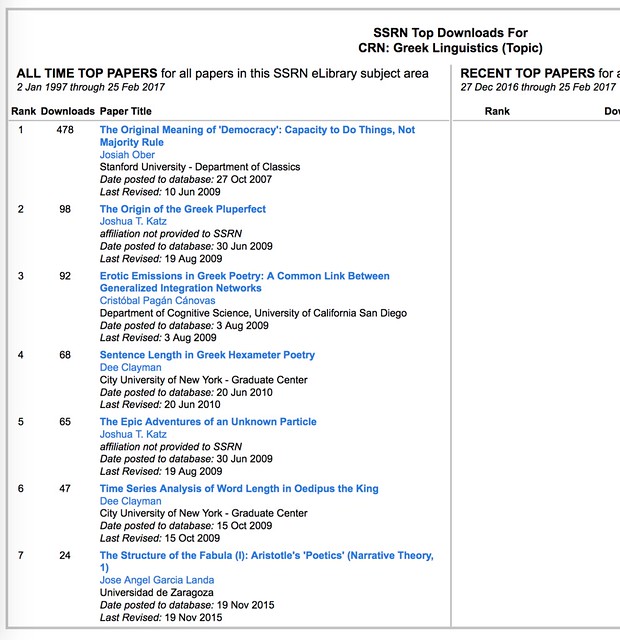
Your paper, "THE STRUCTURE OF THE FABULA (I): ARISTOTLE'S 'POETICS' (NARRATIVE THEORY, 1)", was recently listed on SSRN's Top Ten download list for: CRN: Greek Linguistics (Topic).

As of 25 February 2017, your paper has been downloaded 24 times. You may view the abstract and download statistics at: https://ssrn.com/abstract=2689058.

Top Ten Lists are updated on a daily basis. Click the following link(s) to view the Top Ten list for:

CRN: Greek Linguistics (Topic) Top Ten.

Click the following link(s) to view all the papers in:

CRN: Greek Linguistics (Topic) All Papers.

To view SSRN's Top Ten lists for any network, subnetwork, eJournal or topic on the Browse list (reachable through the following link: http://www.ssrn.com/Browse), click the "i" button to the right of the name, and then select the "Top Downloaded" link in the popup window.

Your paper may be included in future Top Ten lists for other networks or eJournals. If so, you will receive additional notices at that time.


Top Ten in Greek Linguistics

—oOo—

Mi fotoblog

Mi fotoblog
se puede ver haciendo clic en la foto ésta de Termineitor. Y hay más enlaces a cosas mías al pie de esta página.