Mostrando entradas con la etiqueta Platón. Mostrar todas las entradas

viernes, 28 de octubre de 2022

El mito en Platón

Tesis barcelonesa donde se me cita:

Aguilar, Jaume. "Estatut epistemològic i estratègia comunicativa del mite a Plató." Ph.D. diss. U de Barcelona, 2017. Online at Tesis Doctorals en Xarxa.*

         https://www.tdx.cat/bitstream/handle/10803/458365/JAF_TESI.pdf

         2022


—oOo—

sábado, 30 de noviembre de 2019

Narratología del 'Parménides'


Un artículo sobre la narratología del Parménides de Platón:


Díaz López, Lucas. (Departamento de Filosofía Teorética, U Complutense de Madrid). "Las edades de Sócrates: Interpretación del Parménides de Platón a la luz de su estructura narrativa." Eikasia (Nov. 2012): 57-71.*
         2019


 (Cita mi libro Acción, Relato, Discurso).


 —oOo—

jueves, 11 de octubre de 2018

Soy citado en Síntesis

Citan mi libro Acción, Relato, Discurso en


Síntesis: Revista de Filosofía.*
         2018

Aunque en realidad la cita es de cuando la revista se llamaba Intus-Legere; ha cambiado de nombre este año. En este artículo sobre Platón:


Díaz López, Lucas. "El diálogo platónico entre la literatura y la filosofía." Intus-Legere: Revista de Filosofía 7.2 (2013): 91-104.*
         (Journal retitled Síntesis, 2018):
         2018

—oOo—

martes, 18 de septiembre de 2018

La Poética de Platón

Plato's Poetics:

https://www.freelance-filmmaker.com/blog/plato-s-poetics

Enlazan en este blog sobre vídeo y cine, Freelance Filmmaker, mi artículo sobre la poética de Platón


(artículo que tiene DOI 10.2139/ssrn.2414535)

—aunque por asociación con la Poética de Aristóteles se toman demasiado en serio lo de que Platón escribiese una Poética, propiamente dicha.

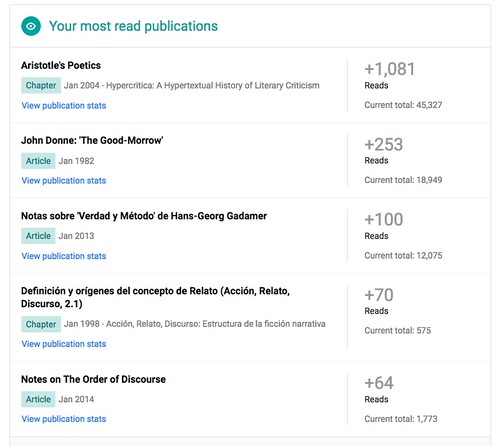
Sí escribí yo en cambio otro artículo o lección sobre la Poética de Aristóteles, y viene siendo ésta mi publicación más leída, tanto en Academia como en ResearchGate:


My most read publications


—oOo—


martes, 27 de febrero de 2018

Post-apocalipsis y Civilización: El evolucionismo social en Platón

En el Libro III de su diálogo tardío Las Leyes, Platón retoma la leyenda de la Atlántida, o quizá las versiones griegas del Diluvio Universal recogidas en el mito de Decaulión y Pirra, y proporciona uno de los primeros acercamientos filosóficos al evolucionismo cultural, a la historia de las civilizaciones, y a la teoría del desarrollo social. No fue el primero:

"Según K. Reinhardt, 'Hekataios von Abdera und Demokrit", Hermes 47 (1912), 492-513, el apartado que aquí comienza hasta 682c tiene como fuente una obra de Demócrito" (Francisco Lisi, nota p. 290).

No deja de recordar este pasaje de Platón a otra teoría del desarrollo político más elaborada, la de Polibio en sus Historias. En "Evolución, Anaciclosis y dialéctica social de la historia" comenté esta teoría de Polibio como una forma temprana de pensamiento evolucionista—con ciertas interferencias empero de una concepción cíclica del tiempo que también se aprecian en Platón. Polibio ciertamente conocería la obra de Platón, y como él reflexionó sobre la naturaleza de la organización política, las instituciones y su surgimiento, y la naturaleza de las diversas constituciones y formas de gobierno.

Reproduzco aquí el pasaje de Platón (posiblemente inspirado en Demócrito) de esta edición de las Leyes, un diálogo entre el Ateniense y Clinias (del libro III: Los principios constitutivos del Estado; 676a-682d).


Platón. Diálogos VII: Leyes (Libros I-V). Diálogos VIII: Leyes (Libros VI-XII). Introd., trans. and notes by Francisco Lisi. 2 vols. Madrid: Gredos, 1982. Rpt. (Biblioteca Gredos, 31, 32). Barcelona: RBA, 2007.*

snowstorm Turner


AT.— Esto, entonces, es así. Pero ¿cuál diremos que fue el principio de la organización política? ¿No es acaso desde la siguiente perspectiva desde la que se la comprendería de manera más fácil y mejor? 
CL.— ¿Desde cuál?
AT.— Desde donde hay que contemplar siempre el progreso de las sociedades que se da al mismo tiempo hacia la virtud y hacia el vicio. 
CL.— ¿Y de dónde dices?
AT.— Creo que desde la infinidad de la extensión del tiempo y de los cambios que se produjeron en él.
CL.— ¿Cómo dices?
AT.— Veamos, ¿crees que es fácil captar la cantidad de tiempo que transcurrió desde que hay ciudades y hombres que se organizan políticamente?
CL.— No es fácil en absoluto.
AT.— ¿Pero al menos estarás de acuerdo en que sería algo infinito e inconmensurable?
CL.— No cabe duda de que eso como mínimo.
AT.— ¿Acaso, pues, no han surgido en ese tiempo decenas de miles de ciudades unas tras otras, y, según el mismo cálculo numérico, no menos han desaparecido? ¿Han tenido, además, todo tipo de órdenes políticos muchas veces en cada lugar?, ¿y unas veces han nacido ciudades de mayor  tamaño de otras más pequeñas, mientras que otras más pequeñas de más grandes, así como peores de mejores, y mejores de peores? 
CL.—Necesariamente.
AT.— Intentemos captar, si pudiéramos, la causa de su cambio, pues probablemente, quizá, podría mostrarnos el primer surgimiento y transformación de los sistemas políticos.
CL.— Bien hablas y debemos esforzarnos, tú al exponernos lo que piensas de ellas y nosotros al atenderte.
AT.— ¿Acaso creéis que las antiguas historias tienen algo de verdad?
CL.— ¿Cuáles?
AT.— Las que dicen que hubo muchas destrucciones de hombres por cataclismos, enfermedades y otras múltiples desgracias, de las que sobrevivió sólo un pequeño número de seres humanos.
CL.— Para todo el mundo eso tiene mucha verosimilitud.
AT.— Veamos pues. Pensemos en una sola de las muchas, en esa que una vez tuvo lugar a causa del cataclismo. 
CL.— ¿Qué debemos pensar acerca de ella?
AT.— Que los que entonces escaparon de la destrucción serían, si no me equivoco, unos pastores montañeses, pequeñas ascuas de la raza humana, salvadas, en algún lugar, en las cimas de las montañas.
CL.— Evidente.
AT.— Además, es necesario, me parece, que gente semejante careciera de experiencia no sólo en las otras artes, sino también en las tramas que urden unos contra otros los que viven en las ciudades para hacer ganancias, imponerse y para todas las otras maldades que conciben para dañarse mutuamente.
CL.— Es probable, en efecto.
AT.— ¿Suponemos pues que las ciudades de las llanuras y las habitadas junto al mar fueron totalmente destruidas en ese tiempo?
CL.— Supongamos.
AT.— ¿Diremos entonces que desaparecieron todas las herramientas y aun que si había algún descubrimiento serio relacionado con el arte político o con alguna otra pericia, todo eso se debilitó en ese entonces? ¿Pues, cómo, querido amigo, si esas cosas hubieran permanecido durante todo el tiempo tal como están organizadas actualmente, podría haberse descubierto alguna vez algo nuevo?
CL.— Esto implica que los de aquel entonces no tuvieron noticia de esas cosas durante diez mil veces diez mil años y que han transcurrido mil años desde que han surgido, o dos veces tantos años. Unas se le revelaron a Dédalo, otras a Orfeo, otras a Palamedes, la música a Marsias y a Olimpo, la lira a Anfione y muchísimas otras a otros, las que surgieron, por decir así, ayer y antes de ayer.
AT.— Está muy bien, Clinias, que dejaras de lado al amigo, el que nació justamente ayer.
CL.— ¿No te refieres a Epiménides?
AT.— Sí, a él. Porque, con su ingenio, el vuestro superó en mucho a todos, amigo, lo que Hesíodo anunció antiguamente con su palabra, aquél lo cumplió con su acción, como decís vosotros.
CL.— Lo decimos, es cierto.
AT.— ¿No debemos decir que, cuando se produjo la destrucción, tal era la situación de los asuntos humanos: una inmensa soledad temible, una gran cantidad de tierra pródiga, mermados los restantes animales, quedaban algunas reses y, si por casualidad había sobrevivido alguna raza de cabras, éstas también eran escasas para que sus pastores vivieran de ellas?
CL.— Sin duda.
AT.— De la ciudad, de la forma de organización política y de la legislación, cuyo argumento ahora se nos ha hecho presente, ¿creemos que, hablando a grandes rasgos, existía algún recuerdo en absoluto?
CL.— En absoluto.
AT.— ¿Entonces no surgió de aquellos grupos, que estaban dispuestos de esta manera, todo lo que hoy existe, ciudades y sistemas políticos, artes y leyes, así como mucha maldad, pero también mucha virtud?
CL.— ¿Cómo dices?
AT.— ¿Pensamos acaso, querido amigo, que los hombres de entonces, al desconocer las muchas cosas bellas que albergan las urbes y las muchas cosas contrarias, llegaron a ser perfectos respecto de la virtud o del vicio?
CL.—Muy bien dicho; entendemos a qué te refieres.
AT.—¿Cuando pasó el tiempo y se multiplicó nuestra raza, no avanzó todo hacia la situación actual?
CL.— Muy cierto.
AT.— No súbitamente, como es probable, sino poco a poco, durante muchísimo tiempo.
CL.— Es muy probable que sucediera así.
AT.— Todos tenían todavía miedo en el cuerpo, creo, como para bajar de las alturas al llano.
CL.— Sí.
AT.— ¿No se alegraban al verse, por el pequeño número de los que vivían en aquella época y porque prácticamente todos los medios de transporte para viajar por tierra o por mar se habían casi extinguido, así como las artes necesarias para construirlos? No era para nada posible, creo, que tuvieran contacto entre sí. El hierro, el bronce y todos los metales habían desaparecido confundidos en el lodo, de modo que carecían totalmente de medios para extraerlos, y el talado de árboles era escaso. Supongo que si se había conservado alguna herramienta en las montañas, éstas, rápidamente gastadas, desaparecían y otras no iban a poder producirse antes de que llegara nuevamente a los hombres el arte de los metales.
CL.— ¿Cómo podrían?
AT.— ¿Cuántas generaciones más tarde creemos que sucedió eso?
CL.— Es evidente que muchísimas.
AT.— ¿En aquel entonces, durante ese período y aún más, no deben de haber permanecido desaparecidas también las artes que necesitan el hierro, el bronce y todas esas cosas?
CL.— Sí.
AT.— Y, además, en aquel tiempo también había desaparecido la rebelión junto con la guerra por muchas razones.
CL.— ¿Cuáles?
AT.— En primer lugar, a causa de la soledad, se apreciaban y tenían una buena disposición entre sí; luego, no tenían que luchar por la alimentación, pues, salvo quizás para algunos al principio no escaseaba el ganado del que vivían fundamentalmente en aquel entonces. En consecuencia, en absoluto necesitaban leche ni carne y, además, por medio de la caza obtenían una alimentación que no era ni mala ni poca. También tenían abundancia de vestimenta, lecho, habitación y recipientes resistentes al fuego y no resistentes a él. Pues las artesanías que producen por modelación y las relacionadas con el tejido y el trenzado no necesitan para nada el hierro. Un dios concedió que estas dos artes proveyeran a los hombres de todo eso, para que cada vez que los hombres cayeran en una carencia tal, el género humano pudiera tener un reflorecimiento y un progreso. Por eso, no eran muy pobres y, al no estar coaccionados por la pobreza, no surgían discordias entre ellos. Nunca llegarían a ser ricos los que carecieran de oro y plata, situación que entonces se daba entre aquéllos. En la comunidad en la que no habitan la riqueza ni la pobreza, pueden darse caracteres nobilísimos, pues no nacen en ella la insolencia ni la injusticia, así como tampoco los celos y las envidias. Por eso y por la ya mencionada simpleza, eran buenos. Por ser simples, creían que era la pura verdad lo que escuchaban que era bello o feo, y obedecían. Nadie poseía conocimiento como para sospechar la mentira, como ahora, sino que creían que era verdad lo que se decía de los dioses y de los hombres y llevaban una vida de acuerdo con esas máximas. Por tanto, eran absolutamente tal como los acabamos de describir.
CL.— Bien, a mí, al menos, y a éste también nos parece que fue así.
AT.— ¿No debemos decir entonces que las muchas generaciones, que viven de esta manera, van a poseer menos conocimientos prácticos e incluso van a ser más ignorantes en las otras artes que los que habían nacido antes del cataclismo y que los hombres actuales y, especialmente, en las relacionadas con la guerra, las que ahora se practican en tierra firme y en el mar y cuantas se dan sólo en el interior de la ciudad, las llamadas procesos judiciales y sediciones, que urden de obra y de palabra todos los medios para que los ciudadanos se perjudiquen unos a otros y se cometan injusticias, ya que eran más simples y más valientes y también más prudentes y más justos en todo? Ya hemos explicado la causa de esto.
CL.— Tienes razón.
AT.— Quede esto establecido y digamos todo lo que se sigue para comprender cuál llegó a ser la necesidad de leyes que tuvieron los de aquel entonces y quién era su legislador.
CL.—Bellas palabras, ciertamente.
AT.— ¿No es verdad que aquéllos no necesitaban legisladores ni solía darse algo semejante en esa época? En efecto, lo que nacieron en esa parte del período no poseían leyes escritas, sino que vivían regidos por las costumbres y las llamadas leyes patrias.
CL.—Es probable, en todo caso.
AT.— Éste ya es al menos un tipo de organización política.
CL.—¿Cuál?
AT.— Me parece que todos llaman a la forma de organización política existente en ese tiempo señorío, la que todavía existe en muchos lugares tanto entre griegos como entre bárbaros. Homero dice también que ella existía donde habitaban los cíclopes, cuando dice
   No tienen asambleas para tomar decisiones ni leyes
   sino que viven en las cumbres de altas montañas
   en huecas grutas; cada uno da las leyes
   a sus hijos y mujeres y no se preocupan unos de otros.
CL.—Este poeta vuestro parece haber alcanzado una perfección de estilo. Nosotros también recitamos otras cosas de él muy bonitas, no muchas, sin embargo, pues los cretenses no recitamos demasiados poemas extranjeros.
MEGILO.— Nosotros lo recitamos, por cierto, y nos parece superior a los poetas de ese género, aunque nunca describe una forma de vida lacedemonia, sino más bien un cierto tipo jonio. Sin embargo, ahora parece servirle bien de testigo a tu exposición, puesto que, en su historia legendaria, refiere lo antiguo en ellos a su rusticidad.
AT.— Sí, le sirve de testigo, en efecto, y tomémosolo como informante de que tales formas de organización politica se dan en alguna ocasión.
CL.—Bien.
AT.— ¿Acaso, pues, no surgen a partir de estas formaciones, dispersas en asentamientos aislados y organizadas por linajes a causa de la escasez que produjeron las destrucciones, en las que gobierna el elemento más anciano, porque del padre y la madre les ha venido la autoridad a los jefes, a los que los otros siguen, como pájaros, para formar una bandada, en la que son regidos por leyes paternas y están sometidos a la monarquía más justa de todas?
CL.—Absolutamente.
AT.— Después, se reúnen en grupos más numerosos, formando comunidades de mayor tamaño y las primeras en las laderas de las montañas se dedican a la agricultura, hacen unas vallas de piedras alrededor como defensas amuralladas contra las fiera y construyen una única gran casa común.
CL.—Es probable que haya sucedido así.
AT.— ¿Y qué?, ¿No es acaso probable lo que sigue?
CL.— ¿Qué?
AT.— Cuando estos asentamientos mayores crecen de los menores y primeros, cada uno de los pequeños sigue existiendo con su ordenamiento familiar, con el más anciano como jefe y con ciertas costumbres propias, por vivir los unos separados de los otros: son diferentes las que tienen acerca de los dioses y de sí mismos, porque otros son los que los engendraron y criaron; más sosegadas las de los más sosegados, y más impulsivas las de los más impulsivos, y, como cada uno imprime así, siguiendo la costumbre, sus concepciones en sus hijos y en los hijos de sus hijos, como decimos, llega con sus propias leyes al asentamiento mayor.
CL.—En efecto.
AT.— Además, es necesario que a cada uno le satisfagan las leyes propias, pero menos las ajenas.
CL.—Así es.
AT.— Es como si hubiéramos pisado sin darnos cuenta el umbral de la legislación, tal como parece.
CL.—Totalmente.
AT.— Ahora bien, el paso siguiente es necesariamente que los que  se han unido elijan en común a algunos de entre ellos para que, tras considerar las costumbres de todos, señalen claramente a los que guían y rigen los pueblos como si fueran reyes las que más les satisfacen para el uso de la comunidad y recomienden su adopción. Ellos se llamarán legisladores y tras poner a los jefes como gobernantes, instaurando una aristocracia a partir de los señoríos o incluso una monarquía, vivirán esn este orden político cambiado.
CL.—Por cierto, podría haber sucedido así paso a paso.
AT.— En tercer lugar, mencionemos el surgimiento de una forma de sistema político en la que coinciden todas las especies y características de las organizaciones políticas y, al mismo tiempo, de las ciudades.
CL.—¿Cuál es?
AT.— La que también mencionó Homero después de la segunda, cuando dice que la tercera surgió así:
   Fundó Dardania,
creo que dice,
          cuando todavía la sagrada Ilión
   no estaba habitada en la llanura, ciudad de hombres de voz articulada,
   sino que aún poblaban las laderas del Ida de muchos manantiales.
Pues dice estos versos y aquellos que dijo acerca de los Cíclopes. Todos están expresados de alguna manera bajo inspiración divina y, por tanto, como sucedieron en realidad. Pues, por cierto, cuando eleva un himno de alabanza, el linaje de los poetas es realmente divino, porque está poseído por un dios, ya que con la ayuda de algunas Cáritas y Musas siempre trata muchas cosas de la forma en que realmente han sucedido.
CL.— Y mucho.
AT.— Avancemos en la leyenda que ahora se nos ha narrado, pues quizá nos podría indicar algo acerca de nuestro objeto de deliberación. ¿No lo creéis necesario?
CL.— Absolutamente.
AT.— Bajaron, decimos, de las alturas a una llanura grande y hermosa y fundaron Troya, sobre una colina, no alta y con muchos ríos que descendían del Ida.
CL.— Se dice, en todo caso.
AT.— ¿No creeremos que esto tuvo lugar mucho tiempo después del diluvio?
CL.— ¿Cómo no iba a suceder mucho tiempo después?
AT.— Bien, parece que entonces ya habían olvidado completamente la destrucción que acabamos de mencionarr, cuando colocan una ciudad así cerca de numerosos ríos que bajan de las alturas, confiados en unas colinas no excesivamente altas.
CL.—Es evidente, por tanto, que un lapso muy grande los separaba de tal calamidad.
AT.—Otras muchas ciudades, creo, habitaban ya en las zonas bajas, mientras aumentaba el número de los seres humanos.
CL.—En efecto.
AT.—Por lo menos, supongo, las que hicieron una campaña por tierra contra ella y quizás también por mar, pues ya todos utilizaban el mar sin temor.
CL.—Así parece.
AT.—Tras permanecer unos diez años, los aqueos devastaron Troya.
CL.—Totalmente.


—oOo—


jueves, 7 de agosto de 2014

Bibliografía de Platón

Procedente de mi bibliografía http://bit.ly/abiblio, y paseada por Google y otros sitios antes, reinserto aquí una bibliografía de Platón, considerado en tanto que teorizador de la literatura y la representación, mayormente:


from A Bibliography of Literary Theory, Criticism and Philology http

View more ebooks on Vifon.net


Y aquí hay otra bibliografía de Simone de Beauvoir—la fecha de 1970 es por cierto errónea, no oiría yo hablar de Simone de Beauvoir hasta diez años después.


—oOo—


viernes, 4 de abril de 2014

Plato's Poetics


This paper presents an introductory overview of Plato's poetics, aesthetics, and literary theory, with particular reference to his notion of mimesis, and grounding the discussion on his Theory of Ideas. It is part of a lecture series on the history of literary criticism, partly available online as Hypercritica: A Hypertextual History of Literary Criticism. 


Plato's Poetics


I used to teach a course in the history of literary criticism in the late 80s and early 90s. And I began, well, before Plato—but Plato was the first major author, before the pièce de résistance of Unit 1, i.e. Aristotle's Poetics. Anyway, this is Plato's "Poetics"—not that it's bound to exist as a bound volume.
 
And it's also been issued now in the following SSRN eJournals:


(Date posted: March 26, 2014)  


eJournal Classifications
AARN Subject Matter eJournals
    
        
CRN Subject Matter eJournals
    
        
LIT Subject Matter eJournals
    
PRN Subject Matter eJournals


_____


Elsewhere:

_____. "1.2. Plato." 1986. Included in Hypercritica (2004).*

http://www.unizar.es/departamentos/filologia_inglesa/garciala/hypercritica/01.Classical/Classical.1.2/Classical.1.2.html

2014 DISCONTINUED 2020

https://personal.unizar.es/garciala/hypercritica/00.Hypercritica.htm 2020

_____. "Plato's Poetics." 1986. Online PDF at Social Science Research Network 26 March 2014.*

         DOI:10.2139/ssrn.2414535

http://ssrn.com/abstract=2414535

2014

Cultural Anthropology eJournal 26 March 2014.*

         http://www.ssrn.com/link/Cultural-Anthropology.html

2014

Ancient Philosophical and Scientific Texts eJournal 26 March 2014.*

         http://www.ssrn.com/link/Ancient-Philosophical-Scientific-Texts.html

Literary Theory & Criticism eJournal 26 March 2014.*

         http://www.ssrn.com/link/English-Lit-Theory-Criticism.html

2014

History of Western Philosophy eJournal 26 March 2014.*

         http://www.ssrn.com/link/History-of-Western-Philosophy.html

2014

_____. "Plato's Poetics." In García Landa, Vanity Fea 4 April 2014.*

         http://vanityfea.blogspot.com.es/2014/04/platos-poetics_4.html

         2014          

_____. "Plato's Poetics." Academia.edu 10 May 2014.*

https://www.academia.edu/7004120/

2014

_____. "Plato's Poetics." ResearchGate 10 May 2014.*

https://www.researchgate.net/publication/262183965

2014

_____. "Plato's Poetics." Humanities Commons 31 Dec. 2017.*

         https://hcommons.org/deposits/item/hc:17209/

         http://dx.doi.org/10.17613/M6C24R

         2017

_____. "Plato's Poetics." Semantic Scholar.*

         https://www.semanticscholar.org/paper/Plato's-Poetics-Landa/9e3878ab4a61ffad8578a8abbea84bc6d848c886

         2019


martes, 25 de marzo de 2014

La poética de Platón / Defensa de mi tesis

La poética de Platón

Una introducción en inglés, "Plato's Poetics." Viene de mis clases de Historia de la Crítica, de los años ochenta.

Defensa de mi tesis doctoral

Aquí está la defensa de la tesis doctoral que presenté ...  no en los años 2010, ni en los 2000, ni en los 90, sino en los ochenta. Hace treinta años comencé a trabajar en ella. Así se titulaba: El relato en la trilogía de Beckett: Molloy, Malone Dies, The Unnamable.

jueves, 31 de octubre de 2013

El decir griego

En el Seminario de Investigaciones Culturales "Tropelías" (SIC) [sic], de nuestra Facultad de Filosofía y Letras, asisto ayer a la conferencia de Robert Caner (Universidad de Barcelona) sobre "El decir griego y el sentido de la mímesis según Martínez Marzoa."

No sabía yo que Martínez Marzoa era tan joven cuando escribió su manual de historia de la filosofía—casi igual de joven que yo cuando yo me lo leía hace treinta y tantos años. Bien, pues recientemente vuelve a publicar mucho, entre otras cosas este libro sobre El decir griego que comenta Caner—una reflexión sobre la mímesis platónica, esencialmente.

Y aparece la mímesis, o bien en la versión de Platón, o en la de Marzoa, o en la de Caner, o en las ideas que a mí se me ocurren mientras lo oigo—que todos somos eslabones magnetizados al fin— como una paradójica actividad. La mímesis o más bien la reflexión sobre ella. La experiencia griega de la mímesis, y del pensamiento sobre ella, está unida a la esencia de la cosa: la cosa como puro aparecer ella misma, mostrarse (la aletheia aquélla), revelar su esencia y definirse como lo que es. Y la mímesis a la vez manifiesta esa esencia y la problematiza. Al igual que la teoría de Platón a la vez centra la esencia de la cosa y la extrae fuera de sí—a ese curioso mundo de las Ideas.

Me viene a la cabeza la crítica de Derrida a la noción platónica de escritura, tan ambivalente—a la vez condenando la escritura por escrito, y escribiéndola en diálogos, que quieren volver a la oralidad, pero una oralidad de nueva dimensión. Algo parecido sucede con el ser de la cosa en este decir griego sobre la mímesis.

Resulta que el decir griego, el decir filosófico, siendo a la vez otro mito (mito de la razón) desmitifica el mito tradicional (y me venían a la mente los comentarios desmitificadores de Platón, en el Fedro creo que era, sobre la interpretación alegórica de los mitos). El griego vive dividido entre la manifestación de la cosa en su esencia, y la búsqueda de los últimos porqués de las cosas, una búsqueda que no puede sino disolver la cosa en las condiciones de su presencia. La metafísica será ese estudio de las condiciones de la presencia, y es en cierto sentido una empresa contradictoria; la cosa, estudiada en las condiciones de su aparición o de su ser, deja de ser ella misma, y se disuelve en una gramática de posibilidades y de condiciones de posibilidad, de aparición.  Buscando la esencia de la presencia, la cosa se esfuma, y aparece la presencia en sí como objeto de pensamiento—el pensamiento ante sí mismo reflejado al infinito.

Es una relación un tanto paradójica, la del conocimiento de las cosas, que las saca de sí mismas, y las convierte en objetos de una disciplina que a la vez las explica y las disuelve en meras apariencias insustanciales. Es una nueva caída del paraíso, el conocimiento filosófico, y también nos embarca en una serie infinita de reflexiones cuando al objeto estudiado le añadimos el estudio o discurso sobre el objeto, y las condiciones de éste asimismo, como nuevo objeto para la reflexión.

Termina Caner con una apología del arte conceptual como análogo a la reflexión filosófica, una reflexión sobre las condiciones de aparición del arte y así también sobre su esencia. Y por el camino también pasamos por los románticos alemanes, los Schlegel, teorizadores del arte reflexivo—el arte que medita sobre las propias condiciones de la representación.

Me quedo con esa sugerencia de la paradoja inherente a la mímesis: imitación del objeto que revela su esencia precisamente no coincidiendo con el objeto, sacándolo fuera de sí—una circulación necesaria para el pensamiento al parecer, la pura presencia del objeto es más bien la fase edénica o infantil del pensamiento. La reflexión desilusionante la desmitifica, pero claro, sólo en un estadio mítico pueden darse las condiciones de aparición de la cosa como prístina o divina. De eso también escribieron los metafísicos ingleses, Traherne, Vaughan, o el propio Marvell, cuando su segador critica las estatuas de los dioses en los jardines—

Their statues polished by some ancient hand,
May to adorn the gardens stand;
But, howsoe'er the figures do excel,
The Gods themselves with us do dwell.


—oOo—

jueves, 7 de febrero de 2013

Plato: The Allegory of the Cave

Or "the Myth of the Cavern". A famous passage from the Republic. I quote (and correct a bit) from Reading about the World vol. 1, which establishes an analogy between Plato's cave and contemporary film spectatorship:
Editors' comments:

Plato, the most creative and influential of Socrates' disciples, wrote dialogues, in which he frequently used the figure of Socrates to espouse his own (Plato's) full-fledged philosophy. In "The Republic," Plato sums up his views in an image of ignorant humanity, trapped in the depths and not even aware of its own limited perspective.

The rare individual escapes the limitations of that cave and, through a long, tortuous intellectual journey, discovers a higher realm, a true reality, with a final, almost mystical awareness of Goodness as the origin of everything that exists. Such a person is then the best equipped to govern in society, having a knowledge of what is ultimately most worthwhile in life and not just a knowledge of techniques; but that person will frequently be misunderstood by those ordinary folks back in the cave who haven't shared in the intellectual insight. If he were living today, Plato might replace his rather awkward cave metaphor with a movie theater, with the projector replacing the fire, the film replacing the objects which cast shadows, the shadows on the cave wall with the projected movie on the screen, and the echo with the loudspeakers behind the screen. The essential point is that the prisoners in the cave are not seeing reality, but only a shadowy representation of it. The importance of the allegory lies in Plato's belief that there are invisible truths lying under the apparent surface of things which only the most enlightened can grasp. Used to the world of illusion in the cave, the prisoners at first resist enlightenment, as students resist education. But those who can achieve enlightenment deserve to be the leaders and rulers of all the rest. At the end of the passage, Plato expresses another of his favorite ideas: that education is not a process of putting knowledge into empty minds, but of making people realize that which they already know. This notion that truth is somehow embedded in our minds was also powerfully influential for many centuries.

Judging by this passage, why do you think many people in the democracy of Athens might have been antagonistic to Plato's ideas? Is a resident of the cave (a prisoner, as it were) likely to want to make the ascent to the outer world? Why or why not? What does the sun symbolize in the allegory? 

—oOo—


From the Republic, Book VII:

And now, I said, let me show in a figure how far our nature is enlightened or unenlightened:--Behold! human beings living in an underground den, which has a mouth open towards the light and reaching all along the den; here they have been from their childhood, and have their legs and necks chained so that they cannot move, and can only see before them, being prevented by the chains from turning round their heads. Above and behind them a fire is blazing at a distance, and between the fire and the prisoners there is a raised way; and you will see, if you look, a low wall built along the way, like the screen which marionette players have in front of them, over which they show the puppets.

I see.

And do you see, I said, men passing along the wall carrying all sorts of vessels, and statues and figures of animals made of wood and stone and various materials, which appear over the wall? Some of them are talking, others silent.

You have shown me a strange image, and they are strange prisoners.

Like ourselves, I replied; and they see only their own shadows, or the shadows of one another, which the fire throws on the opposite wall of the cave?

True, he said; how could they see anything but the shadows if they were never allowed to move their heads?

And of the objects which are being carried in like manner they would only see the shadows?


Yes, he said.

And if they were able to converse with one another, would they not suppose that they were naming what was actually before them?

Very true.

And suppose further that the prison had an echo which came from the other side, would they not be sure to fancy when one of the passers-by spoke that the voice which they heard came from the passing shadow?

No question, he replied.

To them, I said, the truth would be literally nothing but the shadows of the images.

That is certain.

And now look again, and see what will naturally follow if the prisoners are released and disabused of their error. At first, when any of them is liberated and compelled suddenly to stand up and turn his neck round and walk and look towards the light, he will suffer sharp pains; the glare will distress him, and he will be unable to see the realities of which in his former state he had seen the shadows; and then conceive some one saying to him, that what he saw before was an illusion, but that now, when he is approaching nearer to being and his eye is turned towards more real existence, he has a clearer vision,--what will be his reply? And you may further imagine that his instructor is pointing to the objects as they pass and requiring him to name them,--will he not be perplexed? Will he not fancy that the shadows which he formerly saw are truer than the objects which are now shown to him?

Far truer.

And if he is compelled to look straight at the light, will he not have a pain in his eyes which will make him turn away to take refuge in the objects of vision which he can see, and which he will conceive to be in reality clearer than the things which are now being shown to him?

True, he said.

And suppose once more, that he is reluctantly dragged up a steep and rugged ascent, and held fast until he is forced into the presence of the sun himself, is he not likely to be pained and irritated? When he approaches the light his eyes will be dazzled, and he will not be able to see anything at all of what are now called realities.

Not all in a moment, he said.

He will require to grow accustomed to the sight of the upper world. And first he will see the shadows best, next the reflections of men and other objects in the water, and then the objects themselves; then he will gaze upon the light of the moon and the stars and the spangled heaven; and he will see the sky and the stars by night better than the sun or the light of the sun by day?

Certainly.

Last of all he will be able to see the sun, and not mere reflections of him in the water, but he will see him in his own proper place, and not in another; and he will contemplate him as he is.

Certainly.

He will then proceed to argue that this is he who gives the season and the years, and is the guardian of all that is in the visible world, and in a certain way the cause of all things which he and his fellows have been accustomed to behold?

Clearly, he said, he would first see the sun and then reason about him.

And when he remembered his old habitation, and the wisdom of the den and his fellow-prisoners, do you not suppose that he would felicitate himself on the change, and pity them?

Certainly, he would.

And if they were in the habit of conferring honors among themselves on those who were quickest to observe the passing shadows and to remark which of them went before, and which followed after, and which were together; and who were therefore best able to draw conclusions as to the future, do you think that he would care for such honors and glories, or envy the possessors of them? Would he not say with Homer,

Better to be the poor servant of a poor master, and to endure anything, rather than think as they do and live after their manner? (1)

Yes, he said, I think that he would rather suffer anything than entertain these false notions and live in this miserable manner.

Imagine once more, I said, such a one coming suddenly out of the sun to be replaced in his old situation; would he not be certain to have his eyes full of darkness?

To be sure, he said.


And if there were a contest, and he had to compete in measuring the shadows with the prisoners who had never moved out of the den, while his sight was still weak, and before his eyes had become steady (and the time which would be needed to acquire this new habit of sight might be very considerable), would he not be ridiculous? Men would say of him that up he went and down he came without his eyes; (2)and that it was better not even to think of ascending; and if any one tried to loose another and lead him up to the light, let them only catch the offender, and they would put him to death. (3)

No question, he said.

This entire allegory, I said, you may now append, dear Glaucon, to the previous argument; the prison-house is the world of sight, the light of the fire is the sun, and you will not misapprehend me if you interpret the journey upwards to be the ascent of the soul into the intellectual world according to my poor belief, which, at your desire, I have expressed--whether rightly or wrongly God knows. But whether true or false, my opinion is that in the world of knowledge the idea of good appears last of all, and is seen only with an effort; and, when seen, is also inferred to be the universal author of all things beautiful and right, parent of light and of the lord of light in this visible world (4), and the immediate source of reason and truth in the intellectual; and that this is the power upon which he would act rationally either in public or private life must have his eye fixed.

I agree, he said, as far as I am able to understand you.

Moreover, I said, you must not wonder that those who attain to this beatific vision are unwilling to descend to human affairs; for their souls are ever hastening into the upper world where they desire to dwell; which desire of theirs is very natural, if our allegory may be trusted.

Yes, very natural.

And is there anything surprising in one who passes from divine contemplations to the evil state of man, misbehaving himself in a ridiculous manner; if, while his eyes are blinking and before he has become accustomed to the surrounding darkness, he is compelled to fight in courts of law, or in other places, about the images or the shadows of images of justice, and is endeavoring to meet the conception of those who have never yet seen absolute justice?

Anything but surprising, he replied.

Any one who has common sense will remember that the bewilderments of the eyes are of two kinds, and arise from two causes, either from coming out of the light or from going into the light, which is true of the mind's eye; and he who remembers this when he sees any one whose vision is perplexed and weak, will not be too ready to laugh; he will first ask whether that soul of man has come out of the brighter life, and is unable to see because unaccustomed to the dark, or having turned from darkness to the day is dazzled by excess of light. And he will count the one happy in his condition and state of being, and he will pity the other; or, if he have a mind to laugh at the soul which comes from below into the light, there will be more reason in this than in the laugh which greets him who returns from above out of the light into the den.

That, he said, is a very just distinction.

But then, if I am right, certain professors of education must be wrong when they say that they can put a knowledge into the soul which was not there before, like sight into blind eyes.

They undoubtedly say this, he replied.

Whereas our argument shows that the power and capacity of learning exists in the soul already; and that just as the eye was unable to turn from darkness to light without the whole body, so too the instrument of knowledge can only by the movement of the whole soul be turned from the world of becoming into that of being, and learn by degrees to endure the sight of being and of the brightest and best of being, or in other words, of the good.

—oOo—

Translated by Benjamin Jowett

(1) This refers to a famous passage in Homer's Odyssey in which the ghost of the great hero Achilles, when asked if he is not proud of the fame his deeds has spread throughout the world, answers that he would rather be a slave on a worn-out farm than king over all of the famous dead. Interestingly, Plato quotes the same passage elsewhere as disapprovingly as depicting life after death in such a negative manner that it may undermine the willingness of soldiers to die in war.

(2) The comic playwright Aristophanes had mocked Socrates by portraying Plato's master, Socrates, as a foolish intellectual with his head in the clouds.

(3) Plato undoubtedly has in mind the fact that the Athenians had condemned to death his master Socrates, whom Plato considered supremely enlightened.

(4) 
Here Plato describes his notion of God in a way that was influence profoundly Christian theologians.


—oOo—


The dialogue takes place between "Socrates" and Plato's puppet Glaucon. Now that I mention puppets—note that there is a feedback here between the notions of reality and representation, one which pertains to the very notion of representation. (See a Shakespearean analogue here). The editors see an analogy between Plato's cavern and the film screen, "had Plato been living today", and indeed the myth may serve as a primal scene in film theory. Or dramatic theory, or theory of the spectacle, because (note well) the idea for the shadows on the wall already originates, as Socrates' analogy makes clear, in a theatrical spectacle—the cavern wall being like "the screen which marionette players have in front of them, over which they show the puppets". One suspects that Socrates or Plato had been attending one of these spectacles at night, illuminated by a fire at the back the audience, and had somehow been more attentive to the shadows projected spontaneously by the audience, and the shadow play being shown on this proto-cinematic screen, than to the puppets above the screen. Or perhaps it is the unexpected and serendipitous conjunction of these two modes of representation, the theatrical one and the proto-cinematic images on the screen, and the wobble or fluctuation in reality and attention caused by their simultaneity and the interaction of several modes of reality and images of the same, which made the fire of an idea light up in the cavern of Plato's brain, and intuit the dialectical feedback or paradoxical Escher-like circulation existing between so-called reality and its representations.


______


Werner Herzog's Cave of Forgotten Dreams is a documentary film on the Paleolithic paintings of the Chauvet cave, whose walls contain some of the oldest symbolic objects of mankind, three hundred centuries ago. The play of volumes and fire lights on the paintings creates a certain illusion of movement, "a kind of proto-cinema" according to Herzog, to which is added the dynamic positions of the animals and the multiple lines suggesting the movement of legs or the head in some figures.  Paleoanthropologists also suggest that the play of human shadows on the walls of caves must have been one of the earliest forms of theatrical spectacle—the shadowplay, act
ually a mixture of projection and physical presence, perhaps joined to shamanic rituals in which animals were impersonated. Thus we find at the origins of drama, that powerfully reflexive symbolic ritual, a situation strongly reminiscent of the one described by Plato in his allegory of the cave. The image of the cave seems particularly appropriate, at this inaugural allegory of the birth of philosophy, and resonates with an echo coming from that time of forgotten dreams in which the symbolic world of myths had to be created, long before it might be deconstructed by the philosopher.


—oOo—

Mi fotoblog

Mi fotoblog
se puede ver haciendo clic en la foto ésta de Termineitor. Y hay más enlaces a cosas mías al pie de esta página.