jueves, 13 de noviembre de 2014

El argumento número 35

Esto viene del apéndice a 36 Arguments for the Existence of God: A Work of Fiction. Es ésta una excelente novela de campus de Rebecca Goldstein (pareja por cierto de Steven Pinker) en la que, metamorfoseándose imaginativamente en el judío descreído Cass Seltzer, "el ateo con alma", expresa la autora su comprensión (ligeramente irónico-maquiavélica) hacia el fenómeno religioso en tanto que fuente de consuelo metafísico, y en tanto que mecanismo articulador de mundos posibles y de sentimientos de integración en una comunidad.  Aunque sea una comunidad excéntrica articulada por creencias absurdas: los Valdenses, una pequeña tribu superviviente de judíos de Europa del Este, deslocalizados a América, eligen aquí al joven prodigio matemático Azariah, el hijo de su rabino, como nuevo guía espiritual, y éste acepta su destino a pesar de su distancia intelectual hacia las viejas tradiciones. Es, en suma, una versión judeo-americana, y altamente sofisticada, de San Manuel Bueno, Mártir. 

A la vez se completa con una intriga de campus, en la que Cass rompe con su novia perfecta pero carrierista, la genial psicóloga Lucinda, toda cerebro ella, y pasa a reanudar relaciones con la emocional y vital Roz, una antigua novia que reemerge ahora que Cass es famoso. El libro de Cass Seltzer, el que lo lanza a la fama, se llama The Varieties of Religious Illusion, combinando los títulos de libros sobre la religión de William James y de Sigmund Freud. Ese libro terminaba con una colección de argumentos a favor de la existencia de Dios, y sus correspondientes refutaciones, argumentos y refutaciones que son seguramente los mismos que cierran el libro de Rebecca Goldstein. Los argumentos reales se complementan con una colección fantástica de argumentos vividos en el argumento del libro, que dan título a cada capítulo. Creo que voy a incluir una lista de todos, los del argumento y los del apéndice argumentativo. Y terminaré con el argumento 35 del apéndice, por no terminar contando el final.


Contents:

I. The Argument from the Improbable Self.
II. The Argument from Lucinda.
III. The Argument from Dappled Things.
IV. The Argument from the Irrepressible Past.
V. The Argument from Reversal of Fortune.
VI. The Argument from Intimations of Immortality.
VII. The Argument from Soul-Gazing.
VIII. The Argument from the Existence of the Poem.
IX. The Argument from the Eternity of Irony.
X. The Argument from the Purer Self.
XI. The Artument from Transcendental Signifiers.
XII. The Argument from Prime Numbers.
XIII. The Argument from Taking Differences.
XIV. The Argument from Inconsolable Solitude.
XV. The Argumment from Sacred Circles.
XVI. The Argument from the Longing on the Gate.
XVII. The Argument from Strange Laughter.
XVIII. The Argument from the Arrow of Time.
XIX. The Argument from the Overheard Whispers of Angels.
XX. The Argument from Tidings of Destruction.
XXI. The Argument from the Remains.
XXII. The Argument from Fraught Distance.
XXIII. The Argument from the Disenchantment of the World.
XXIV. The Argument from the Ethics of the Fathers.
XXV.The Argument from Cosmic Tremblings.
XXVI. The Argument from Chosen Individuals.
XXVII. The Argument from the Bones of the Dead.
XXVIII. The Argument from the Mandelbaum Equilibrium.
XXIX. The Argument from Rigid Designators.
XXX. The Argument from the Long Silence of the Night.
XXXI. The Argument from the New York Times.
XXXII. The Argument from the Precipice.
XXXIII. The Argument from the Violable Self.
XXXIV. The Argument from the View from Nowhere.
XXXV. The Argument from Solemn Emotions.
XXXVI. The Argument from the Silent Rebbe's Dance.

Un libro con capítulos titulados así merece ser leído. Sobre todo si en el apéndice encontramos los auténticos argumentos sobre la existencia de Dios:


Appendix: 36 Arguments for the Existence of God:

1. The Cosmological Argument.
2. The Ontological Argument.
3. The Argument from Design.
    a) The Classical Teleological Argument
    b) The Argument from Irreducible Complexity
    c) The Argument from the Paucity of Benign Mutations
    d) The Argument from the Original Replicator.
4. The Argument from the Big Bang.
5. The Argument from the Fine-Tuning of Physical Constants.
6. The Argument from the Beauty of Physical Laws.
7. The Argument from Cosmic Coincidences.
8. The Argument from Personal Coincidences.
9. The Argument from Answered Prayers.
10. The Argument from a Wonderful Life.
11. The Argument from Miracles.
12. The Argument from the Hard Problem of Consciousness.
13. The Argument from the Improbable Self.
14. The Argument from Survival After Death.
15. The Argument from the Inconceivability of Personal Annihilation.
16. The Argument from Moral Truth.
17. The Argument from Altruism.
18. The Argument from Free Will.
19. The Argument from Personal Purpose.
20. The Argument from the Intolerability of Insignificance.
21. The Argument from the Consensus of Humanity.
22. The Argument from the Consensus of Mystics.
23. The Argument from Holy Books.
24. The Argument from Perfect Justice.
25. The Argument from Suffering.
26. The Argument from the Survival of the Jews.
27. The Argument from the Upward Curve of History.
28. The Argument from Prodigious Genius.
29. The Argument from Human Knowledge of Infinity.
30. The Argument from Mathematical Reality.
31. The Argument from Decision Theory (Pascal's Wager).
32. The Argument from Pragmatics (William James's Leap of Faith).
33. The Argument from the Unreasonableness of Reason.
34. The Argument from Sublimity.
35. The Argument from the Intelligibility of the Universe (Spinoza's God).
36. The Argument from the Abundance of Arguments.


35. The Argument from the Intelligibility of the Universe (Spinoza's God)

1. All facts must have explanations.

2. The fact that there is a universe at all—and that it is this universe, with just these laws of nature—has an explanation (from 1).

3. There must, in principle, be a Theory of Everything that explains why just this universe, with these laws of nature, exists. (From 2. Note that this should not be interpreted as requiring that we have the capacity to come up with a Theory of Everything; it may elude the cognitive abilities that we have.)

4. If the Theory of Everything explains everything, it explains why it is the Theory of Everything.

5. The only way that the Theory of Everything could explain why it is the Theory of Everything is if it is itself necessarily true (i.e., true in all possible worlds).

6. The Theory of Everything is necessarily true (from 4 and 5).

7. The universe, understood in terms of the Theory of Everything, exists necessarily and explains itself (from 6).

8. That which exists necessarily and explains itself a God (a definition of "God").

9. The universe is God (from 7 and 8).

10. God exists.

Whenever Einstein was asked whether he believed in God, he responded that he believed in "Spinoza's God." This argument presents Spinoza's God. It is one of the most elegant and subtle arguments for God's existence, demonstrating where one ends up if one rigorously eschews the fallacy of Inoking one Mystery to Explain Another: one ends up with the universe and nothing but the universe, which itself provides all the answers to all the questions one can ask about it. A major problem with the argument, however, in addition to the flaws discussed below, is that it is not at all clear that it is God whose exisntence is being proved. Spinoza's conclusion is that the universe that itself provides all the answers about itself simply is God. Perhaps tha conclusion should, rather, be that the universe is different from what it appears to be—no matter how arbitrary and chaotic it may appear, it is in fact perfectly lawful and necessary, and therefore worthy of our awe. But is its awe-inspiring lawfulness reason enough to regard it as God? Spinoza's God is sharply at variance with all other divine conceptions.

The argument has only one substantive premise, its first one, which, though unprovable, is not unreasonable; it is, in fact, the claim that the universe itself is thoroughly reasonable. Though this first premise can't be proved, it is the guiding faith of many physicists (including Einstein). It is the claim that everything must have an explanation; even the laws of nature, in terms of which processes are explained, must have an explanation. In other words, there has to be an explanation for why it is these laws of nature rather than some other, which is another way of asking why it is this world rather than some other.

FLAW: The first premise cannot be proved. Our world could conceivably be one in which randomness and contingency have free reign, no matter what the intuitions of some scientists are. Maybe some things just are ("stuff happens"), including the fundamental laws of nature. Philosophers sometimes call this just-is-ness "contingency," and if the fundamental laws of nature are contingent, then, even if everything that happens in the world is explainable by those laws, the laws themselves couldn't be explained. There is a sense in which this argument recalls The Argument from the Improbable Self. Both demand explanations for just this-ness, whether of just this universe, or just this me.

The Argument from the Intelligibility of the Universe fleshes out the consequences of the powerful first premise, but some might regard the argument as a reductio ad absurdum of that premise.

COMMENT: Spinoza's argument, if sound, invalidates all the other arguments, the ones that try to establish the existence of a more traditional God—that is, a God who stands distinct from the world described by the laws of nature, as well as distinct from the world of human meaning, purpose, and morality. Spinoza's argument claims that any transcendent God, standing outside of that for which he is invoked as an explanation, is invalidated by the first powerful premise, that all things are parts of the same explanatory fabric. The mere coherence of The Argument from the Intelligibility of the Universe, therefore, is sufficient to reveal the invalidity of the other theistic arguments. This is why Spinoza, although he offered a proof of what he called "God," is often regarded as the most effective of all atheists.


—oOo—

An introduction to Brechtian theatre

Mujer sola en la playa 2

Mujer sola en la playa 2

miércoles, 12 de noviembre de 2014

Rosa Díez (UPyD): "El Gobierno debía haber hecho cumplir la ley"

Bibliografía sobre DEFINICIONES DE LA LITERATURA

Looking for Richard

Narración autodiegética

"Samuel Beckett y la Narración Reflexiva" es un estudio en profundidad de la escritura experimental de Beckett, en especial de la trilogía novelística "Molloy," "Malone Dies," and "The Unnamable", desde la perspectiva de la narratología estructuralista y las teorías estructuralistas sobre la enunciación. Resulta de allí no sólo una mejor comprensión de la técnica utilizada por Beckett para transmitir su peculiar visión de la realidad, sino también toda una nueva gama de significaciones en estos textos. En este capítulo examinamos la problematización a que se somete la narración en primera persona (autodiegética), el uso paródico de la motivación realista, y la relación entre el autor ficticio y el autor textual o implícito.

Texto completo:  

Narración autodiegética (Samuel Beckett y la narración reflexiva, 6)

http://papers.ssrn.com/abstract=2514510


Autodiegetic Narration (Samuel Beckett and Reflexive Narrative, 6)

 "Samuel Beckett and Reflexive Narrative" is an in-depth study of Beckett's experimental writing, more specifically of the novelistic trilogy "Molloy," "Malone Dies" and "The Unnamable," from the standpoint of structuralist theories of narrative and of enunciation. An increased insight is thereby obtained into the technique used by Beckett to articulate his peculiar view of reality, and a new dimension of signification of these texts emerges. This chapter examines Beckett's problematization of first-person (autodiegetic) narration, the parodic use of realistic motivation for the narrative, and the relationship between the fictional author and the textual or implied author.

Note: Downloadable document is in Spanish.
Number of Pages in PDF File: 14


Reference Info: Samuel Beckett y la narración reflexiva (Zaragoza: Prensas Universitarias de Zaragoza, 1992)


eJournal Classifications (Date posted: October 26, 2014)
LIT Subject Matter eJournals
    
        
LIT Subject Matter eJournals


________


_____. "Narración autodiegética (Samuel Beckett y la narración reflexiva, 6). Academia 14 May 2015.*
         2015
_____. "Narración autodiegética (Samuel Beckett y la narración reflexiva, 6). ResearchGate 31 July 2015.*
         2015


—oOo—

martes, 11 de noviembre de 2014

Mujer con sombrero

Mujer con sombrero

Britten - Curlew River


Britten, Benjamin. Curlew River. Libretto by William Plomer, after Sumidagawa by Juro Motamasa.

_____. "Curlew River – Benjamin Britten (Eng-Subs)." Cast: Michael Bennett, Jussi Järpenpää, Andrew Rupp, JJ. Yang, Ulas Inan Inac, Kim Ta, Fernando Cobo, Nicolas Bauchau. European Academy of Music Orchestra. Prod. David Stern. RD Studio Productions – La Sept Arte – Mezzo – Radio France – France Telecom Fondation. Rec. Aix-en-Provence Festival International d'Art Lyrique, 28-29 Jul. 1998. Video. RD Studio Productions, dir. Mathias Ledoux. YouTube (Nigel Verney) 4 Nov. 2016.*

https://youtu.be/UElSN7HTSeM

         2024


—oOo—

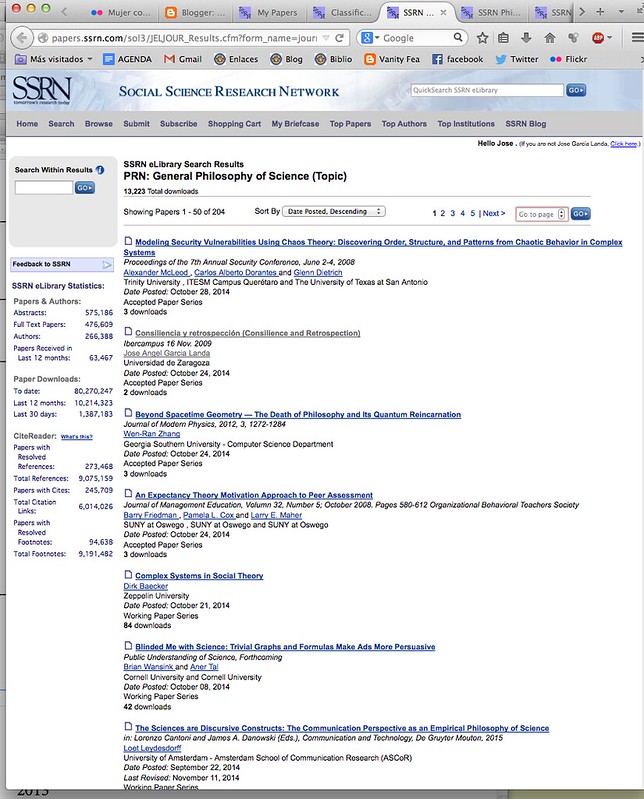
Consiliencia y retrospección

Mi artículo sobre Stephen Jay Gould, E. O. Wilson, la unidad del conocimiento, la comprensión de los fenómenos y la retrospección,

Consiliencia y retrospección
http://papers.ssrn.com/abstract=2513969


Este artículo reexamina la crítica de Stephen Jay Gould al concepto de consiliencia propuesto por E. O. Wilson, remontándose a la formulación original del concepto por parte de William Whewell. Aquí clarificamos el componente de retrospección hermenéutica inherente al proceso efectual de la consiliencia, una cuestión que puede enfocarse desde la perspectiva de una narratología cognitiva.  


Reference Info: Ibercampus 16 Nov. 2009

Se encuentra ahora, en español, en estas revistas temáticas de la SSRN (Date posted: October 24, 2014)
eJournal Classifications
AARN Subject Matter eJournals
    
        
AARN Subject Matter eJournals


CSN Subject Matter eJournals
    
        
PRN Subject Matter eJournals


También aquí:
 

_____. "Consiliencia y retrospección." In García Landa, Vanity Fea 12 Nov. 2009.* (Gould, Whewell, Wilson, science, humanities).

         http://vanityfea.blogspot.com/2009/11/consiliencia-y-retrospeccion.html

         2009

_____. "Consiliencia y retrospección." Ibercampus (Vanity Fea) 16 Nov. 2009.*

         http://www.ibercampus.es/articulos.asp?idarticulo=14473

         2009 DISCONTINUED 2011

_____. "Consiliencia y retrospección (Consilience and Retrospection)." Social Science Research Network 24 Oct. 2014.*

         http://papers.ssrn.com/abstract=2513969

         2014

         Biological Anthropology eJournal 24 Oct. 2014.*

         http://www.ssrn.com/link/Biological-Anthropology.html

         2014

         Cultural Anthropology eJournal 24 Oct. 2014.*

         http://www.ssrn.com/link/Cultural-Anthropology.html

         2014

         Philosophy of Science eJournal 24 Oct. 2014.*

         http://www.ssrn.com/link/Philosophy-Science.html

         2014

         Cognition in Mathematics, Science and Technology eJournal 24 Oct. 2014.*

         http://www.ssrn.com/link/Cognition-Math-Science-Tech.html

         2014

_____. "Consiliencia y retrospección." In García Landa, Vanity Fea 11 Nov. 2014.*

         http://vanityfea.blogspot.com.es/2014/11/consiliencia-y-retrospeccion.html

         2014

_____.  "Consiliencia y retrospección." Academia 11 Oct. 2017.*

         https://www.academia.edu/34831735/

         2017

_____. "Consiliencia y retrospección." ResearchGate 12 Oct. 2017.*

         https://www.researchgate.net/publication/320346966

         2017


(Consilience and Retrospection) - aquí el texto revisado en inglés.


_____. "Consilience and Retrospection." Social Science Research Network 24 Oct. 2013.*

         http://dx.doi.org/10.2139/ssrn.2344625

         http://ssrn.com/abstract=2344625

         2013

         Cultural Anthropology eJournal 24 Oct. 2013.*

         http://www.ssrn.com/link/Cultural-Anthropology.html

2013

Literary Theory and Criticism eJournal 3.10 (11 Nov. 2013).

http://hq.ssrn.com/Journals/IssueProof.cfm?abstractid=2344625&journalid=949618&issue_number=10&volume=3&journal_type=CMBO&function=showissue

         http://www.ssrn.com/link/English-Lit-Theory-Criticism.html (24 Oct. 2013)

2013

Philosophy of Science eJournal 6.49 (21 Nov. 2013).*

         http://hq.ssrn.com/Journals/IssueProof.cfm?abstractid=2344625&journalid=950426&issue_number=49&volume=6&journal_type=CMBO&function=showissue

         http://papers.ssrn.com/sol3/JELJOUR_Results.cfm?form_name=journalBrowse&journal_id=950426 (24 Oct. 2013)

         2013

         Rhetoric of Academic Disciplines eJournal 2.1 (18 Nov. 2013).*

         http://hq.ssrn.com/Journals/IssueProof.cfm?abstractid=2344625&journalid=1121343&issue_number=1&volume=2&journal_type=CMBO&function=showissue

         http://www.ssrn.com/link/Rhetoric-Academic-Disciplines.html (24 Oct. 2013).

         2013

_____. "Consilience and Retrospection." ResearchGate 25 March 2015.*

         DOI: 10.2139/ssrn.2344625

         https://www.researchgate.net/publication/272304755

         2015

_____. "Consilience and Retrospection." Academia 7 Jan. 2016.*

         https://www.academia.edu/20088095/

         2016

_____. "Consilience and Retrospection." Net Sight de José Angel García Landa 4 Jan. 2023.*

         https://personal.unizar.es/garciala/publicaciones/Consilience&Retro.pdf

         2023


Consiliencia y retrospección


—oOo—

Purcell: Dido and Aeneas, opera in three acts | Le Poème Harmonique

La Angustia de la Evolución

Seguimos actualizando, sin prisa pero con pausa, el blog sobre narratología evolucionista, y también el viejo Vanity Fea de Blogia:


lunes, 10 de noviembre de 2014

Gotye - Somebody That I Used To Know

Solo en Agrelo

Solo en Rodeira

España territorio sin ley


Y aquí el primer comentario de Federico: Nos gobiernan unos cobardes


domingo, 9 de noviembre de 2014

El narrador autorial y las otras voces narrativas

El narrador autorial y las otras voces narrativas 

(Samuel Beckett y la narración reflexiva, 5) 

http://papers.ssrn.com/abstract=2511946 

"Samuel Beckett y la Narración Reflexiva" es un estudio en profundidad de la escritura experimental de Beckett, en especial de la trilogía novelística "Molloy," "Malone Dies," and "The Unnamable", desde la perspectiva de la narratología estructuralista y las teorías estructuralistas sobre la enunciación. Resulta de allí no sólo una mejor comprensión de la técnica utilizada por Beckett para transmitir su peculiar visión de la realidad, sino también toda una nueva gama de significaciones en estos textos. La forma se ha tematizado, ha pasado a a ser el contenido mismo de la obra de Beckett, la base de su articulación narrativa. En este capítulo examinamos el uso de la voz narrativa en la escritura de Beckett, y la transformación que efectúa sobre las modalidades enunciativas de la narrativa clásica.


The Authorial Narrator and the Other Narrative Voices (Samuel Beckett and Reflexive Narrative, 5)

 "Samuel Beckett and Reflexive Narrative" is an in-depth study of Beckett's experimental writing, more specifically of the novelistic trilogy "Molloy," "Malone Dies" and "The Unnamable," from the standpoint of structuralist theories of narrative and of enunciation. An increased insight is thereby obtained into the technique used by Beckett to articulate his peculiar view of reality, and a new dimension of signification of these texts emerges. Form is thematized and has become the subject matter of Beckett's writing, the basis of its narrative articulation. This chapter examines the use of narrative voice in Beckett's writing and the transformation it effects on the enunciative modes of classical narrative.

Number of Pages in PDF File: 7

De Samuel Beckett y la narración reflexiva (Zaragoza: Prensas Universitarias de Zaragoza, 1992) 

Aparece también en esta revista sobre "otras literaturas inglesas" con fecha de 21 de octubre de 2014 (Date posted: October 21, 2014)


LIT Subject Matter eJournals


______

_____. "El narrador autorial y las otras voces narrativas (Samuel Beckett y la narración reflexiva, 5)." Academia 10 mayo 2015.*
2015
_____. "El narrador autorial y las otras voces narrativas (Samuel Beckett y la narración reflexiva, 5)." ResearchGate 30 julio 2015.*
2015


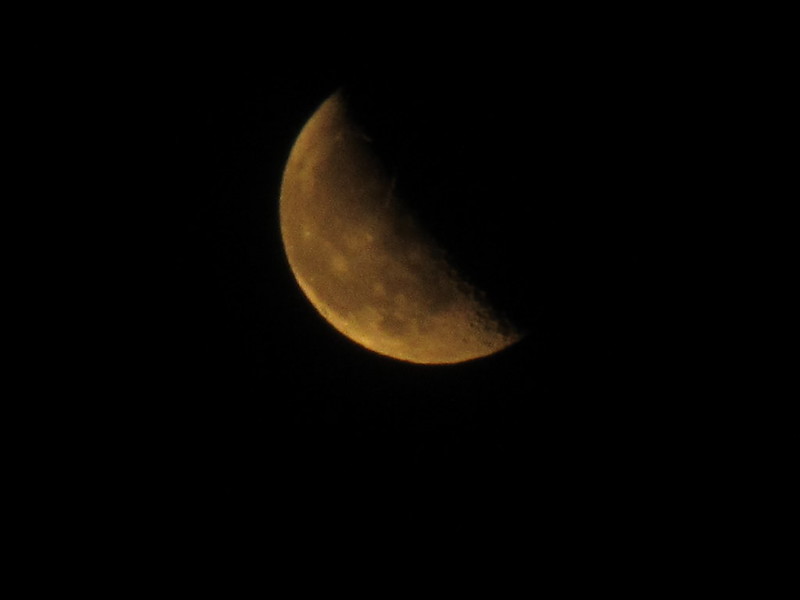
Luna con cráteres

Luna con cráteres

El famoso Nueve Ene

sábado, 8 de noviembre de 2014

En la Vniversidad de Salamanca

No es de ayer, tampoco es de hoy, pero aquí estamos Shakespeare y yo como dos referencias centrales en Filología Inglesa. En una buena universidad, con buena tradición de Filología Inglesa, la Universidad de Salamanca.  También en la Universidad de Salamanca publiqué uno de mis escasos libros, Acción, Relato, Discurso: Estructura de la ficción narrativa. Como más libros no creo que escriba yo, déjenme al menos retratarme en pantallazo de esta Biblioteca de Filología:
—oOo—

viernes, 7 de noviembre de 2014

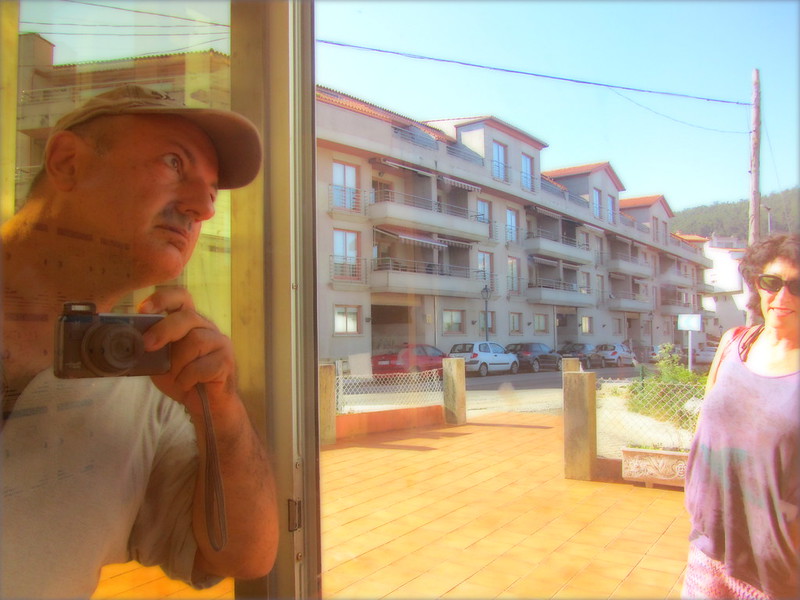
Aquí con mis fotos de reflejos

Aquí con mis fotos de reflejos

Topsight in 'The Art of War'

La perspectiva dominante en 'El Arte de la Guerra': Más aspectos de un clásico chino 

 (Topsight in 'The Art of War': Further aspects of a Chinese classic))


Jose Angel Garcia Landa


Universidad de Zaragoza

May 5, 2014

Ibercampus (May 5, 2014)

Abstract:     
Spanish abstract: Proporcionamos en este artículo un acercamiento narratológico al 'Arte de la Guerra', clásico chino sobre estrategia militar atribuido a Sun Tzu (Sunzi). Esta lectura enfatiza las dimensiones cognitivas del texto, entendido como un tratado sobre la perspectiva y el punto de vista, y como una formulación temprana del concepto de perspectiva dominante o 'topsight'. También examinamos sus estructuras temporales implícitas, en especial en lo referente al papel de la retrospección. El texto de Sunzi tiene, en suma, una interesante dimensión como teoría de la perspectiva, de la acción, y de la representación intersubjetiva.

English abstract: This paper provides a narratological perspective on 'The Art of War', a Chinese classic treatise of military strategy attributed to Sun Tzu. This reading foregrounds the cognitive aspects of the text as a treatise in perspective and point of view, and as an early formulation of the concept of topsight. It also examines its implicit temporal structures, especially as regards the role of retrospection. All in all, Sun Tzu's text has an interesting dimension as a theory of perspective, of action, and of intersubjective representation.

Number of Pages in PDF File: 10

Keywords: Sun Tzu, Strategy, Topsight, Perspective, Knowledge, Information, War, Strategy, Models, Plans, Retrospection, Narratology, Theory of action, Chinese literature,
 
Accepted Paper Series

jueves, 6 de noviembre de 2014

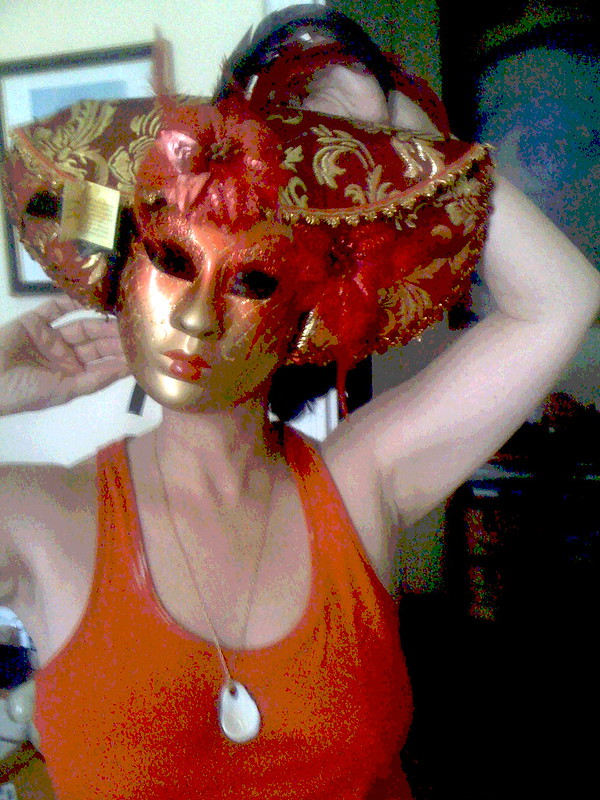
Trying on a Mask

Trying on a Mask

Fotos antiguas no vistas

Me las manda mamá, una colección de esas que van circulando por la red—y es que son buenísimas, estas fotos antiguas no vistas (powerpoint).


Ps, 2024: Como desaparecieron... pongo otras igual de antiguas, no igual de buenas.
 
 
—oOo—

Posicionamiento en Google Scholar

En Google Scholar no salgo quizá tan bien retratado como en Academia.edu. Tiene una opción este Google, poniendo el nombre de la universidad en el buscador, que muestra de modo cruel y despiadado a todos los profesores de esa universidad ordenados por número de citas. (De las que le constan a Google).

Así que éste es el ránking de los profesores de la Universidad de Zaragoza, según Google, que es autoridad en la materia.

Ahí es ése el ránking, por citas, y no por número de visitas recientes como en Academia. Y no es que figure mal, yo—sigo el primero de mi área, si no contamos a Susana Onega, que no ha puesto su universidad y no figura por tanto en el ránking general—y en total salgo en posición 130, con más de 500 citas, que para humanidades es muchísimo, pues normalmente nos ignoramos mutuamente, y nos ignoran también. De hecho hay sólo tres o cuatro de las áreas de Letras (Javier García Marco, Juan de la Riva, Tramullas...) que salen mejor posicionados. Ahora bien, Google Scholar creo que sólo incluye a los que se dan de alta voluntariamente—como Academia, por otra parte—así que más serán los llamados y más los elegidos si atienden y se dan de alta, igual me mandan al puesto 200, por decir.


Y a ver cómo ando de índices y de bilirrubina:

 Citation indices     All        since 2009
Citations        522         235
h-index                        7          5
i10-index           4          3


Hace dos meses iba así la cosa:


Citation indicesAll       Since 2009
Citations 513           226
h-index   6        5
i10-index   4         3


PS: En febrero de 2015 hemos subido algo más:

Citation indicesAllSince 2010
Citations630248
h-index96
i10-index93

—y aún más a mediados de mes:

Citation indicesAllSince 2010
Citations663261
h-index106
i10-index113


______


A principios de abril 2015:

Citation indicesAllSince 2010
Citations690266
h-index116
i10-index123

____

Y a finales de mayo de 2015:

Citation indicesAllSince 2010
Citations702277
h-index116
i10-index123


______________________________


Demos un valiente salto hasta 2024, diez años más tarde:

                    All                    Since 2019
Citations50601519
h-index1710
i10-index4110


—oOo—

Documentos del Departamento

Aquí hay 464 publicaciones subidas a Academia.edu por miembros de nuestro departamento de Filología Inglesa y Alemana. Pueden hacerse vistas comparativas por universidad, por departamento, etc., así panorámicamente. Me está feo decir que en mi departamento no sólo soy el usuario mejor valorado de Academia (estoy en el top uno por mil, con cierta ventaja sobre el resto) sino que también tengo yo el mayor número de publicaciones, de descargas, y de seguidores, con diferencia— y el mayor número de mini-trofeos de Top Porcentajes o pequeños premios pixelados de esos que reparte Academia. 

Con este baremo no quedo mal situado en mi departamento—con otros, sí, como se ha demostrado repetidamente.


____

PS, 2024: Diez años más tarde, se mantiene el recuento y vamos (o van) por 1266 publicaciones. Pero he bajado al Top 0,5%. Y ya no estamos en edad de superarnos.


—oOo—

El escrito de acusación penal

Me citan en el artículo "El escrito de acusación penal" de Raquel Taranilla, sobre narratología jurídica:


Taranilla, Raquel.  "El escrito de acusación penal: Convenciones genéricas en la configuración del relato de los hechos." I Vardande: Revista Electrónica de Semiótica y Fenomenología Jurídicas Burcaramanga 2.2 (March 2013-Feb. 2014): 64-94. Online at Scribd (alilozadaprado) 5 Nov. 2014.*
         2014


miércoles, 5 de noviembre de 2014

The Great Stories of Venice

The Great Stories of Venice

Richard Bulliet - History of the World to 1500 CE (Session 1)

La suspensión del merendéndum

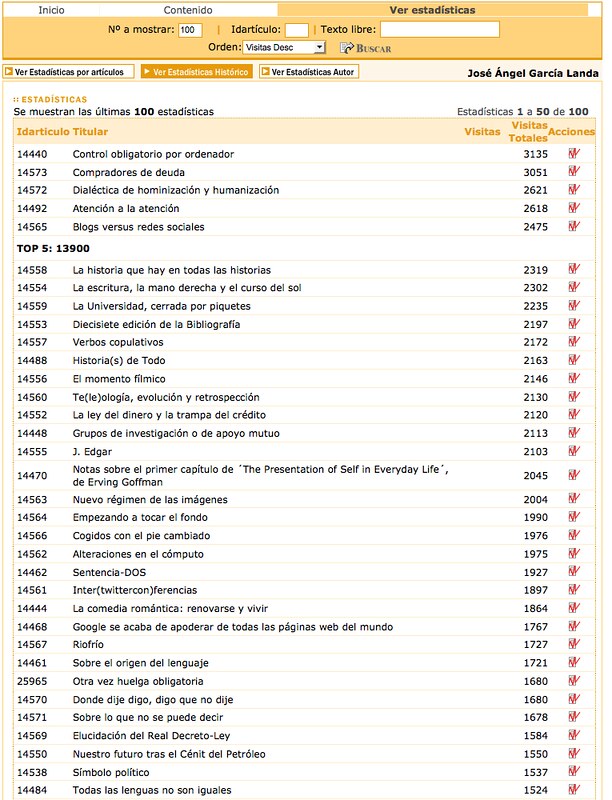
Mis artículos más leídos en IBERCAMPUS

O, mi faceta de columnista y periodical essayist.

Mis artículos más visitados en IBERCAMPUS

Y aquí, directamente, mi propio periódico en paper.li: GARCIALANDIA is out!


—oOo—

Darwin, la selección natural y la selección sexual

Mi fotoblog

Mi fotoblog
se puede ver haciendo clic en la foto ésta de Termineitor. Y hay más enlaces a cosas mías al pie de esta página.