Mostrando entradas con la etiqueta Marcos. Mostrar todas las entradas

jueves, 17 de abril de 2025

La realidad, según se mire


La realidad, según se mire, está en el mundo o está en la mente. Hablaremos aquí de idealismo, realidad, y marcos conceptuales. En una epistemología interaccional e intersubjetiva, la realidad está sujeta a negociación y a debate, como lo están las definiciones de las situaciones en las que estamos interactuando, de modo que nuestro entorno viene a ser mucho más social y mental que meramente físico.

Texto completo:

La realidad, según se mire 

https://ssrn.com/abstract=4269595


El Diario (Bolivia) Nov. 17, 2021

1 Pages Posted: 17 Apr 2023

José Angel García Landa

Universidad de Zaragoza

Date Written: 2011


English abstract: 

Reality, Depending on the Way You Look

Reality, depending on the way you look, is located in the world or in the mind. This paper deals with idealism, reality, and conceptual frame theory. An interactional and intersubjective epistemology conceives reality as subject to negotiation and debate, like the definition of the situations we are interacting in, so that out environment is ultimately social and mental rather than a merely physical one.

Note: Downloadable document is in Spanish.

Keywords: Reality, Interaction, Epistemology, Frame theory, Idealism, Intersubjectivity, Phenomenology, Cognition,

Garcia Landa, Jose Angel, La realidad, según se mire (Reality, Depending on the Way You Look) ( 2011). El Diario (Bolivia) Nov. 17, 2021, Available at SSRN: https://ssrn.com/abstract=4269595


En varias revistas de la SSRN, el 17 de abril de 2023:


https://www.ssrn.com/link/Epistemology.html


eJournal Classifications Message
PRN Subject Matter eJournals
    
Added to eLibrary
PRN Subject Matter eJournals
    
Philosophy of Action eJournal - CMBO
        
PRN: Action Theory (Topic) - CMBO
Added to eLibrary
PRN Subject Matter eJournals
    
Philosophy of Mind eJournal - CMBO
        
PRN: Epistemology of Mind (Topic) - CMBO
Added to eLibrary
PRN Subject Matter eJournals
    
Epistemology eJournal - CMBO
        
PRN: Testimony & Social Epistemology (Topic) - CMBO
Added to eLibrary
PRN Subject Matter eJournals
    
Added to eLibrary
PRN Subject Matter eJournals
    
Added to eLibrary


PsychRN Subject Matter eJournals
            
Added to eLibrary


También aquí:


_____. "La realidad, según se mire." In García Landa, Vanity Fea 19 July 2011.*

         http://vanityfea.blogspot.com/2011/07/la-realidad-segun-se-mire.html

         2011

_____. "La realidad, según se mire." Ibercampus (Vanity Fea) 19 July 2021.*

         https://www.ibercampus.es/la-realidad-segun-se-mire-41351.htm

         2021 DISCONTINUED 2024 – Online at the Internet Archive:

         https://web.archive.org/web/20230323181801/https://www.ibercampus.es/la-realidad-segun-se-mire-41351.htm

         2025

         Online at Net Sight:

         https://personal.unizar.es/garciala/publicaciones/larealidadsegun2.pdf

         2025

_____. "La realidad, según se mire." El Diario (Bolivia, 17 Nov. 2021).*

         https://www.eldiario.net/portal/2021/11/17/la-realidad-segun-se-mire/

         2021 DISCONTINUED 2025 – Online at the Internet Archive:

         https://web.archive.org/web/20211118191638/https://www.eldiario.net/portal/2021/11/17/la-realidad-segun-se-mire/

         2025

_____. "La realidad, según se mire." From El Diario. In García Landa, Vanity Fea 20 Nov. 2021.*

         https://vanityfea.blogspot.com/2021/11/la-realidad-segun-se-mire.html

         2021

_____. "La realidad, según se mire." From El Diario. Online at Academia 5 Nov. 2022.*

         https://www.academia.edu/90060236/

         2022

_____. "La realidad, según se mire." From El Diario. Online at Net Sight:

https://personal.unizar.es/garciala/publicaciones/larrealidad.pdf

         2022

_____. " La realidad, según se mire (Reality, Depending on the Way You Look)" ( 2011). From El Diario (Bolivia) Nov. 17, 2021. SSRN 17 April 2023.*

https://ssrn.com/abstract=4269595

         2025

         Epistemology eJournal 17 April 2023.*

         https://www.ssrn.com/link/Epistemology.html

         2025

         Philosophy of Action eJournal 17 April 2023.*

         https://www.ssrn.com/link/Philosophy-Action.html

         2025

         Philosophy of Mind eJournal 17 April 2023.*

         https://www.ssrn.com/link/Philosophy-Mind.html

         2025

         Cognitive Psychology eJournal 17 April 2023.*

         https://www.ssrn.com/link/Cognitive-Psychology.html

         2025

_____. "La realidad, según se mire." Net Sight de José Angel García Landa 20 Jan. 2025.*

         https://personal.unizar.es/garciala/publicaciones/larealidadsegun.pdf

         https://personal.unizar.es/garciala/publicaciones/larealidadsegun2.pdf

         https://personal.unizar.es/garciala/publicaciones/larrealidad.pdf

         2025


—oOo—

sábado, 8 de febrero de 2025

Estromas, Marcos, y Virtualidad de lo Real

Nada es tan sólido como parece, ni la materia ni el mundo. Un artículo sobre dos conceptos de análisis de la realidad, o de la virtualidad de la realidad, según los teorizan Gustavo Bueno y Erving Goffman.


Texto completo:

Estromas, marcos, y virtualidad de lo real

http://dx.doi.org/10.2139/ssrn.4841147

Ibercampus (May 25, 2014)

4 Pages Posted: 20 Jun 2024

Jose Angel Garcia Landa

Universidad de Zaragoza

Date Written: May 25, 2014

Keywords: Cognitive science, Interactionalism, Ontology, Materialism, Gustavo Bueno, Erving Goffman, Philosophy, Reality, Interaction, Cognition, Frame theory,

Garcia Landa, Jose Angel, Estromas, marcos, y virtualidad de lo real (May 25, 2014). Ibercampus (May 25, 2014), Available at SSRN: https://ssrn.com/abstract=4841147 or http://dx.doi.org/10.2139/ssrn.4841147


SSRN eJournal Classifications Message


PRN Subject Matter eJournals
    
Added to eLibrary
PRN Subject Matter eJournals
    
Added to eLibrary
PRN Subject Matter eJournals
    
Added to eLibrary


También aquí:

_____. "Estromas, marcos y virtualidad de lo real." In García Landa, Vanity Fea 25 May 2014.*

         http://vanityfea.blogspot.com.es/2014/05/gustavo-bueno-estroma.html

         2014

_____. "Estromas, marcos, y virtualidad de lo real." Ibercampus (Vanity Fea) 25 May 2014.*

         http://www.ibercampus.es/estromas-marcos-y-virtualidad-de-lo-real-27671.htm

         2014 DISCONTINUED 2024 – Online at the Internet Archive:

         https://web.archive.org/web/20150326101639/http://www.ibercampus.es/estromas-marcos-y-virtualidad-de-lo-real-27671.htm

         2025

_____. "Estromas, marcos, y virtualidad de lo real." SSRN 20 June 2024.*

https://ssrn.com/abstract=4841147

http://dx.doi.org/10.2139/ssrn.4841147

         2025


sábado, 13 de enero de 2024

Esbozo de la realidad

 Me citan en este artículo ucraniano, "Quis custodiet ipsos custodes? Un esbozo de la realidad"—

Синебрюхов, Ю. Б. (Iuri Sinebryukhov, Национальный технический университет 'Харьковский политехнический институт'; silyx@i.ua) "Quis custodiet ipsos custodes? Набросок реальности." Science and Education a New Dimension. Humanities and Social Sciences VIII(37) (Feb. 2020): 40-44.*

https://doi.org/10.31174/SEND-HS2020-223VIII37-10

https://seanewdim.com/wp-content/uploads/2021/04/Quis-custodiet-ipsos-custodes-A-SKETCH-OF-REALITY-Yu.-Sinebryukhov.pdf

2024


El artículo mío citado es, en inglés, éste:

_____. "The (In)Definition of Reality: Reframing and Contested Topsight." SSRN 13 April 2016.*

         http://ssrn.com/abstract=2763243

         2016


La versión en ruso citada está aquí:

_____. "(Не)определение реальности: изменение рамок восприятия и спор за контролирующую перспективу (The (In)Definition of Reality: Reframing and Contested Topsight)." Trans. Larissa Muravieva. SSRN 23 June 2016.*

         http://ssrn.com/abstract=2799319

         2016


Y se publicó originalmente aquí en Rusia— o en Russian Red:


–oOo—

miércoles, 20 de diciembre de 2023

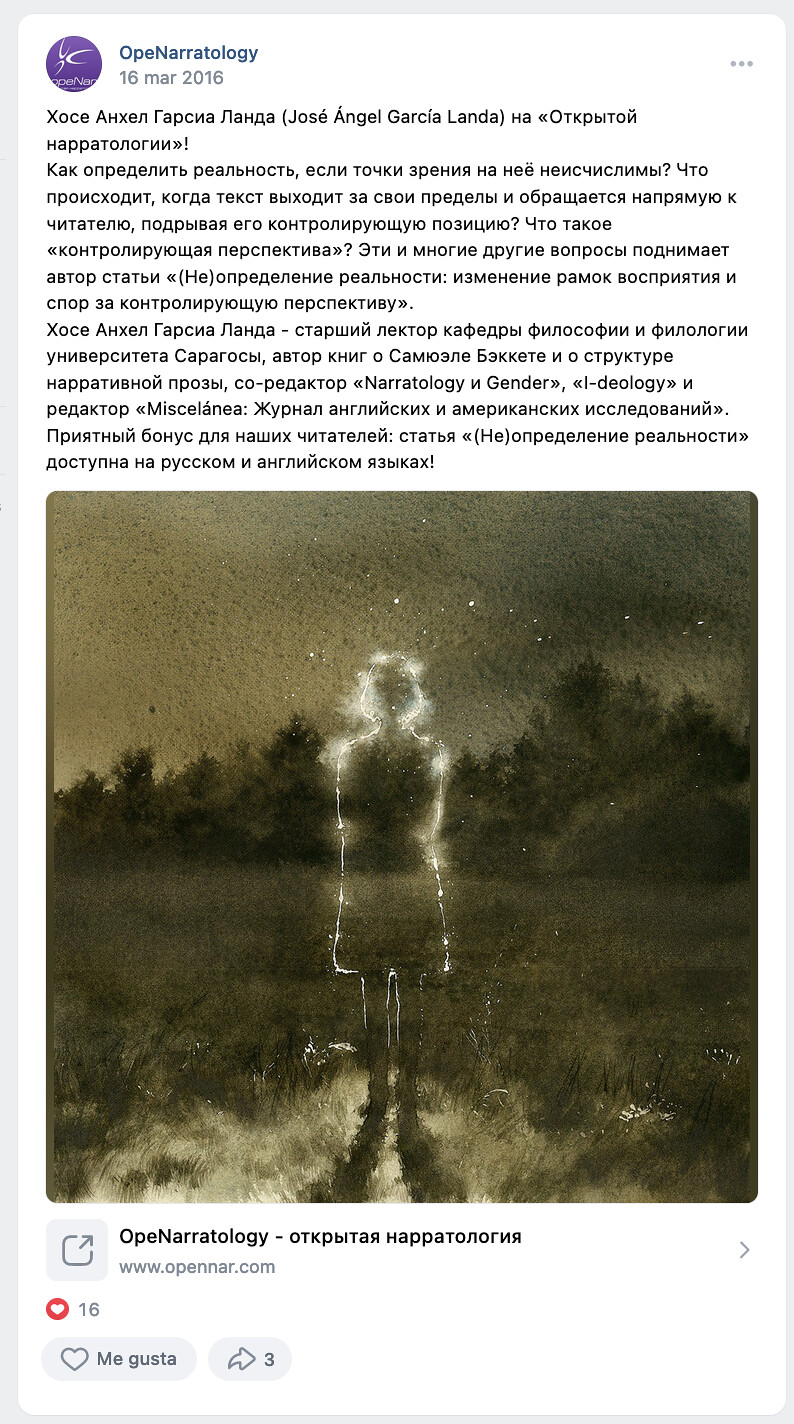
на «Открытой нарратологии»

Open Narratology

Хосе Анхел Гарсиа Ланда (José Ángel García Landa) на «Открытой нарратологии»! https://vk.com/wall-107994874_33


 _____


Переиздано здесь:

Хосе Анхел Гарсиа Ланда (José Ángel García Landa) "(Не)определение реальности: изменение рамок восприятия и спор за контролирующую перспективу (The (In)Definition of Reality: Reframing and Contested Topsight)." Trans. Larissa Muravieva. SSRN 23 June 2016.*

         http://ssrn.com/abstract=2799319

         2016


—oOo—

viernes, 19 de noviembre de 2021

Esbozo de la realidad

Me citan en Ucrania, y en ruso—no en latín—en este número de Science and Education:


Синебрюхов, Ю. Б. (Национальный технический университет «Харьковский политехнический институт») "Quis custodiet ipsos custodes? Набросок реальности." In Science and Education: A New Dimension—Humanities and Social Sciences 8.37 (Issue 223, Feb. 2020): 41-44.*

http://www.seanewdim.com

http://seanewdim.com/uploads/3/4/5/1/34511564/hum_viii_223_37.pdf

https://seanewdim.com/uploads/3/4/5/1/34511564/httpsdoi.org10.31174send-hs2020-223viii37-10.pdf

https://doi.org/10.31174/SEND-HS2020-223VIII37-10

Online at Academia.*

https://www.academia.edu/42243977/

2021


El artículo mío citado está en inglés aquí:

"The (In)Definition of Reality: Reframing and Contested Topsight" https://docs.wixstatic.com/ugd/3b11da_36190c7dd7e34db78be52587391d4d3d.docx?dn=In-definition.docx


Y en ruso estaba aquí: "(Не)определение реальности: изменение рамок восприятия и спор за контролирующую перспективу", en Open Narratology,

https://www.opennar.com/singlepost/2016/03/16/Неопределение-реальности-изменение-рамок-восприятия-и-спор-за-контролирующую-перспективу

Y ahora está aquí en SSRN: http://ssrn.com/abstract=2799319


Mi traductora rusa:


—oOo—

jueves, 26 de marzo de 2020

El clivaje, el marco, el relato

sábado, 8 de febrero de 2020

Rupturas de marco en los anuncios televisivos


Me citan en este artículo turco sobre rupturas de marco ("metalepsis") en los anuncios televisvos.


Yilmaz, Recep. "Televizyon Reklamlarında Metaleptik Kullanımların Tipolojisi." E-Gifder 5.6 (Sept. 2017): 691-704.*
         2020


—oOo—


miércoles, 3 de octubre de 2018

Retropost (2 de octubre de 2008): On Framing and Methodizing


From a narratological correspondence:

Dear Maria:

Thanks for the references you give me on "prosaics"; I attach a file with some titles by Gary Saul Morson, who has written on the subject too. I think his essay on "Sideshadowing and Tempics" might be interesting for the subject you mention, about authors not planning the whole of the story in advance, there's a whole theory there on "prosaics": and also, I insist too much, in his book Narrative and Freedom, which is a masterpiece of criticism, it was a revelation to me because of his treatment of narrative time. Don't let it pass you by unnoticed. Stanzel is fine in his own line; I haven't read him much since the 80s though. There's the danger with that grand model of his narrative situations that one may find him too totalizing and close off other aspects of the texts from sight, but he's all right (like Genette) as long as you take him as a source for further ideas, and not as a finished method for application. As to frame narratives and narrative frames... I think I'll just enclose a bibliography on narrative embedding. Of course the great book on "frames" as such (inside and outside literature) is Erving Goffman's Frame Theory (1974)—he uses them to explain the whole structure of human reality and action, another MUST, to my mind. In the field of literature, I would read Mieke Bal's and Dällenbach's works on narrative structure if you haven't come across them yet, and also a more recent book, William Nelles's Frameworks: Narrative Levels and Embedded Narrative.  I also write occasionally on these subjects—but I don't know whether you read Spanish; here's a blog post anyway:
http://garciala.blogia.com/2005/120702-la-realidad-flojea.php
And good luck with your seminar; I think what you say about working from the important issues you see in the texts is the right approach, theories are all right to make you see aspects you would otherwise overlook, but don't let the formal methods "methodize" the text for you!
      I'll be around if you want further conversation on these and suchlike issues. Best regards,
      JoseAngel


—oOo—


jueves, 26 de octubre de 2017

Frames in Narrative Pragmatics


(From Suzanne Fleischman's Tense and Narrativity (U of Texas P / Routledge, 1990; p. 3):


Pragmatics is understood as referring to all types of meaning dependent on context. Of primary concern here are, on the one hand, discourse context—the portion of discourse or text that surrounds a given sentence or sequence of sentences—as well as the nature of the text as a whole (narration, conversation, oratory), and, on the other, situation context—the communicative context or setting in which the text as a speech-act occurs. The pragmatics of discourse is concerned in large part with the organization of texts as coherent hwoles; this includes strategies for packaging the information in sentences as either topic or focus, signaling the relative saliency of different pieces of information, establishing intersentential cohesion, and other linguistically describable aspects of text structure. Situational pragmatics refers to aspects of the extratextual setting of the discourse, including its relationship to speech-act participants, the relationship of these participants—notably speaker and hearer(s)—to one another, and any other relevant features of the context of communication, linguistic or nonlinguistic.

Also relevant to this inquiry, and within the domain of pragmatics, are meanings and presuppositions that derive from our familiarity as members of a culture or subculture with certain culture-specific "frames"—a term coined by cognitive psychologists to refer to clusters of interrelated expectations associated with prototypical experiences or situation contexts. Though the frame concept was conceived with reference to real-world situations (e.g., a visit to the doctor, a Ph.D.  exam), it is easily extended to textual worlds, which also fall into recognizable types—genres—to which similar sets of expectations attach. To the extent that all forms of discourse entail "horizons of expectations"—reader-response theorists' umbrella term for the shared knowledge, assumptions, and values that writers/speakers tacitly draw on in constructing texts and that initiated readers/listeners draw on in decoding them—these must also figure into any analysis of narrative language that claims a pragmatic orientation.


—oOo—


viernes, 11 de agosto de 2017

Retropost #1740 (11 de agosto de 2007): Reframing and Narrative Technique


Reframing and narrative technique

A photo on Flickr

Sometimes (as happens in Beckett's trilogy) a later work throws new light on, or reframes, the narrative technique as well as the story of previous related works. There is much talk these days in the narrative list of the "T.S. Eliot-influence-over-Shakespeare" kind of issue, actually the modernist influence on our readings of Richardson. (The issue began as an offshoot of the debate over first person versus third person narratives).

Does a later work rewrite its predecessors? Well, such rewritings are part of the postmodernist narrative consciousness, they have been happening all the time, but now they take place in elaborate and self-conscious ways, and are fed back on the process of composition and reading. These issues are fascinating for me—they lie at the fuzzy edge where retrospection meets retroaction, and the significance of previous discourse or previous works is modified après la lettre through a reframing which both transforms the previous work and leaves it untouched—most masterfully by bringing to a clearer light certain aspects which were already there, or perhaps had the potential  to be there. Such reframing, then, is a process of emergence.

Here is my contribution in answer to Annjeanette Wiese's note on one such reframing:


Annjeanette Michelle Wiese escribió:

> seymour chatman wrote:
>> So, with all due respect to Annjeanette Michelle Wiese's interesting citations, I would question the utility of a phrase like "told mostly in an omniscient third-person perspective from one of the twins."  It is precisely to avoid that kind of blurring of terminology that I proposed a distinction between "slant"--the narrator's perspective--and "filter"--the focalizer's perspective.
>
> I agree with the others that we are appreciatively in Seymour Chatman's debt for keeping these distinctions in view--thank you.
>
> To further this idea, I would very much like to know what is thought about the situation in this second novel, The Proof (La Preuve), in the trilogy by Agota Kristof. This is the novel about which I said it was a third-person narrative from the voice of one of the twins. Sorry for the lack of clarity in this comment. The situation is difficult because the story itself is strictly speaking about "Lucas" and is told in the third person ("On his return to Grandmother's house, Lucas lies down by the garden gate..."). The last chapter changes and is about Claus, Lucus's brother. But the end of the book and the other two novels in the trilogy that bracket it suggest that perhaps unbeknownst to the reader what we've been reading up to the end of the penultimate chapter is either from Lucas's own notebooks (the most likely choice based on the story) or from those of his brother Claus. But the latter claims to have only written the last chapter (although even this last chapter is told in the third person: "Claus arrives by train," etc., perhaps simulating the voice of the rest of the novel). Evidence in a report appended to the end of the novel suggests it was written in same handwriting throughout. It's also possible neither brother exists and that someone is making it all up, as neither twin's identity is confirmed by this report. So it is only retroactively that we get suggestions of who the narrator was. And even then the books remain ambiguous. How should one qualify this situation?
>
> Thank you in advance for your thoughts.
> -Annjeanette Wiese

José Angel García Landa escribió:

Hindsight bias—or perhaps hindsight slant!

I would suggest the reframing—with its retroactive 'rewriting' or alternative insights—takes place not just "objectively" in the context of the later novels, but also locally every time one of these novels, or else the three, is used in a given reading or communicative exchange. Which is perhaps another way of saying that a trilogy is a whole made of self-standing units.

Jose Angel Garcia Landa
www.garcialanda.net


There are bibliographical listings on retrospection, hindsight bias, etc. in my Bibliography of Literary Theory, Criticism and Philology.


Sábado, 11 de Agosto de 2007 11:19. José Ángel García Landa Enlace permanente. Semiótica

sábado, 8 de abril de 2017

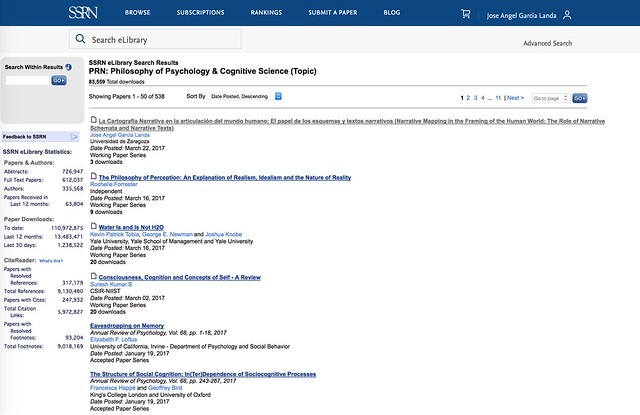
La cartografía narrativa en la articulación del mundo humano: El papel de los esquemas y textos narrativos


https://ssrn.com/abstract=2938380


Universidad de Zaragoza

Efectuamos en este artículo una integración de la narratología cognitiva, el interaccionismo dramatístico, y la teoría evolucionista. Definimos los conceptos de cartografía narrativa y anclaje narrativo, y desarrollamos el marco conceptual constructivista definido por Schutz, Luckmann y Berger en sus estudios de fenomenología social. La teoría de los marcos de Goffman también se trata y se incorpora al modelo, así como diversos modelos narratológicos que van desde la poética aristotélica a la hermenéutica de Ricœur, o los estudios bajtinianos de Morson y Bernstein sobre las patologías del tiempo. Sostenemos que la narración y las operaciones mentales narrativizadoras son un fenómeno emergente de importancia crucial para la construcción del nicho cultural humano; que de hecho son nada menos que la operación cognitiva fundamental que sirve como base para la emergencia del tiempo considerado como una dimensión compleja y multiestratificada de la realidad.


English Abstract:

Narrative Mapping in the Framing of the Human World: The Role of Narrative Schemata and Narrative Texts

This paper effects an integration of cognitive narratology, dramatistic interactionism, phenomenology, and evolutionary theory. It defines the concepts of narrative mapping and narrative anchoring, and builds up from the constructivist conceptual framework established by Schutz, Luckmann, and Berger in their studies in social phenomenology. Goffman's frame theory is also dealt with and integrated into the model, as well as a number of narratological approaches ranging from Aristotle's poetics to Ricœur's hermeneutics and Morson and Bernstein's Bakhtinian studies of the pathologies of time. A case is made for narrative and narrativizing mental operations as a major emergent phenomenon in the construction of the human cultural niche, and as nothing less than the major cognitive operation resulting in the emergence of time as a complex multi-layered dimension of reality.
Notes: Downloadable document is available in Spanish.
29 Pages Posted: 22 Mar 2017  
Date Written: March 17, 2017


Garcia Landa, Jose Angel, La Cartografía Narrativa en la articulación del mundo humano: El papel de los esquemas y textos narrativos (Narrative Mapping in the Framing of the Human World: The Role of Narrative Schemata and Narrative Texts) (March 17, 2017). Available at SSRN: https://ssrn.com/abstract=2938380


eJournal Classifications


AARN Subject Matter eJournals


AARN Subject Matter eJournals


CSN Subject Matter eJournals


PRN Subject Matter eJournals


PRN Subject Matter eJournals


Philosophy of Psychology & Cognitive Science


También aquí:


_____. "La cartografía narrativa en la articulación del mundo humano: El papel de los esquemas y textos narrativos." Lecture at the Escuela de Doctorado de la Universidad de Zaragoza ('Intencionalidad y Narratividad', 17 March 2017).

         https://escueladoctorado.unizar.es/es/intencionalidad-y-narratividad

         2017

Online at Net Sight de José Angel García Landa (2017).*

         http://www.unizar.es/departamentos/filologia_inglesa/garciala/publicaciones/mapasnarrativos.html

         2017 DISCONTINUED 2020 – Online at Internet Archive:

https://web.archive.org/web/20181127095150/http://www.unizar.es/departamentos/filologia_inglesa/garciala/publicaciones/mapasnarrativos.html

         2020

         https://personal.unizar.es/garciala/publicaciones/mapasnarrativos.html

         2020

         https://personal.unizar.es/garciala/publicaciones/mapasnarrativos.pdf

         2023

_____. "La Cartografía Narrativa en la articulación del mundo humano: El papel de los esquemas y textos narrativos (Narrative Mapping in the Framing of the Human World: The Role of Narrative Schemata and Narrative Texts)." Social Science Research Network 22 March 2017.*

         https://ssrn.com/abstract=2938380

         2017

         Biology & Anthropology eJournal 22 March 2017.*

         https://www.ssrn.com/link/Biological-Anthropology.html

         2017

         Linguistic Anthropology eJournal 22 March 2017.
https://www.ssrn.com/link/Linguistic-Anthropology.html

         2017

         Cognition & the Arts eJournal 22 March 2017.*

         https://www.ssrn.com/link/Cognition-Arts.html

         2017

         Continental Philosophy eJournal 22 March 2017.*

         https://www.ssrn.com/link/Continental-Philosophy.html

         2017

         Philosophy of Mind eJournal 22 March 2017.*

         https://www.ssrn.com/link/Philosophy-Mind.html

         2017

_____. "La cartografía narrativa en la articulación del mundo humano: El papel de los esquemas y textos narrativos." In García Landa, Vanity Fea 8 April 2017.*

         http://vanityfea.blogspot.com.es/2017/04/la-cartografia-narrativa-en-la.html

         2017

_____. "La cartografía narrativa en la articulación del mundo humano: El papel de los esquemas y textos narrativos." Academia 20 Oct. 2017.*

         http://www.academia.edu/34906149/mapasnarrativos.pdf

         2017

_____. "La cartografía narrativa en la articulación del mundo humano: El papel de los esquemas y textos narrativos." ResearchGate 21 Oct. 2017.*

         https://www.researchgate.net/publication/320551799

         2017

         https://www.researchgate.net/publication/324672343

         2021

_____. "La cartografía narrativa en la articulación del mundo humano: El papel de los esquemas y textos narrativos." Scribd (Giovannigregory) 10 March 2018.*

https://es.scribd.com/document/371181817/Garcia-Landa-Jose-Angel-La-Cartografia-Narrativa-en-La-Articulacion-Del-Mundo-Humano-El-Papel-de-Los-Esquemas-y-Textos-Narrativos

2023

_____. "La cartografía narrativa en la articulación del mundo humano: El papel de los esquemas y textos narrativos." Knowledge Commons 15 March 2026.*

doi:10.2139/ssrn.2938380

https://works.hcommons.org/records/fwpkq-ht684

2026


—oOo—

Mi fotoblog

Mi fotoblog
se puede ver haciendo clic en la foto ésta de Termineitor. Y hay más enlaces a cosas mías al pie de esta página.