


Yet what is human speech for the most part but mere imitation? In the most obvious sense this stands out on the surface. We learn the same words, we speak the same language, as our elders. Not only our words, but our phrases, are the same. We are like players, who come out as if they were real persons, but only utter what is set down for them. We represent the same drama every day; and, however stale is the eternal repetition, pass it off upon others, and even upon ourselves, as if it were the suggestion of the moment. In reality, in rural or vulgar life, the invention of a new phrase ought to be marked down among the memorable things in the calendar (...)
Our religion, our civil practices, our political creed, are all imitation. How many men are there, that have examined the evidences of their religious belief, and can give a sound "reason of the faith that is in them?" When I was a child, I was taught that there are four religions in the world, the Popish, the Protestant, the Mahometan, the Pagan. It is a phenomenon to find the man, who has held the balance steady, and rendered full and exact justice to the pretensions of each of these. No: tell me the longitude and latitude in which a man is born, and I will tell you his religion.
By education most have been misled;And, if this happens, where we are told our everlasting salvation is at issue, we may easily judge of the rest.
So they believe, because they so were bred:
The priest continues what the nurse began,
And thus the child imposes on the man.
[Solomon] has observed, "One generation passeth away, and another generation cometh; but the earth abideth for ever". It is a maxim o the English constitution that "the king never dies," and the same may with nearly equal propriety be observed of every private man, especially if he have children. "Death," say the writers of natural history, "is the generator of life:" and what is thus true of animal corruption, may with small variation be affirmed of human mortality. I turn off my footman, and hire another; and he puts on the livery of his predecessor: he thinks himself somebody; but he is only a tenant. The same thing is true, when a country-gentleman, a noble, a bishop, or a king dies. He puts off his garmens, and another puts them on. Every one knows the story of the Tartarian dervvise, who mistook the royal palace for a caravansera, and who proved to his magesty by genealogical deduction, that he was only a lodger. In this sense the mutability, which so eminently characterises everything sublunary, is immutability under another name.
The most calamitous, and the most stupendous scenes are nothing but an eternal and wearisome repetition: executions, murders, plagues, famine and battle. Military execution, the demolition of cities, the conquest of nations, have been acted a hundred times before. The mighty conqueror, who "smote the people in wrath with a continual stroke," who "sat in the seat of God, shewing himself that he was God," and assuredly persuaded himself that he was doing something to be had in everlasting remembrance, only did that which a hundred other vulgar conquerors had done in successive ages of the world, whose very names have long since perished from the records of mankind.
Thus it is that the human species is for ever engaged in laborious idleness. We put our shoulder to the wheel, and raise the vehicle out of the mire in which it was swallowed, and we say, I have done something; but the same feat under the same circumstances has been performed a thousand times before. We make what strikes us as a profound observation; and, when fairly analysed, it turns out to be about as sagacious, as if we told what's o'clock, or whether it is rain or sunsine. Nothing can be more delightfully ludicrous, than the important and emphatical air with which the herd of mankind enunciate the most trifling observations. With much labour we are delivered of what is to us a new thought; and, after a time, we find the same in a musty volume, thrown by in a corner, and covered with cobwebs and dust.
This is pleasantly ridiculed in the well known exclamation,
Deuce take the old fellows who gave utterance to our wit,
before we ever thought of it!

Derrida déroule:
"Quelle est l'unité ou l'identité du locuteur? Est-il responsable des speech acts que lui dicte son inconscient? Car j'ai aussi le mien qui peut vouloir faire plaisir à Sarl en tant qu'il veut être critiqué, lui faire de la peine en ne le critiquant pas, lui faire plaisir en ne le critiquant pas et de la peine en le critiquant, lui promettre une menace ou le menacer d'une promesse, m'offir aussi à la critique en prenant plaisir à dire des choses 'obviously false', jouir de ma faiblesse ou aimer l'exhibition par-dessus tout, etc."
Évidemment, tout l'assistence se retroune vers Searle qui, comme s'il avait anticipé ce moment, s'est placé exactement au centre des gradins. L'homme seul au milieu de la foule: on dirait un plan hitchcockien. Son visage impassible ne cille pas ous le poids des regards. C'est bien simple, on dirait qu'il est empaillé.
Et d'ailleurs, lorsque je fais des phrases, est-ce vraiment moi qui parle? Comment quiconque pourrait-il jamais dire quelque chose d'original, de personnel, de propre, quand par définition le langage nous oblige à puiser dans un trésor de mots préexistants (le fameux trésor de la langue)? Quand nous sommes traversés par tellement d'agents extérieurs: notre époque, nos lectures, nos déterminismes socioculturels, nos 'tics' de langage tellement précieux pour nous faire une identité (comme on dirait 'se faire une beauté'), les discours dont nous sommes constamment bombardés, sous toutes les formes possibles et imaginables.
Qui n'a jamais pris en flagrant délit un ami, un parent, un collègue de bureau ou un beau-père en train de répéter quasiment mot pour mot l'argumentaire qu'il aura lu dans un journal ou entendu à la télé, comme si c'était lui qui parlait en son nom propre, comme s'il s'était approprié ce discours, comme s'il en était la source et n'était pas traversé par lui, reprenant les mêmes formules, la même rhétorique, les mêmes présupposés, les mêmes inflexions indigneée, le même air entendu, comme s'il n'était pas le simple médium par lequel la voix différée d'un journal répétant lui-même les propos d'un homme politique qui lui-même avait lu dans un livre dont l'auteur, et ainsi de suite, la voix, disais-je, nomade et sans origine d'un locuteur fantôme s'exprimait, communiquait, au sens où deux lieux communiquent l'un avec l'autre par un passage.
Répétant ce qu'il a lu dans le journal, dans quelle mesure la conversation de votre beau-père n'est-elle pas une citation?
Derrida a repris comme si de rien n'était le fil de son propos. Il aborde son autre question centrale: la citationnalité. Ou plutôt l'itérabilité (Simon n'est pas certain d'avoir saisi la différence.)
Pour être entendu, au moins partiellement, par notre interlocuteur, nous devons employer la même langue. Nous devons répéter (réitérer) des mots qui ont déjà été utilisés, sans quoi notre interlocuteur ne pourra pas les comprendre. Nous sommes donc toujours, fatalement, dans une forme de citation. Nous utilisons les mots des autres. Or, comme pour le téléphone arabe, il est plus que probable, il est inéluctable, qu'au fil des répétitions, nous employions les mots des autres, tous autant que nous sommes, dans un sens légèrement différent les uns des autres.
La voix de pied-noir de Derrida se fait plus solennelle et enfle:
"Cela même qui assurera, au-delà de ce moment, le fonctionnement de la marque (psychique, orale, graphique, peu importe), à savoir la possibilité d'être repétée une autre fois, cela même entame, divise, exproprie la plénitude ou la présence à soi "idéales" de l'intention, du vouloir-dire et a fortiori de l'adéquation entre meaning et saying."
Judith, Simon, la jeune femme aux cheveux noirs, Cixous, Guattari, Slimane, toute la salle et même Bayard sont suspendus à ses lèvres quand il dit:
"Limitant cela même qu'elle autorise, transgressant le code ou la loi qu'elle constitue, l'itérabilité inscrit, de façon irréductible, l'altération dans la répétition."
Et il ajoute, impérial:
"L'accident n'est jamais un accident."
Este artículo introduce el concepto de 'dividuo', basado en el enfoque interaccionista simbólico sobre la identidad social. La identidad personal y social, y la subjetividad, se constituyen como resultado de los roles sociales y comunicativos. Relacionamos los marcos que estructuran la realidad social según el análisis de Goffman con las posibilidades y modos de interacción social convencionalizados que posibilitan, y con las tecnologías de la comunicación que los posibilitan a ellos. La teoría de los marcos sirve así de base a una semiótica interaccional de los géneros literarios y de los roles textuales (por ej. la autoría, el lector implícito, etc.). La Red y las tecnologías de la información y de la comunicación están llevando las estructuras de auto-interacción del individuo, junto con las estructuras interaccionales entre individuos, a nuevos niveles de complejidad.
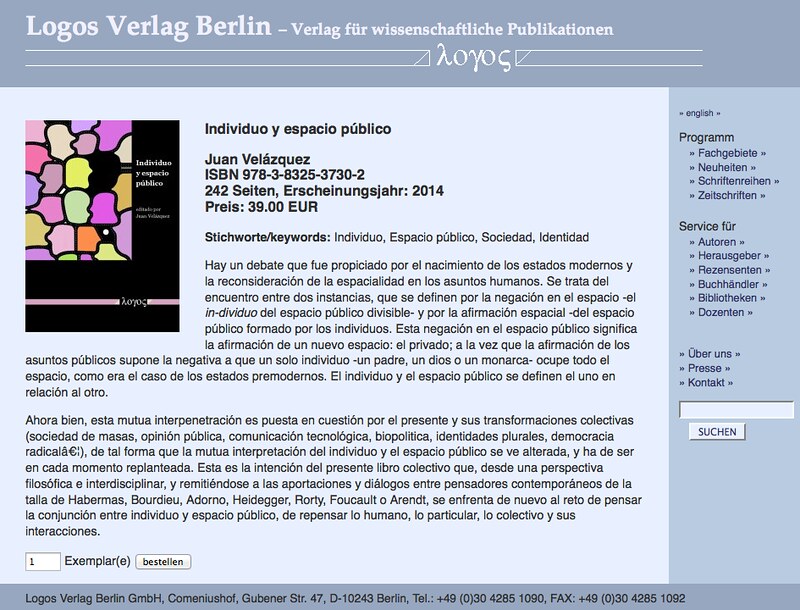
Una conferencia que di el año pasado, en un seminario sobre "Individuo y espacio público", en la Universidad de Zaragoza. Reescrita para los repositorios.
Texto completo:
English abstract:
This paper introduces the concept of the dividual, based on the symbolic interactionist approach to social identity. Personal and social identity — and subjectivity — are constitued as a result of the internalization of social and communicative roles. Frames structuring social reality according to Goffman's analysis are related to the conventionalized possibilities and modes of social interaction they enable, and to the technologies of communication which enable them. An interactional semiotics of literary genres and textual roles (e.g. authorship, the implied reader, etc.) is thus grounded on frame theory. The Web and the information and communication technologies of the electronic age are taking the (in)dividual's self-interactional structures, together with the interactional structures between individuals, to new levels of complexity.

Note: Downloadable document is in Spanish.
Keywords: ICT, Communication, Symbolic Interactionism, Subject, Self, Frames, Frame theory, Social psychology, Semiotics, Implied author, Dramatism, World as stage, Theatricality, Roles, Identity, Face
Suggested Citation:
_____. "La evolución del dividuo social y de los espacios públicos." Lecture at the HERAF seminar, Facultad de Filosofía y Letras, Zaragoza, 10 jan. 2014.
_____. "La evolución del dividuo social y de los espacios públicos (The Evolution of the Social Dividual and of Public Spaces)." Social Science Research Network 12 Jan. 2014.*
DOI: 10.2139/ssrn.2377963
http://ssrn.com/abstract=2377963
2014
Psychological Anthropology eJournal 12 Jan. 2014.*
http://www.ssrn.com/link/Psychological-Anthropology.html
2014
Cross-Cultural Studies eJournal 12 Jan. 2014.*
http://www.ssrn.com/link/Cross-Cultural-Studies.html
2014
Cultural Anthropology eJournal 12 Jan. 2014.*
http://www.ssrn.com/link/Cultural-Anthropology.html
2014
Cognition & Culture … eJournal 6.4 (22 Jan. 2014).*
http://www.ssrn.com/link/Cognition-Culture.html (12 Jan. 2014)
2014
Cognitive Social Science eJournal 6.8 (22 Jan. 2014).*
http://www.ssrn.com/link/Cognitive-Social-Science.html (12 Jan. 2014)
2014
Philosophy of Action eJournal 7.1 (23 Jan. 2014).*
http://www.ssrn.com/link/Philosophy-Action.html (12 Jan. 2014)
2014
Metaphysics eJournal 7.5 (29 Jan. 2014)
http://www.ssrn.com/link/Metaphysics.html (12 Jan. 2014)
2014
Philosophy of Mind eJournal 7.2 (24 Jan. 2014).*
http://www.ssrn.com/link/Philosophy-Mind.html (12 Jan. 2014)
2014
_____. "La evolución del dividuo social y de los espacios públicos." Academia 5 Oct. 2014.*
https://www.academia.edu/8637776/
2014
https://www.academia.edu/86981466/
2022
_____. "La evolución del dividuo social y de los espacios públicos." ResearchGate 5 Oct. 2014.*
https://www.researchgate.net/publication/266393290
DOI: 10.13140/2.1.5095.2961
2014
_____. "La evolución del dividuo social y de los espacios públicos." Scribd (shantydiaz) 13 Feb. 2015.*
https://es.scribd.com/doc/255660233/
2015
_____. "La evolución del dividuo social y de los espacios públicos." In García Landa, Vanity Fea 14 Feb. 2015.*
http://vanityfea.blogspot.com.es/2015/02/la-evolucion-del-dividuo-social-y-de.html
2015
_____. "La evolución del dividuo social y de los espacios públicos." Net Sight de José Angel García Landa 4 Jan. 2023.*
https://personal.unizar.es/garciala/publicaciones/dividuo.pdf
2023
Estuvo un tiempo en Scribd:
García Landa, J - La Evolución Del Dividuo Social y de Los Espacios Públicos (2014) by shantydiaz
 José Angel García Landa (garciala@unizar.es) es Doctor en Filosofía y Letras (Filología Inglesa) por la Universidad de Zaragoza (1988) y Master of Arts
en literatura inglesa por la Universidad Brown (Providence, EE.UU.). Es
Profesor Titular en la Facultad de Filosofía y Letras de la Universidad
de Zaragoza desde 1992, y al margen de su docencia en las titulaciones
de Filología Inglesa, Estudios Ingleses y Lenguas Modernas, ha impartido
numerosos cursos de postgrado (máster y cursos de doctorado) sobre
teoría de la narración, semiótica cultural, hermenéutica y teoría
crítica.
José Angel García Landa (garciala@unizar.es) es Doctor en Filosofía y Letras (Filología Inglesa) por la Universidad de Zaragoza (1988) y Master of Arts
en literatura inglesa por la Universidad Brown (Providence, EE.UU.). Es
Profesor Titular en la Facultad de Filosofía y Letras de la Universidad
de Zaragoza desde 1992, y al margen de su docencia en las titulaciones
de Filología Inglesa, Estudios Ingleses y Lenguas Modernas, ha impartido
numerosos cursos de postgrado (máster y cursos de doctorado) sobre
teoría de la narración, semiótica cultural, hermenéutica y teoría
crítica.

